How is the defining body pattern of the White Crappie contrasted with the markings of the Black Crappie?
Answer
White Crappie are defined by dark vertical bars
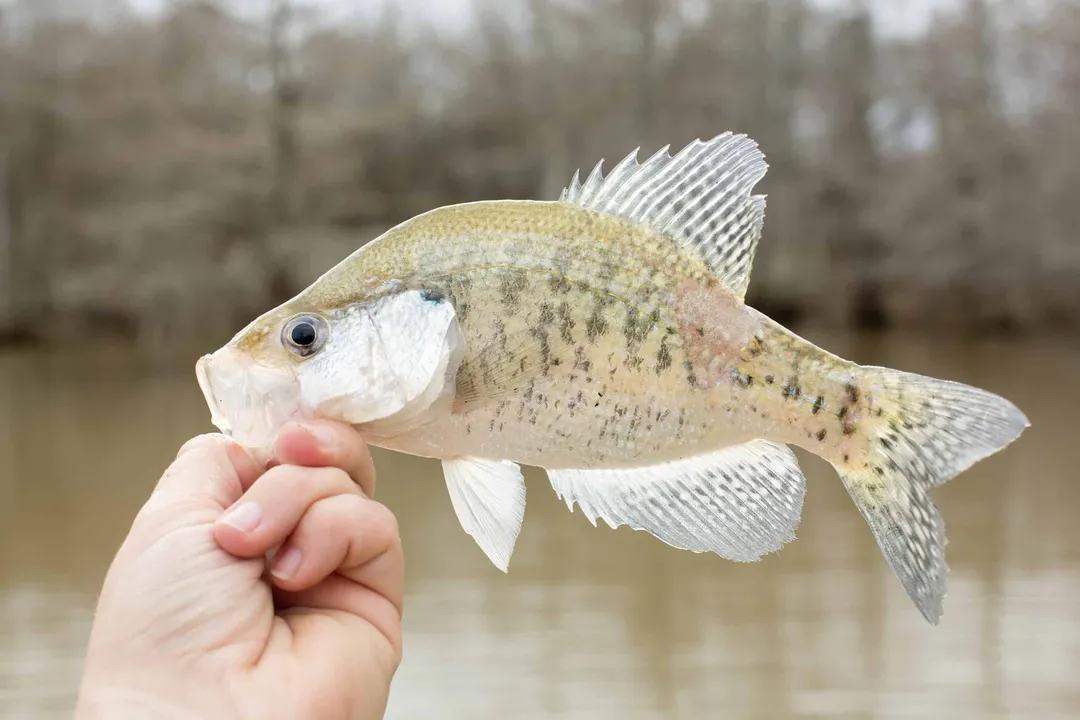
A primary visual difference used to separate *Pomoxis annularis* from *Pomoxis nigromaculatus* lies in their respective body patterns. The White Crappie is characterized by possessing dark vertical bars that run along its flanks. These bars, although sometimes faint, provide the definition for this species. In stark contrast, the Black Crappie features markings that manifest as black spots. These spots are generally more scattered and appear less organized or systematic than the distinct vertical barring seen in the White Crappie, making the pattern distinction a reliable, albeit subtle, identification cue.
Related Questions
What is the typical dorsal fin spine count for White Crappie (*Pomoxis annularis*) versus the Black Crappie?What feature of *Pomoxis annularis* inspired the Latin term *annularis* in its scientific name?What specialized diet defines juvenile White Crappie, facilitated by long, fine gill rakers?According to the Turbidity Gradient Hypothesis, what water condition do White Crappie generally tolerate and prefer?Approximately how long has the White Crappie (*P. annularis*) existed in some recognizable form?What feeding strategy primarily characterizes mature White Crappie exceeding 12–15 centimeters in length?What specific type of scale structure indicates the sophisticated physical organization of *Pomoxis annularis*?What reproductive activity is the male White Crappie dedicated to, requiring defense for up to five days post-hatching?How is the defining body pattern of the White Crappie contrasted with the markings of the Black Crappie?Despite tolerating turbidity, what environmental factor correlates with demonstrably better growth rates for White Crappie?