How does the Wood Duck's communication differ from that of a typical duck that 'true quacks'?
Answer
The female emits a high-pitched squeal and the drake produces a finch-like whistle.
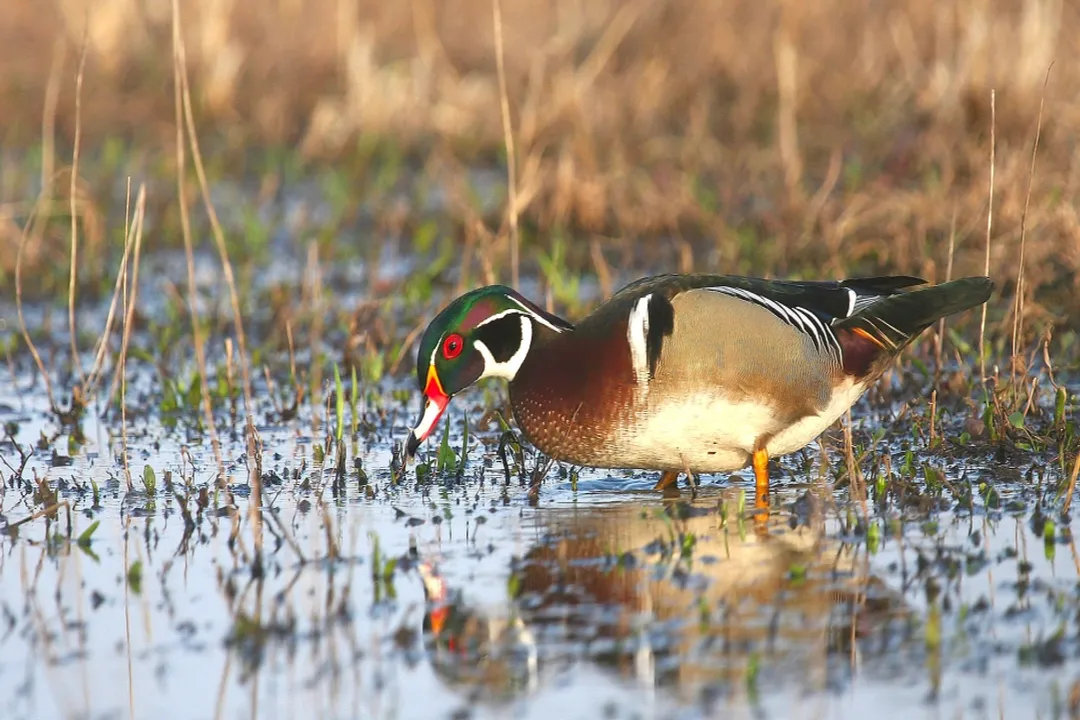
The vocalizations of *Aix sponsa* are distinct and contribute to their classification as specialists, setting them apart from many common waterfowl species known for standard quacking calls. Specifically, the female Wood Duck does not produce the typical duck call; instead, she is noted for emitting a high-pitched squeal. Complementing this, the male, or drake, communicates using a characteristic finch-like whistle. These specialized sounds are part of the unique biological signature of the species, reflecting adaptations tied to their complex social behaviors near dense wooded areas, rather than the open marsh calls typical of true quackers.
Related Questions
What is the common translation associated with the scientific designation Aix sponsa?Which specific nesting behavior distinguishes the Wood Duck within the Family Anatidae?What are the two living species comprising the Genus Aix?What adaptation explains the Wood Duck's shorter wings compared to some other ducks?If the Wood Duck is classified under Phylum Craniata, what structural feature must it possess?What defines the feeding niche of the Wood Duck categorized as a 'dabbling duck' within Order Anseriformes?What striking feature contrasts the subdued coloration of the female Wood Duck?What critical limiting factor, addressed by human intervention, dramatically aided the recovery of *Aix sponsa* populations?How does the Wood Duck's communication differ from that of a typical duck that 'true quacks'?What crucial characteristic, shared by all members of Class Aves, is essential for the Wood Duck's active lifestyle?