How does the morphology of *Hylaeus* contrast with the common European honeybee (*Apis mellifera*)?
Answer
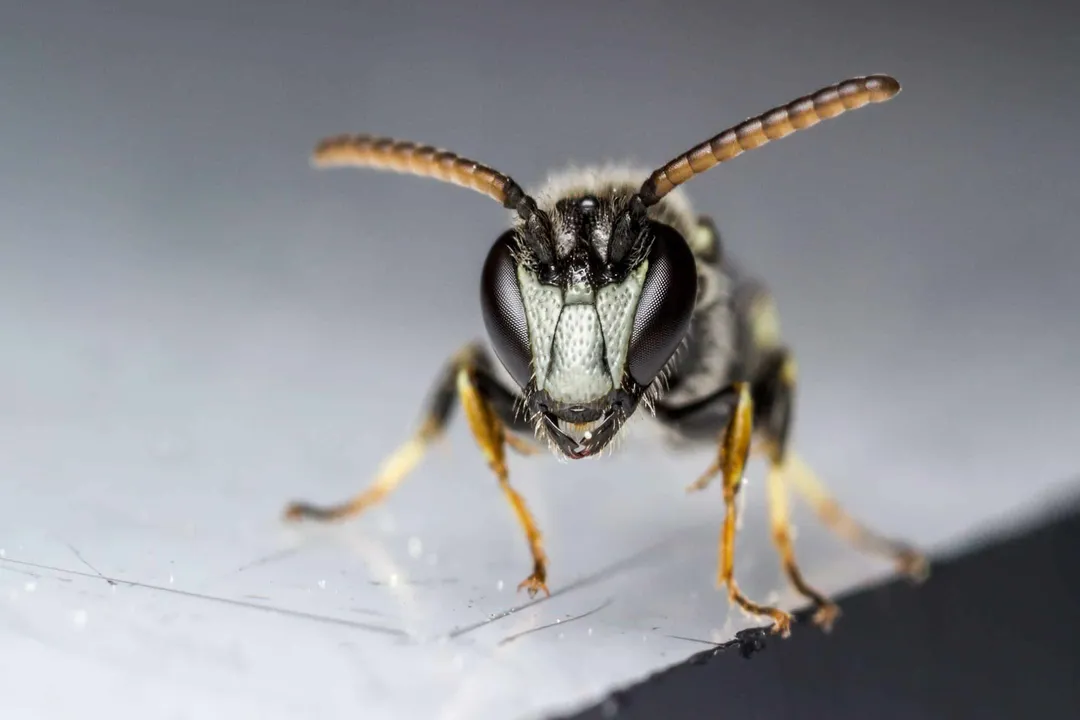
*Hylaeus* lacks the dense, fuzzy coat designed to carry pollen on its hind legs
The contrast between *Hylaeus* and the European honeybee, *Apis mellifera*, highlights different evolutionary strategies for pollination. *Apis mellifera* is defined by its dense, fuzzy coat, specifically adapted to carry significant loads of pollen externally on specialized structures, known as scopa, located on the hind legs. In stark opposition, the yellow-faced bee is structurally adapted for rapid, discreet foraging by lacking this dense external hair structure entirely. This absence of a fuzzy coat means *Hylaeus* cannot rely on external transport mechanisms like the honeybee.
Related Questions
What is the most diagnostic physical trait distinguishing yellow-faced bees?How do yellow-faced bees (*Hylaeus*) primarily collect and transport pollen?What physical aspect causes *Hylaeus* to sometimes be mistaken for wasps or flies?How does the morphology of *Hylaeus* contrast with the common European honeybee (*Apis mellifera*)?What finer physical details are crucial for distinguishing North American *Hylaeus* species?What structural element differentiates *Hylaeus* from the solitary wasps it can resemble?What is noted about the yellow markings in the species *Hylaeus facilis*?What combination of features generally describes the overall build of the *Hylaeus* genus?For taxonomic work on Hawaiian endemic *Hylaeus* species, what subtle features are often relied upon?What role do the metallic sheens found on some *Hylaeus* species play in identification?