Yellow Bass Physical Characteristics
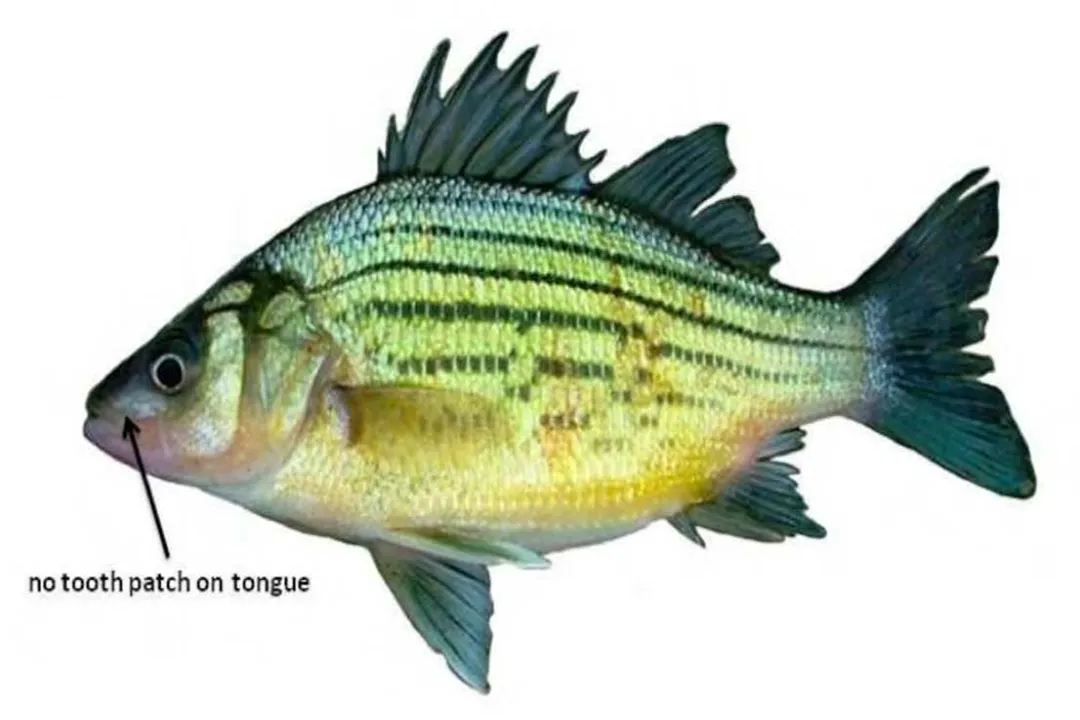
The Yellow Bass, Morone mississippiensis, presents a striking yet often overlooked profile within the temperate bass family. At first glance, especially to the casual observer, it carries a general appearance very similar to its more famous relative, the White Bass. However, stepping closer reveals subtle yet definitive physical markers that allow for accurate identification of this species, which is named, quite literally, for its distinctive yellow hue.
# Body Profile
The overall build of the Yellow Bass is characterized as being laterally compressed, meaning it is flattened side-to-side. Descriptions often include terms like "slab-sided" or moderately deep. They possess spiny rays, typical of the Morone genus, and are generally considered stocky fish.
Size-wise, the Yellow Bass is decidedly on the smaller end of the bass spectrum compared to Largemouth or Striped Bass. Most anglers encounter individuals measuring between 10 and 14 inches in length, often weighing in around one or two pounds. While many specimens stay within this range, they are capable of growing larger; some reports indicate adults reaching 8 to 11 inches is typical, though others suggest they rarely exceed 12 inches in places like Minnesota. The maximum recorded length for the species nears 18 inches total length, with the world record tipping the scales just over four pounds. This smaller stature, while reducing their profile as a premier game fish, contributes to their reputation as spirited fighters on lighter tackle.
# Coloration Nuances
The defining characteristic that earns the Yellow Bass its name is its coloration, primarily manifesting as a yellowish-gold tone across the body and around the eye. The overall appearance is often described as silvery-yellow. This color is not uniform across the entire fish, however. The dorsal area, or back, tends toward a darker shade, frequently described as olive green or olive-gray. As one moves ventrally, the color transitions down to a white or yellow abdomen. The median fins, those along the top and bottom centerline, tend toward a dusky or dark appearance, whereas the paired fins, such as the pectorals, often remain clear or white.

# Stripe Markings
The lateral striping is the most crucial feature for differentiating the Yellow Bass from its close relatives. Like other temperate basses, it exhibits dark horizontal stripes running along its sides. However, the pattern exhibits specific breakages that serve as critical identifiers.
The stripes running along the back are typically dark brown or black and remain continuous. The key distinction arises with the lower stripes, numbering three or four, which run along the sides and venter: these are distinctly broken or offset before they reach the origin of the anal fin. This offset pattern is a principal feature separating it from the White Bass, whose stripes are usually continuous to the tail.
# Specific Structures
Beyond color and stripes, a few specific anatomical details are essential for positive identification, especially in situations where coloration may be faded or confusing. The Yellow Bass is distinguished from the White Bass and the Striped Bass by the complete absence of a tooth patch on the base of the tongue.
Examining the fins provides further confirmation. The dorsal fin structure is noteworthy; the soft dorsal fin and the spinous dorsal fin are connected, sometimes by a slight membrane. Another structural separator from the White Bass is found in the anal fin rays, where Yellow Bass possess nine to ten soft rays, contrasting with the eleven or thirteen found in White Bass. Furthermore, within the Morone genus, the Yellow Bass is unique because its second and third anal spines are approximately equal in length.
If a definitive identification is difficult due to fish wear or poor lighting, a quick scale count on the lateral line can be a good objective measure. Sources indicate counts generally fall between 47 and 55 scales along this line. While the visual key of the broken stripes is usually sufficient, having a quantitative metric like the scale count provides an excellent secondary confirmation, particularly for anglers examining less-than-pristine specimens where pigmentation might be muted. The mouth position is terminal, and its overall size is generally smaller than that of other, larger bass species.

# Size Comparison Analysis
Anglers often confuse the Yellow Bass with the White Bass, leading to potential frustration if they are targeting one and catching the other. While the stripe difference is critical, the size difference often gives the game away before close inspection is needed. White Bass commonly reach much greater weights. In Mississippi, for example, the White Bass state record significantly surpasses the Yellow Bass record of just over 2 pounds.
When fishing for these similar species, knowing the morphological differences can guide lure choice. Because Yellow Bass are smaller and exhibit a stockier build, attempting to haul them in with gear sized for Largemouth or even robust White Bass can be detrimental to the fish and the angler's experience. A light or ultralight rod is often recommended when specifically targeting Yellow Bass to allow the fish to fight effectively, ensuring that you feel the full action of their aggressive strikes without overpowering their smaller frames. This sensitivity to tackle is a direct consequence of their physical stature—a compact, deep body that fights hard for its size but lacks the sheer mass of its cousins.
# Fin Ray Counts Summary
To make the finer points of identification clearer, especially when dealing with specimens resembling White Perch (Morone americana), which lacks lateral stripes entirely, focusing on the fin structures is helpful. The count of rays and spines provides a quantifiable checklist that transcends subjective color interpretation.
| Feature | Yellow Bass (M. mississippiensis) | White Bass (M. chrysops) (for contrast) |
|---|---|---|
| Anal Soft Rays | 9–10 | 11–13 |
| Dorsal Spines | 10 | Not specified, but context implies difference |
| Lateral Line Scales | 47–55 | Not specified |
| Lower Stripes | Distinctly broken/offset anterior to anal fin | Continuous |
| Tongue Teeth | Absent | Present (a patch) |
This table highlights how the combination of fin ray counts and the stripe pattern creates a unique physical signature for Morone mississippiensis. Paying attention to these seemingly minor numerical differences—like a single soft ray in the anal fin—can move an identification from a guess to a certainty, especially when relying on preserved specimens or underwater visuals where body color fidelity is low.
Related Questions
#Citations
Yellow Bass - | Outdoor Alabama
Yellow Bass | Mississippi Department of Wildlife, Fisheries, and Parks
Morone mississippiensis (Bass) - Animal Diversity Web
Morone mississippiensis : Yellow Bass | Rare Species Guide
Yellow Bass | The Most Complete Species Guide - BassForecast
Yellow Bass - O'Brien County Conservation - Prairie Heritage Center
Yellow bass - Wikipedia