How do members of the Family *Scolopacidae*, including the Whimbrel, typically forage?
Answer
They probe mudflats and sand with their specialized bills to extract marine invertebrates
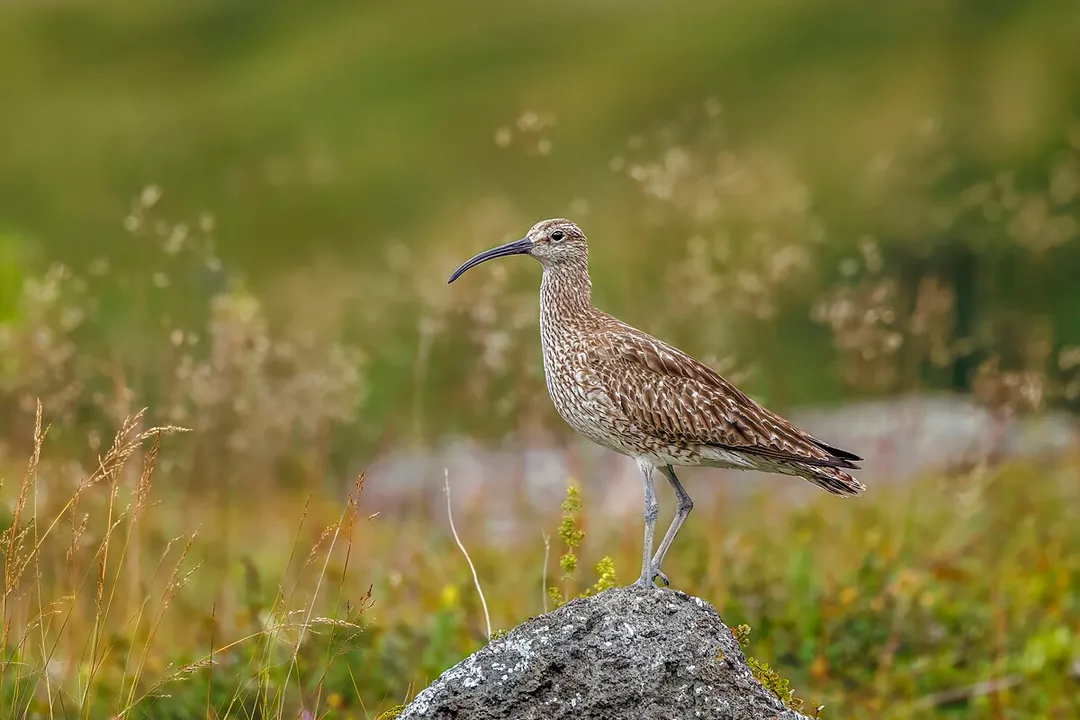
The placement of the Whimbrel within the Family *Scolopacidae* (sandpipers and allies) signifies that they share a common ecological niche centered around soft substrates. Their specialized, long, curved bills are perfectly adapted for the function of probing into mud and sand in tidal zones. This action allows them to extract subterranean marine invertebrates, such as small crabs, a feeding behavior common to many members of this family that inhabit these coastal environments. While they supplement their diet with insects and berries during the breeding season, their primary specialized foraging technique involves probing for buried prey.
Related Questions
What does the Ancient Greek root used for the genus *Numenius* refer to?What observable feature distinguishes the rump of *Numenius phaeopus* from *N. hudsonicus*?Which taxonomic Order unites the Whimbrel with gulls and auks?How do members of the Family *Scolopacidae*, including the Whimbrel, typically forage?What do the Ancient Greek words *phaios* and *pous* contribute to the meaning of *phaeopus*?Where do populations of the subspecies *N. p. islandicus* primarily breed?What is the etymological basis for the common name 'Whimbrel'?Which classification status do some authorities still apply to the Eurasian and American Whimbrels?Which subspecies of *N. p. phaeopus* breeds in northeastern Siberia and winters as far east as Australia?What key physical characteristic contributed to the initial placement of the Whimbrel in Class *Aves*?