How did the Woolly Rhino's front horn structure differ from many living species?
Answer
Massive and flattened
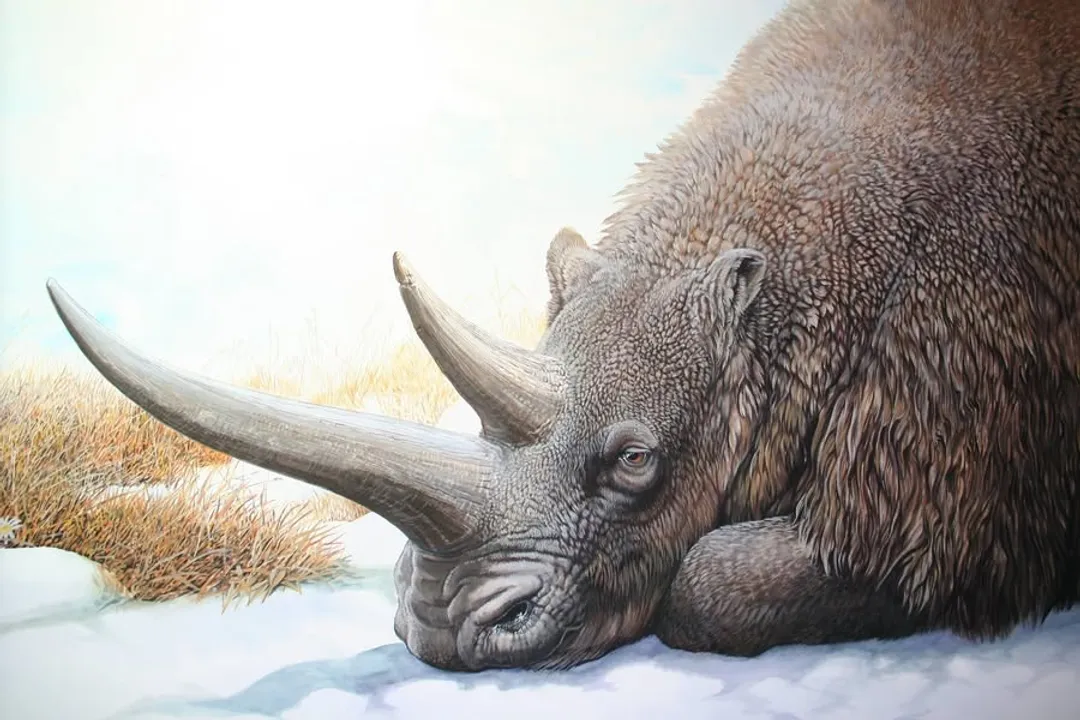
The Woolly Rhinoceros possessed two horns, but the morphology of the front horn was a distinctive trait. Unlike the more conical horns found on many living rhino species, the Woolly Rhino's front horn was characterized as being massive and flattened. Paleontological speculation suggests this unique structure was adapted for practical functions in its environment, such as sweeping snow aside to access vegetation or potentially serving as a defensive tool on the open plains.
Related Questions
What functional toe count defines the Order Perissodactyla for the Woolly Rhino?What does the Greek derivation of the genus name Coelodonta signify?Which family grouping unites *Coelodonta antiquitatis* with modern rhinoceroses?What specific meaning is conveyed by the Latin specific epithet antiquitatis?In taxonomy, what distinct Order separates the Woolly Rhino from the Woolly Mammoth?How did the Woolly Rhino's front horn structure differ from many living species?Membership in which Class confirms the Woolly Rhino nursed its young and possessed hair?Approximately when did *Coelodonta antiquitatis* become extinct following the last glaciation?What key morphological detail defines the genus *Coelodonta* apart from *Elasmotherium*?What characteristic of the enamel structure gives the genus *Coelodonta* its name?