Yellowthroat Facts
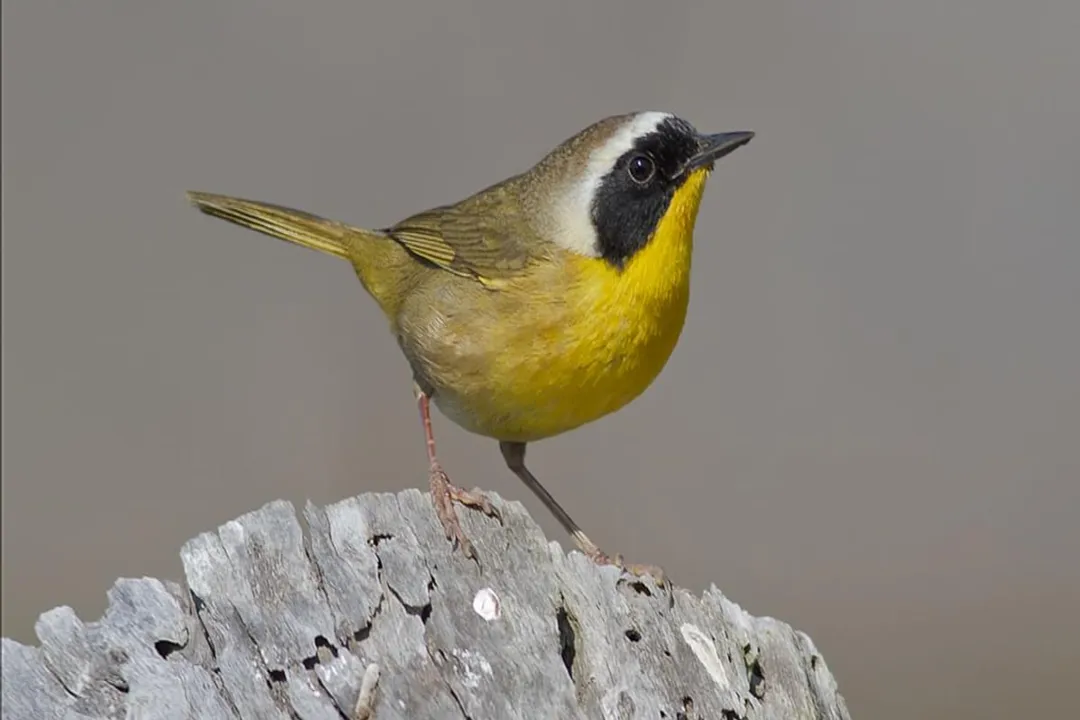
The Common Yellowthroat, often spotted as a fleeting flash of olive and yellow, is one of North America's most widespread warblers, yet it remains secretive, preferring to skulks in the thick underbrush rather than soaring in the high canopy. [4][5] This small, chunky songbird carries the nickname “brush bandit” in some regions, especially the male, whose bold facial markings give him a masked appearance. [1][7] Despite its prevalence in marshes and thickets across the continent, its reclusive nature means that for many birders, hearing the distinctive song is the first confirmation of its presence. [4] Its very name is descriptive, as both sexes and all ages exhibit that namesake bright yellow throat, though the male’s appearance is far more striking. [1]
# Ground Lineage
The Yellowthroat belongs to the Parulidae family, classifying it among the New World Warblers. [2][4] Specifically, the Common Yellowthroat carries the scientific designation Geothlypis trichas. [2][6][7] The genus name, Geothlypis, is derived from Ancient Greek roots meaning "ground-" or "earth-" paired with thlupis, a term for an unknown small bird, perfectly encapsulating its low-to-the-ground lifestyle. [2] Historically, this species holds a notable place in ornithology; it was among the very first birds cataloged from the New World when a specimen from Maryland was described by Linnaeus in 1766. [4][7] While the bird is commonly known as the Common Yellowthroat, it has accrued other titles, including the Maryland Yellowthroat and, in parts of the Midwest, the yellow bandit. [5][7] The global group is complex, with the genus containing about 15 species, many of which have localized ranges in Mexico and Central America. [2] The Common Yellowthroat itself has fourteen recognized subspecies, though distinguishing between them in the field can be challenging due to significant overlap in appearance. [7][8]
# Distinctive Markers
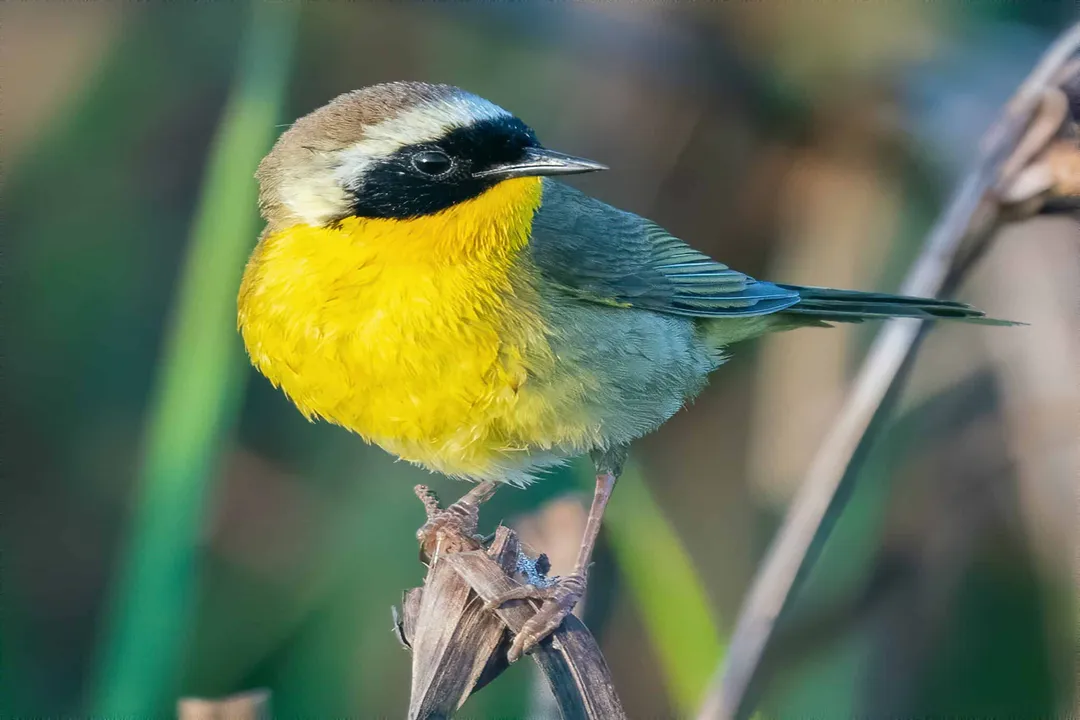
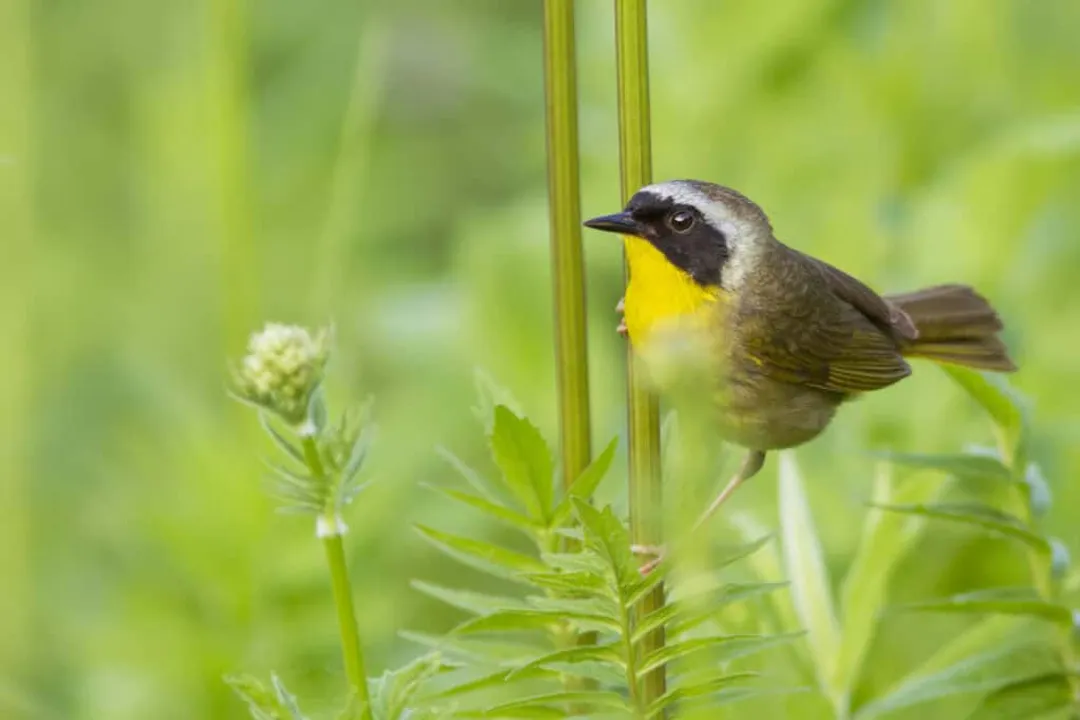
The physical characteristics of the Common Yellowthroat are highly revealing, particularly when comparing the sexes, a feature known as sexual dimorphism. [3][7] An adult in full breeding plumage immediately draws attention because of the vibrant yellow on its throat and breast, contrasting sharply with olive-brown upperparts and generally plain wings. [2][4][6] The adult male is unmistakable: he wears a broad black mask across his face, which is typically bordered above by a conspicuous gray or white band. [2][6] In contrast, the female is much duller and lacks this dark facial marking, instead showing brown coloration on her face. [3][4] Even so, she usually retains a hint of that characteristic warm yellow at the throat. [4] Juvenile females can be quite nondescript, sometimes showing virtually no yellow at all. [1] Size-wise, these are small birds, generally matching that of a small sparrow, measuring about 4.3 to 5.1 inches in length and weighing only around 0.3 ounces. [3][7] They possess a short tail, which they often hold cocked upward in a posture reminiscent of a wren, and have a sharp, pointed black bill. [1][7]
# Marsh Niche
The Common Yellowthroat excels by inhabiting an ecological niche that many other warblers avoid. While most Parulidae are tree-dwellers, the Yellowthroat is an exception, consistently favoring dense, low vegetation. [1][4] Their primary breeding habitat is defined by wet, open areas such as swamps, marshes, and the dense thickets lining streams and wet fields. [3][5][6] They are notably successful at utilizing reed-beds and cattail patches coast to coast. [5] This preference for low cover is functional; the nest is built very low, often less than three feet high, situated in grass tussocks, briars, or dense weeds near the ground or even on plants growing in water. [4][8] Because their preferred breeding sites, especially marshes, are often small and patchy, their density can be hard to uniformly characterize across large regions like Texas, where they are described as "rare to locally common" in some areas. [8] This reliance on low, dense cover for nesting and foraging dictates their movements, but it also affords them a unique advantage during migration. Unlike warblers that feed on the caterpillars found in deciduous trees, which disappear early when leaves drop, Yellowthroats forage in the leaf litter and dense undergrowth. This ground-level food source—invertebrates hidden beneath lingering leaves—persists later into the fall, allowing the Common Yellowthroat to be one of the hardier warblers, delaying its southern migration well after many canopy feeders have departed. [1] If you are looking to attract them to a larger property, providing dense, tangled, low-growing vegetation is the key habitat component they require. [4]
# Song and Sound
The very sound of the Common Yellowthroat often betrays its hidden location. [4] The male’s vocal performance is robust, serving as both a territorial marker and a courtship signal. [3] The song is immediately recognizable: a loud, fast, and repetitive “Wichity-witchity-witchity-witchity-wit” or a clear “which-is-it, which-is-it, which-is-it”. [4][5] These birds are prolific singers, with individual males recorded singing thousands of times in a single day when establishing their claim. [5][7] In addition to the primary song, they use distinctive call notes—often a husky, low chuck—to communicate alarm or presence within the dense foliage. [4] Interestingly, while they are generally secretive, their inquisitiveness can sometimes lead them into the open; making a "pishing" sound can often cause a Yellowthroat to pop out momentarily to investigate the disturbance. [4]
# Foraging Tactics
The Common Yellowthroat is fundamentally an insectivore, relying on its speed and stealth to procure its meal. [4][7] Its diet is broad, consisting mostly of insects and spiders found in its low habitat. [3][6] They exhibit varied foraging techniques, efficiently catching prey on the ground, picking insects directly from the surface of leaves and plants, or snatching them mid-air with short, swift flights from a low perch. [1][4][7] Their menu includes a wide variety of small prey: ants, beetles, flies, aphids, leafhoppers, caterpillars, grubs, small grasshoppers, crickets, moths, dragonflies, and damselflies. [4][7] Though primarily insectivorous, they may supplement their diet with small amounts of fruit during the winter months. [3] Their light weight allows them to perch on surprisingly slender supports, such as a single stalk of grass or a thin reed, enabling access to small, hidden invertebrates. [5][7]
# Courtship and Nesting
Reproductively, the Common Yellowthroat reaches sexual maturity around one year of age. [7] Courtship involves the male displaying by flicking his wings and tail, performing an aerial flight display of 25 to 100 feet while singing, before dropping back to a low perch. [5] The pair-bond formed is socially monogamous, meaning they cooperate in raising the young, but the relationship often includes instances of extrapair mating, where the female mates with other males. [4][7] Research suggests that female choice is heavily influenced by the male’s appearance; the size and intensity of the male’s yellow bib and the quality of his black mask are key factors in securing a mate, whether primary or secondary. [7] The female undertakes the construction of the nest, a bulky, open cup woven from grasses, sedges, bark strips, and leaves, often lined with finer material like hair or rootlets. [5][8] This structure is strategically placed low to the ground, concealed within dense vegetation near water sources. [4][8] Clutch sizes typically range from three to six eggs, usually averaging four. [5][8] The female handles the incubation, which lasts about 12 days, though the male will defend the territory and occasionally provide her with food during this period. [3][5] Once hatched, both parents feed the young, which fledge quickly, leaving the nest after about eight to ten days. [3] A fascinating aspect of their parenting commitment is that the pair bond often extends well past fledging; some pairs will continue to care for their young all the way through the fall migration. [5][7]
# Continental Movement
The distribution of the Common Yellowthroat is vast, breeding across southern Canada and most of the United States, south into Mexico. [2][8] This wide range dictates varied migratory patterns. Some populations undertake long journeys, traveling from northern Canada down to Central America or the Caribbean. [5][7] Other northern populations migrate shorter distances, perhaps only reaching the southeastern U.S.. [1] The arrival in northern breeding grounds is staggered, with males generally arriving one to two weeks ahead of the females to secure territories. [1][3] They migrate predominantly at night, a common behavior among warblers that increases their vulnerability to man-made hazards. [3][5] In Texas, for instance, migration is hard to pin down as some individuals are present year-round, but the bulk move through between mid-March and mid-May in spring, and early September to late October southbound. [8] Wintering occurs across the Atlantic and Gulf coastal plains from Virginia southward, throughout mainland Mexico, and into Central America down to Panama, in addition to resident populations in Mexico and the Caribbean islands. [1][8]
# Conservation Status
Despite their widespread nature and estimated population of around 77 million mature individuals, the overall trend for the Common Yellowthroat is one of decline, leading the IUCN to classify them as a species of Least Concern. [3][5][7] The principal threat facing the species is habitat degradation, specifically the draining and filling of the wetlands and marshes they rely upon for breeding. [3][5][8] Furthermore, their nighttime migration habit makes them susceptible to fatal collisions with brightly lit or reflective human-made structures like towers and tall buildings. [3] When looking closer at regional data, a concerning pattern emerges that highlights the difficulty in assessing population health solely by distribution maps. In Massachusetts, for example, the species remains extremely widespread, occupying nearly 97% of surveyed blocks in the second Breeding Bird Atlas, suggesting their footprint is stable or slightly increasing. [9] However, concurrent Breeding Bird Survey data for the same region shows a definite, significant decline in abundance. [9] This situation, where a species maintains its geographical spread but fewer individuals occupy those areas, places the Yellowthroat in a category demanding continued monitoring and conservation effort, as the local density is clearly eroding. [9] Protecting their habitat, which includes advocating for the preservation of local waterways and reducing pesticide use that harms their invertebrate food base, is vital for their long-term survival. [3]
Related Questions
#Citations
Common Yellowthroat Overview, All About Birds, Cornell Lab of ...
Common Yellowthroat | Audubon Field Guide
Common yellowthroat - National Zoo
Yellowthroat - Wikipedia
Common Yellowthroat - Montana Field Guide
Common Yellowthroat Bird Facts - Geothlypis trichas - A-Z Animals
COMMON YELLOWTHROAT - The Texas Breeding Bird Atlas
The Common Yellowthroat - Bryant Park
Common Yellowthroat - Find a Bird