Wood Frog Facts
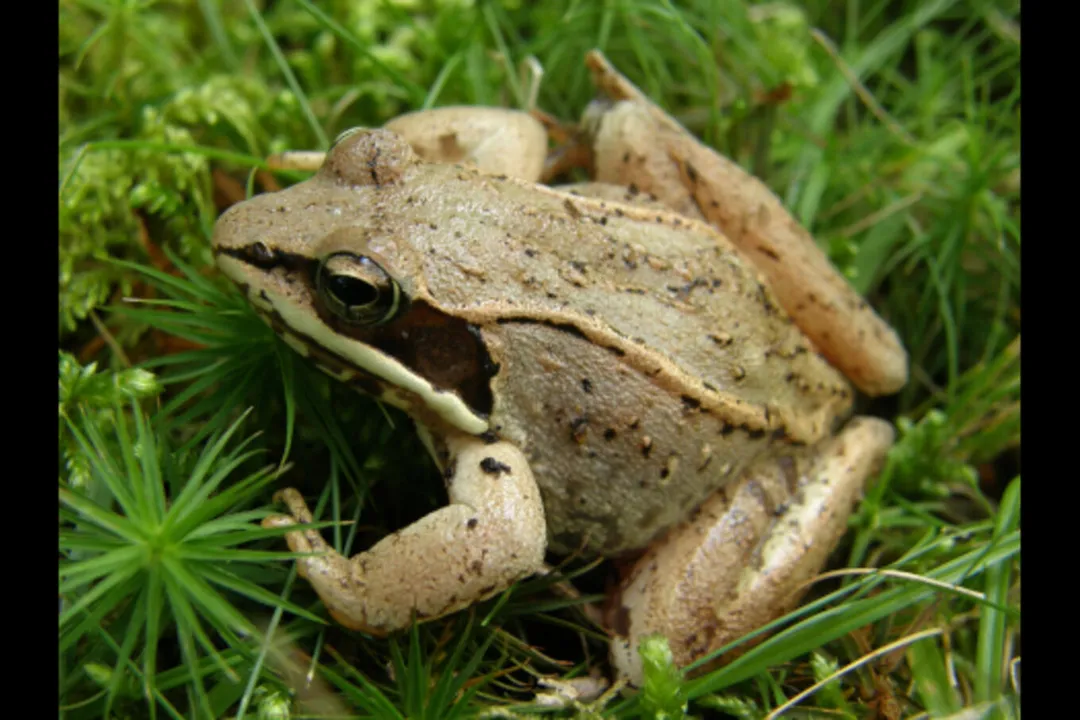
The wood frog, Lithobates sylvaticus, is a remarkable amphibian known for its wide distribution across North America, stretching from the southeastern United States well into the boreal forests of Alaska and Canada. Unlike many of its frog relatives that wait for warmer conditions, the wood frog is famous for its exceptionally early emergence in the spring, often being the first amphibian chorus heard as snow is still on the ground. This early timing is necessary because these frogs breed in temporary woodland pools, known as vernal pools, which dry up as the season progresses.
# Appearance General
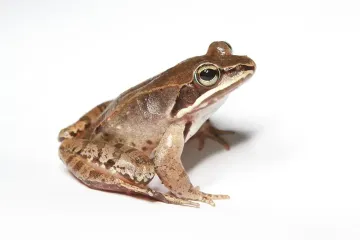
These medium-sized frogs typically have smooth skin and vary in color, usually presenting shades of brown, tan, or reddish-brown, which helps them blend in with the leaf litter of the forest floor. Their underside is often paler, sometimes appearing cream or yellowish. A key identifying feature, present in nearly all individuals, is a prominent dark brown or black "mask" that stretches from behind the eye to the eardrum, or tympanum. They usually have a light stripe running down the center of their back, though this marking is not always present. The hind legs are generally shorter than those of a typical leopard frog, suggesting they are primarily walkers or short hoppers rather than long jumpers. Males are typically smaller than females, a common trait in many frog species.
# Geographic Range
The wood frog boasts one of the most extensive ranges of any terrestrial amphibian in North America. Its territory spans from Newfoundland and Labrador down to the Great Lakes region and south through the Appalachian Mountains into the southeastern US, with populations as far south as Georgia and Alabama. Western populations are found in the Rocky Mountains, reaching as far west as Colorado, though their distribution is more fragmented there. Due to this vast north-south distribution, their size can exhibit clinal variation; frogs in the colder, more northern reaches tend to be smaller than those found in the warmer, southern portions of their range. In the Great Smoky Mountains National Park, for instance, wood frogs can be found from the lower elevations up to about 5,000 feet. Their presence in a given area is highly dependent on the availability of appropriate woodland habitat containing ephemeral wetlands.
# Habitat Preferences
While they breed in water, wood frogs are largely terrestrial amphibians for the rest of the year. They prefer moist, cool woodland habitats, particularly deciduous or mixed forests with ample leaf litter for cover and foraging. The absolute necessity for their survival is the presence of vernal pools—small, temporary bodies of water that accumulate in spring rain or snowmelt but dry up completely later in the year. These pools are crucial because they usually lack predatory fish, which would otherwise consume the eggs and tadpoles. Finding a wood frog outside of the breeding season often involves looking under logs, rocks, or within dense vegetation near the ephemeral wetlands they rely on. If a suitable woodland pool does not fill up reliably, the local wood frog population will struggle to persist, regardless of how much surrounding forest cover exists.
# Breeding Behavior
The onset of breeding activity is signaled by the males' calling, which can begin as early as late February or March, even when ice is still present nearby. The call is often described as a quack, sounding remarkably similar to a duck. Males congregate at the vernal pools and call loudly, creating a chorus to attract females. Females arrive shortly after the males and breeding occurs quickly. A male may grasp a female in amplexus—the mating embrace—and hold on until she lays her eggs. Females deposit large, gelatinous masses of eggs, typically containing several hundred eggs, near the water's surface or attached to submerged vegetation. A single female can lay between 500 and 1,000 eggs. These egg masses are often laid in clusters by multiple females in the most suitable, protected areas of the pool.
# Early Emergence Timing
The wood frog's timing is dictated by temperature, but its need to breed before the temporary pools evaporate is paramount. In many northern areas, their breeding window is incredibly narrow, sometimes lasting only a few weeks. Considering the vast longitudinal and latitudinal stretch of their range, this means that the earliest calling date in, say, Virginia, might be weeks later than the earliest calling date in Michigan or Minnesota. When a local temperature threshold is met, activity rapidly begins. For instance, in areas where the last hard frost might occur around late April, the wood frogs are already laying eggs in March, utilizing that brief period of available water before the forest canopy fully leafs out and shades the shallow water too much, or before the water evaporates. This puts them in direct competition for the brief period of water availability with only the earliest emerging salamanders, like the Spotted Salamander, an interesting ecological overlap where resources must be quickly secured.
# Tadpole Stage
Once laid, the eggs develop relatively quickly, hatching into small, dark-colored tadpoles in about one to three weeks, depending on water temperature. The tadpoles are entirely aquatic and feed primarily on algae and decaying plant matter in the pool. Because they inhabit temporary pools, their time in the water is limited; they must undergo metamorphosis before the water dries up. This developmental period usually lasts between 6 to 10 weeks. Tadpoles often cluster together in the deeper parts of the pool for safety and warmth. Their dark coloration helps them absorb solar radiation in the shallow water, speeding up development, which is a necessary countermeasure to their limited time window.
# Metamorphosis Survival
The transition from aquatic tadpole to terrestrial froglet is dramatic and critical for survival. Upon metamorphosis, the newly formed tiny frogs absorb their gills, develop lungs, and leave the water, often looking like miniature adults. This exodus usually occurs in mid-to-late summer. The young frogs must disperse quickly into the surrounding forest floor habitat to begin foraging and preparing for their first winter. If the vernal pool dries prematurely, tadpoles that have not yet completed metamorphosis will perish, leading to complete reproductive failure for that breeding event in that specific pool.
# Winter Survival
The most astonishing fact about the wood frog involves its ability to survive the harsh northern winters, a feat few vertebrates can manage. Wood frogs are one of the few known vertebrates capable of surviving being frozen solid. When temperatures drop below freezing, the frog buries itself under leaf litter or soil in the forest, sometimes near the breeding pond. As the temperature drops further, ice crystals form in the frog’s body, typically filling up to 65% of its body water, but crucially, not within its cells. This is managed by the production of high concentrations of glucose (a form of sugar) in the vital organs, like the heart and brain, acting as a natural cryoprotectant.
This glucose acts like antifreeze, protecting the cells from fatal dehydration and ice crystal damage. During this state, the frog’s heartbeat stops, its breathing ceases, and it essentially appears dead, sometimes for several months. When spring thaws begin, the ice melts, the frog slowly reanimates, and normal bodily functions—breathing and circulation—resume within hours. This unique physiological capability dictates their northern range limits more than their summer habitat needs do, as it allows them to exploit habitats too cold for other frog species.
# Diet and Foraging
Once they emerge from hibernation and after the breeding season, wood frogs are carnivorous predators that feed on small invertebrates found on the forest floor. Their diet primarily consists of soft-bodied creatures such as insects, slugs, snails, spiders, and earthworms. They hunt using their long, sticky tongues, capturing prey with quick flicks. Because they are active relatively early in the season, they compete for insects that are only just becoming active, placing them in a distinct temporal niche compared to later-emerging frogs like the American Toad or Green Frog.
# Conservation Status
Generally, the wood frog is classified as Least Concern globally by the IUCN Red List due to its vast range. However, local populations face specific threats that warrant attention. In the western portions of its range, particularly in states like Colorado, the wood frog is listed as a species of special concern or even endangered, reflecting habitat fragmentation and sensitivity. The biggest threat across its entire range is the destruction or degradation of the temporary wetlands they depend on. Development, draining of wetlands, pollution, and changes in forest management that eliminate the necessary leaf litter or canopy cover all pose risks to successful breeding. Even if a large forest area is protected, if the specific ephemeral pools dry out too consistently due to climate change or altered hydrology, the population in that forest patch will decline rapidly.
# Comparative Differences
When contrasting the wood frog with other common frogs, its adaptations stand out significantly. For instance, the Northern Leopard Frog (Lithobates pipiens) also calls early but requires more permanent water sources for its tadpoles, making it less specialized for vernal pools. The wood frog’s tolerance for freezing is a huge differentiator; most other common North American frogs overwinter under water or deep underground, relying on insulation to remain unfrozen, rather than actively tolerating cellular ice formation. If a local area has high water table fluctuations, the wood frog is better equipped than a pond-breeding frog, provided the water lasts long enough for metamorphosis.
| Characteristic | Wood Frog (L. sylvaticus) | Typical Pond Frog (e.g., Green Frog) |
|---|---|---|
| Breeding Water Type | Ephemeral/Vernal Pools | Permanent or semi-permanent ponds |
| Winter Survival | Freezing solid (cryoprotectants) | Buried in mud below frost line, unfrozen |
| Emergence Time | Very early spring (March/April) | Mid to late spring (April/May onwards) |
| Key Identifier | Dark eye mask | Varies; often lacks distinct mask |
| Egg Mass Type | Clustered masses on water surface | Scattered clumps or strings |
The ecological strategy of the wood frog, therefore, is one of extreme temporal specialization: use the first available water source, breed immediately, and develop rapidly, relying on an almost unbelievable physiological trick to survive the interim period when the rest of the world is still frozen.
# Local Context in the Chesapeake Bay Watershed
In the Chesapeake Bay region, the wood frog plays a role in early spring ecology within the forested uplands feeding the bay. They are found in forested wetlands across the states bordering the Bay. For citizen scientists monitoring water quality in these critical headwater streams, the appearance of the wood frog chorus is an invaluable indicator that the spring thaw is truly underway and that the local vernal pool ecosystem has been activated for the year. Their presence signals a healthy, relatively undisturbed forest canopy overhead that allows the necessary snowmelt and rainfall to reach the forest floor without excessive runoff or soil compaction. If you are in a forested area within the Bay watershed and hear a duck-like quacking in late winter, you are likely near a wood frog breeding site, and approaching quietly might reveal masses of eggs floating near shaded banks. It is important to remember that disturbing the leaf litter around these pools unnecessarily can destroy the crucial insulation required for the frogs to survive their winter dormancy just a few months later.
If you ever encounter a wood frog during the summer foraging season, resist the urge to handle it excessively, even though they are generally hardy. A good practice in the field, especially when identifying them based on their dark mask, is to note the mask's termination point. On the wood frog, the mask usually extends right to the edge of the tympanum (eardrum), unlike some other frog species where the mask might be broken or stop short of the ear structure. Furthermore, because they have shorter hind legs than some field look-alikes, if you disturb one and it hops, a short, clumsy series of bounds is more characteristic than the long, elegant leaps seen in true leopard frogs.
# Life Span and Size Variation
While exact life spans in the wild are difficult to ascertain, wood frogs can live for several years in their natural environment. In laboratory settings, they have been recorded living for over 16 years, but a typical lifespan in the wild is likely shorter due to predation and the rigors of their extreme overwintering process. Size varies significantly based on gender and geographic location. Females are generally larger, potentially reaching over two inches in length, while males are smaller. As noted before, northern individuals tend to be smaller than their southern counterparts, illustrating an adaptation to slightly different thermal regimes and potentially different food availability windows throughout the year. Observing the difference in size between the calling males and the larger females at a breeding pool can offer a quick lesson in amphibian sexual dimorphism.
#Videos
Wood Frog Facts for Kids - YouTube
Related Questions
#Citations
Wood Frog | National Wildlife Federation
Kids' Inquiry of Diverse Species, Lithobates sylvaticus, Wood Frog
Wood frog - Wikipedia
Wood Frog - Biological Miracle - National Park Service
Ten Facts about Wood Frogs - Nature for my Soul
Wood Frog- Lithobates sylvatica - New Hampshire PBS
Wood Frog - Colorado Parks and Wildlife
Wood Frog - Virginia Department of Wildlife Resources
Wood Frog Lithobates sylvaticus - Chesapeake Bay Program
Wood Frog Facts for Kids - YouTube