Wood Duck Facts
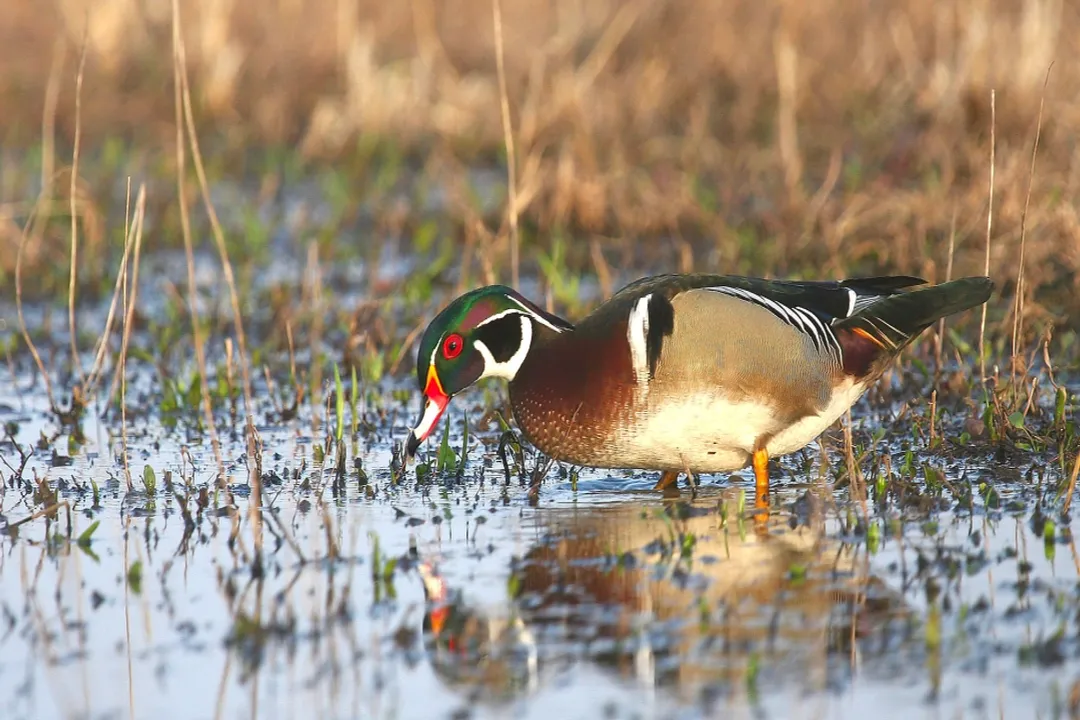
The Wood Duck, formally known as Aix sponsa, is arguably the most striking waterfowl found across North America, a dazzling creature whose very scientific name, Aix sponsa, translates roughly to “in wedding raiment”—a nod to the male’s spectacular appearance. [1][3][5] It is a species that immediately demands a second look, often appearing less like a wild bird and more like the result of a talented artist’s most vibrant palette. [1] While the male captures most of the attention, the more subdued female is equally captivating, bearing a distinct profile marked by a noticeable white patch encircling her eye. [2][6][7]
# Brilliant Plumage
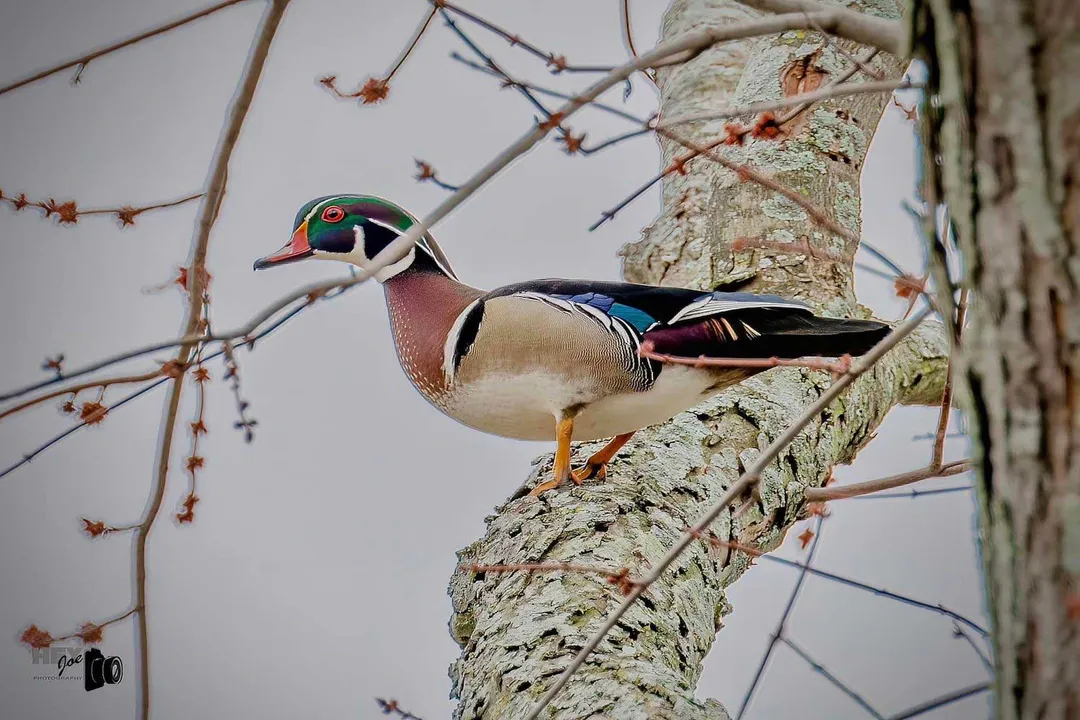
The drake, or male Wood Duck, showcases an intricate pattern on nearly every feather, featuring iridescent greens, purples, and blues on the crest, contrasted with a rich chestnut breast. [3][4][6][7] The face is marked with bold white stripes running down the neck and extending up the cheeks, while the eyes are a deep, arresting red. [5][6] The bill itself is multicolored, often featuring red, white, and yellow with a black tip. [7] Females are far more muted, generally displaying a grayish-brown body, but their elegance shines through with that signature white eye-ring and a white throat area, plus flashes of iridescent blue-green on their wings. [2][6]
It is fascinating to consider the seasonal shift in the male's appearance. This intense, kaleidoscopic breeding plumage is purely functional—it exists to attract a mate. [2][6] Once the breeding season concludes in the early summer, the male undergoes a dramatic transformation, shedding his finery for what is called eclipse plumage. [2][3] During this phase, he becomes predominantly gray or grayish-brown, losing his bold striping. Even in this subdued state, he remains identifiable by those distinctive red eyes and bill. [2][6] This drastic change highlights a crucial survival trade-off: the momentary need to be highly visible for courtship is replaced by a need for camouflage during vulnerability, especially given the species' relatively short average lifespan of about four years in the wild, with high juvenile mortality. [1]
# Habitat Preference
Wood Ducks are strongly associated with the trees that give them their name. [2][3] Unlike many other waterfowl that prefer wide-open expanses of water, these ducks thrive in environments where water and woodland intertwine. [3][6] Their preferred areas include wooded swamps, bottomland hardwood forests, freshwater marshes, and sluggish streams or beaver ponds. [4][7][8] They seem to do best where open water alternates with substantial vegetative cover, such as downed trees or dense shrubs like buttonbush or willow, which offer cover for foraging and safety. [4][9]
Their physical adaptations perfectly suit this environment. Wood Ducks are one of the few duck species equipped with sharp claws on their webbed feet, which provide the necessary grip to balance on branches and maneuver into tree cavities for nesting. [1][2][4][6] Furthermore, their wing structure is designed for navigating the tight confines of a forested waterway, enabling them to fly nimbly through branches. [2][8]
# Nesting Habits
The reliance on trees for nesting is perhaps the Wood Duck’s most defining behavioral trait. [3] They seek out cavities in large, mature trees, generally situated near or directly over water. [4][7][8] Since they cannot create their own holes, they rely on natural decay or abandoned excavations made by woodpeckers. [2][4] A female will line her chosen cavity with soft down feathers plucked from her own breast. [4][9] Clutch sizes usually range between six and sixteen eggs, which take about 28 to 37 days to incubate. [4][9]
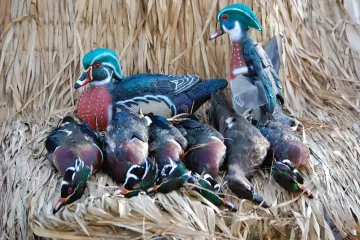
One of the most notable reproductive strategies is that the Wood Duck is the only duck species native to North America that regularly produces two broods in a single breeding season, though this is more common in the southern parts of their range. [2][3][4][5] Adding another layer to their complex family structure is the common practice of brood parasitism, or "egg dumping," where females deposit some of their eggs into a neighboring Wood Duck’s nest to be raised by another hen. [1][2][4] While the male assists in pairing and courtship, he departs during the later stages of incubation to molt, leaving the female solely in charge of the eggs and subsequent brood. [7][1]
When managing properties for these birds, placing nest boxes is highly encouraged, as natural cavities are becoming scarcer due to wetland destruction. [3][6] However, if you choose to install multiple boxes, aim for some distance between them. If boxes are placed too closely, the instances of egg dumping increase significantly, sometimes leading to abnormally large clutches—nests have been found containing up to 40 eggs—which can strain the incubating female and reduce overall success rates. [1][4][5] A good initial separation of perhaps 100 to 150 yards between boxes might mitigate some of this competitive nesting behavior, ensuring a single hen isn't burdened with too many extra offspring to care for. [4]
# Duckling Leap
The first challenge for a newly hatched Wood Duck is immense, yet they are remarkably equipped for it. Only about a day after emerging from the shell, the ducklings must climb to the nest entrance, often situated high up in a tree, and take a formidable leap. [1][2][4] Nests can be situated 50 feet or more above the ground or water surface. [2][4] The remarkable part is their survival upon landing. These young birds are so lightweight, possessing pliable bones and a coat of down, that they safely flutter down, often landing directly in the water if the nest is strategically placed above it. [2][4][7]
Once on the ground, the mother does not physically assist them in their descent or travel. [4] Instead, she emits a soft maternal call from just below the nest site or on a nearby branch, waiting for the brood to gather. [4][7] The hen then guides the young to nearby shallow water areas that offer plenty of cover, like low shrubs, where they can forage for the protein-rich invertebrates necessary for their rapid development. [1][7][8] By about six to eight weeks, they are independent, and can generally take flight by nine weeks of age. [1][2]
# Vocal Range
Despite their vibrant looks, Wood Ducks do not produce the classic "quack" associated with ducks; that sound is generally reserved for female Mallards. [2] Wood Ducks possess a unique array of vocalizations that are essential for communication, particularly when pairing up in late winter. [6] The male’s flight call is a distinct, high-pitched whistle, often transcribed as "jeeeeee". [1][2][5][7] Females produce louder, different sounds; when flushed, they often emit a drawn-out, rising squeal described as "do weep do weep". [3][5] For alarm, females will use a sharper "cr-r-ek, cr-e-ek" sound. [5][7] These distinct calls, coupled with visual courtship displays like wing-flashing and head-bobbing, secure their pair bonds. [7][9]
# Conservation Story
The history of the Wood Duck population is a powerful case study in conservation success. By the close of the nineteenth century, intense market hunting—driven by demand for their meat and the male’s colorful plumes for ladies' hats—combined with significant habitat destruction, brought the species to the brink of near extinction. [3][5][7] However, legislative protection arrived just in time. The establishment of regulations like the Migratory Bird Treaty Act (starting in 1916) and enforcement of hunting limits, alongside the protection of crucial wetland habitats through initiatives like the National Wildlife Refuge System, allowed the birds to begin rebounding by the 1920s. [3][5]
The introduction of artificial nest boxes starting in the 1930s provided a massive boost, addressing the shortage of suitable natural cavities. [3][7] While natural hollows remain preferred, boxes have proven very beneficial to the overall population growth. [3][9] This concerted management effort has been so effective that the Wood Duck is currently classified as of Low Concern by conservation groups. [4][9] Today, they are one of the most numerous waterfowl, with estimates suggesting up to 4.6 million breeding pairs across North America. [5][9] Ironically, this recovery means the Wood Duck is now the second most commonly hunted duck in the continent, trailing only the Mallard, necessitating ongoing regulated harvest management across the various flyways. [3][5] The longevity of these birds can also be impressive; the oldest recorded individual lived to be over 22 years old. [4]
Related Questions
#Citations
Wood Duck Overview, All About Birds, Cornell Lab of Ornithology
10 Fun Facts About the Wood Duck - National Audubon Society
Wood duck - Wikipedia
Wood Duck | NC Wildlife
Five fast facts about ornate wood ducks
Wood Duck | National Wildlife Federation
Wood Duck (Aix sponsa) | U.S. Fish & Wildlife Service
Five facts about wood ducks - CodeBlue BC