Which prehistoric birds had teeth?
The evolutionary history of birds is marked by a dramatic feature loss: the complete shedding of true teeth from the jaws of their ancestors, the dinosaurs. [2] For a significant stretch of time, however, birds sported dental arsenals that rivaled those of their reptilian relatives. These toothed avians were not fleeting anomalies; they thrived for over 86 million years within the Mesozoic world, inhabiting forests, floodplains, and open oceans right up until the catastrophic event 66 million years ago. [2] The fossils recovered today paint a picture of diverse forms, from the primitive to the surprisingly advanced, all sharing this common, now-vanished trait. [2]
# Primeval Wing
When we look back to the transition point, the creature often named as the earliest bird, Archaeopteryx, immediately comes to mind. This Late Jurassic fossil, unearthed in Germany roughly 149–145 million years ago, was truly a transitional form, straddling the line between bird and non-avian dinosaur. Archaeopteryx was small, about the size of a magpie, and possessed several reptilian characteristics that modern birds lack, notably a long, bony tail and sharp teeth. Its mouth was lined with many small, cone-shaped teeth, indicating a carnivorous diet likely composed of small reptiles, mammals, or insects found in its lagoonal environment. The very discovery of Archaeopteryx—a feathered, dinosaur-like animal—provided crucial evidence supporting Charles Darwin's nascent theory of evolution, demonstrating that dinosaurs could, in fact, give rise to birds.
# Cretaceous Grins
The persistence of teeth was not limited to the very first bird ancestors. Throughout the Cretaceous Period, entire groups of birds retained their dentition, often in forms adapted to specific ecological niches. [2]
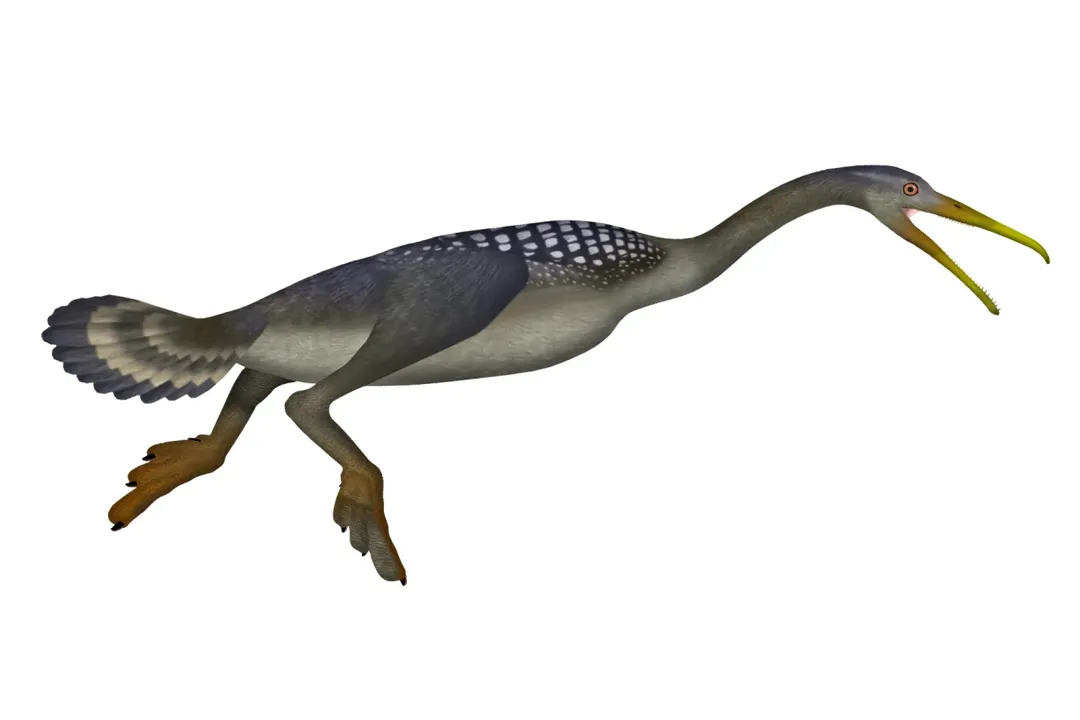
One famous example is Hesperornis, known since the 1870s. This was a marine bird, built for paddling with its hind feet, living in the warm, shallow Cretaceous seas that once covered parts of North America. [2] Its small teeth were specialized for grasping slippery prey; Hesperornis carved out a living chasing fish and soft-bodied cephalopods alongside massive marine reptiles like plesiosaurs. [2] Another notable contemporary was Ichthyornis, which sported a gull-like body plan but also possessed teeth along its jaws. [2]
Most of the successful toothed birds of the Mesozoic belonged to a group known as the enantiornithes. [2] These birds are instantly recognizable as birds but possessed critical anatomical differences from later lineages. For instance, most enantiornithines lacked cranial kinesis—the ability of the beak to flex relative to the skull, a feature modern birds use for faster biting and wider gape. [2] Their teeth were often small and peg-like, generally concealed by primitive lips. [2] Among this group were fascinating specialists, such as Longirostravis, characterized by its long jaws and tiny teeth, and Eoalulavis, which appears to have crunched crustaceans. [2]
What’s interesting when comparing these Mesozoic types is the sheer specialization evident even among the group that still bore teeth. Consider Archaeopteryx with its general carnivorous dentition, versus the marine Hesperornis focused on fish, and then look at the incredible specialization seen in later enantiornithines. [2] It suggests that the loss of teeth wasn't a simple switch; rather, the evolutionary path to modern beaks involved discarding the teeth while simultaneously developing new, better ways to process food with the jaw structure itself. [2] This hints that the presence of teeth was less about being a bird and more about occupying specific, perhaps less flexible, foraging roles during that particular phase of avian evolution. [2]
# Strange Beaks
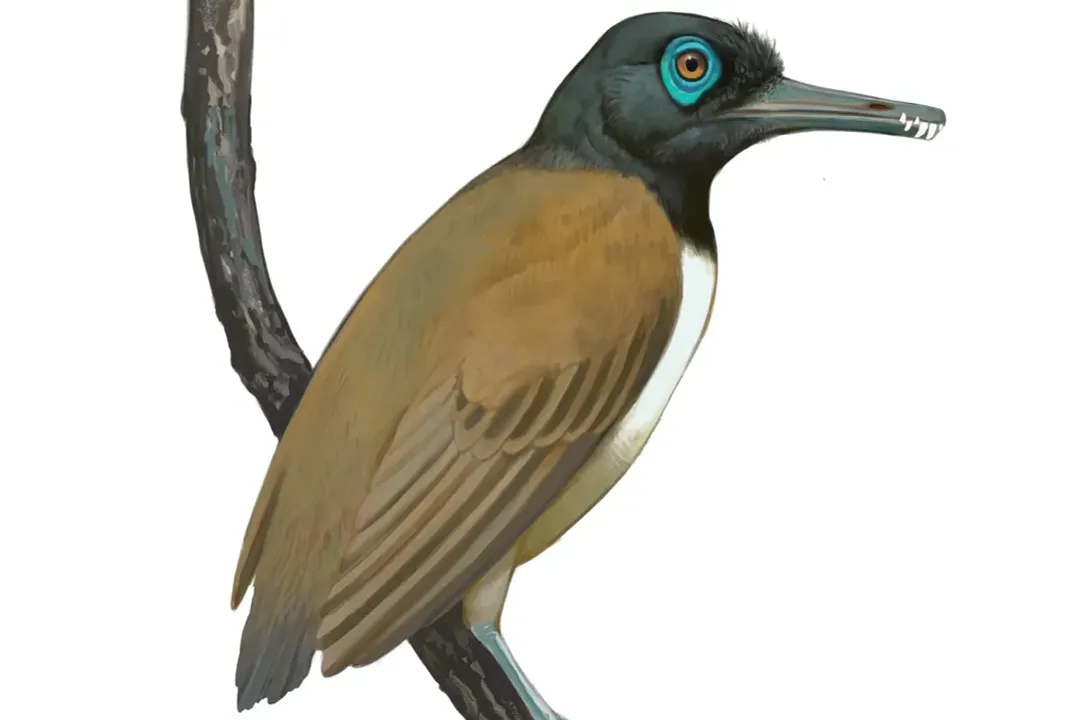
One of the most unusual finds challenges older assumptions about the diet of early birds. The species Longipteryx chaoyangensis, which lived around 120 million years ago in what is now northeastern China, presents a truly bizarre combination of features. [1] It possessed an elongated skull, somewhat reminiscent of a modern kingfisher, but crucially, it bore teeth only at the very tip of its beak. [1] Early paleontologists assumed, based on the skull shape, that Longipteryx was a fish-eater, similar to other toothed birds like Yanornis that had teeth running the length of their jaws. [1]
However, analysis of Longipteryx stomach contents revealed something unexpected: small, round, fossilized seeds from ancient flowering plants. [1] This discovery pointed toward a mixed diet that included fruit—a major shift in our understanding of this enantiornithine group. [1] To manage seeds or tough fruit husks, Longipteryx evolved an extreme defense mechanism for its dentition: its tooth enamel was an incredible 50 microns thick, matching the density found on enormous predators like Allosaurus, even though Longipteryx itself was only the size of a bluejay. [1] This anatomical overkill for seed-mashing suggests an adaptation for exploiting ephemeral or difficult-to-process resources. [1]
Further study of this unique beak structure suggests another novel function. Given the robust, almost "weaponized" quality of the teeth positioned at the beak's end, researchers hypothesized they might have been used in aggression or competition, much like the tooth-like structures some modern hummingbirds use for sparring over resources. [1] Thus, for Longipteryx, the teeth may have served a dual role: processing tough food and perhaps acting as an extension of a display weapon, rather than purely for capturing agile prey like fish or insects. [1] This demonstrates a fascinating divergence in how the presence of teeth was functionally integrated into different avian lifestyles before beaks fully took over. [1]
# Cenozoic Giants
The narrative of toothed birds does not end with the extinction of the dinosaurs. An entirely different, massive lineage, the Pelagornithidae, or pseudotooth birds, dominated the Cenozoic oceans for some 50 million years. [3] These were not birds with true teeth, but their dental mimicry was spectacular. [3] Their common names—bony-toothed birds or false-toothed birds—refer to the sharp, tooth-like projections along the edges of their beaks. [3] These structures were not true teeth, which contain specialized enamel and structures like Volkmann's canals; instead, the pseudoteeth were outgrowths of the jaw bones themselves. [3]
Pelagornithids were immense; the largest among them boasted estimated wingspans of 5 to 6 meters, ranking them among the largest flying birds known to science. [3] Their skeletal structure, particularly the elongated shape of the humerus, suggests they relied almost exclusively on dynamic soaring flight, using ocean currents to glide vast distances, similar to modern albatrosses, but they were also found in all climates, unlike tropical-avoiding albatrosses today. [3] Their prey was likely soft-bodied—fish and cephalopods—which they would snatch from just below the water's surface, perhaps aided by a wide gape similar to pelicans. [3] They occupied an ecological role previously held by the large pterosaurs, which went extinct at the end of the Cretaceous. [3]
# Extinction Event
The reign of the pseudotooth birds ended abruptly, likely tied to the mass extinction at the end of the Cretaceous, which wiped out their dinosaur-era cousins, and later, as their own numbers dwindled in the Pliocene. [2][3] The common factor in their disappearance, and the survival of their beaked relatives, appears to be diet specialization in the face of planetary collapse. [2]
When the asteroid struck, the ensuing impact winter devastated global ecosystems, leading to the near-total collapse of photosynthetic life—the foundation of many food webs. [2] Toothed birds, like the Mesozoic enantiornithines and marine hunters like Hesperornis, often relied on chasing live prey such as insects, small reptiles, or fish, whose populations plummeted. [2] As these food sources vanished, so did the specialized predators that required them. [2]
In stark contrast, the ancestors of modern birds possessed beaks, gizzards, and metabolic adaptations that allowed them to subsist on more resilient foods like seeds and nuts, which could survive in the soil. [2] This adaptability in processing hard, stored, or easily accessible plant matter—rather than hunting volatile live prey—proved to be the ultimate survival tool when ecosystems toppled. [2] Even the giant pelagornithids, who hunted in a marine environment, were vulnerable; the death of phytoplankton decimated the oceanic food web, meaning their high metabolisms required abundant food that simply ceased to exist. [3] While the exact mechanism is debated, the general shift toward a diet that required less immediate capture of fast-moving prey, facilitated by the evolution of the toothless beak, was key to the lineage that survived. [2] The loss of teeth, therefore, wasn't a weakness; rather, the specialization for feeding that replaced teeth offered a superior buffering mechanism against global ecological shock. [2] The subsequent radiation of modern, beaked birds filled the vacant niches left by the extinct, toothy forms, forever changing the face of avian life on Earth. [3][2]
Related Questions
#Citations
Pelagornithidae - Wikipedia
During the Age of Dinosaurs, Some Birds Sported Toothy Grins
'Weird' prehistoric bird had a weaponized beak with teeth
Archaeopteryx - Natural History Museum