Which locomotion characteristic shared with *Otariidae* enables the walrus to move effectively on land?
Answer
Ability to rotate rear flippers forward
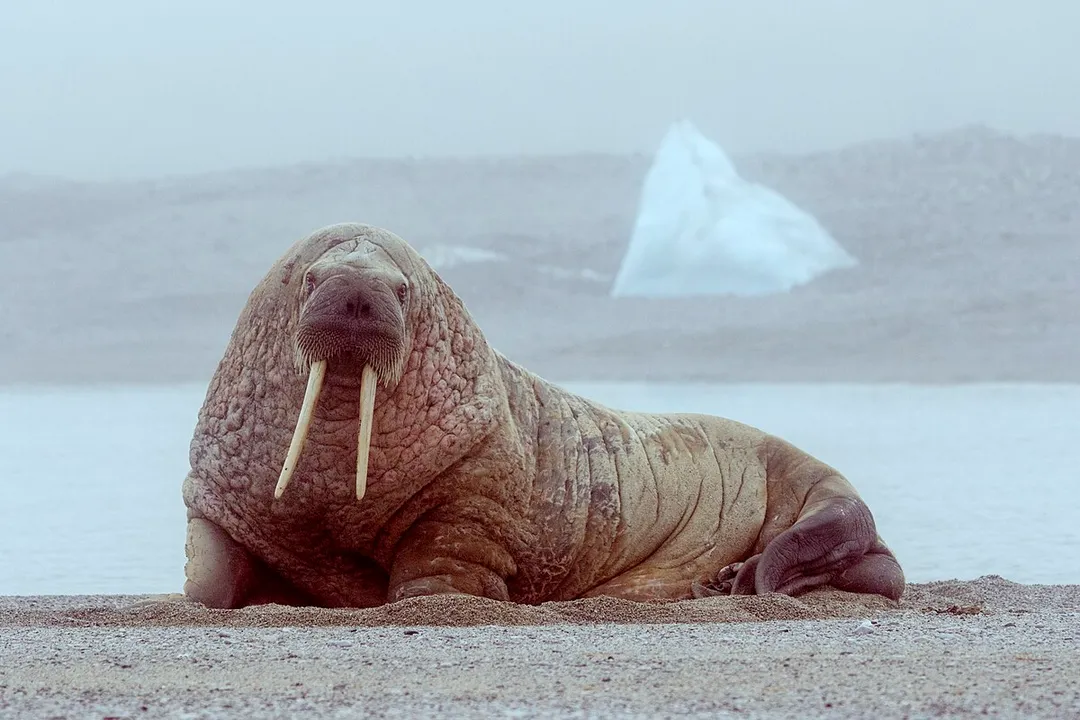
The walrus exhibits a fascinating duality in its movement patterns that reflects its unique evolutionary position within the Pinnipedia. Specifically regarding terrestrial movement, the walrus shares a key physical capability with the eared seals, or *Otariidae*: the ability to rotate its rear flippers forward underneath the body. This adaptation permits the walrus to bear weight and move efficiently across solid surfaces, allowing it to 'walk' using all four limbs, contrasting with the more restricted movement seen in true seals (*Phocidae*).
Related Questions
What is the literal meaning of the genus name *Odobenus* for the walrus?For what purpose are the prominent tusks of *Odobenus rosmarus* not used according to functional descriptions?Why do many modern researchers argue against grouping *Odobenidae* within *Phocidae* or *Otariidae*?Which locomotion characteristic shared with *Otariidae* enables the walrus to move effectively on land?How does the average weight of an Atlantic walrus male (*O. r. rosmarus*) compare to a Pacific walrus male (*O. r. divergens*)?What anatomical feature is primarily responsible for helping the walrus locate and extract prey from the seabed?What is the global conservation status assigned to the walrus by the IUCN Red List?Molecular data suggests the Pinnipedia parvorder descended from an ancestor related to which modern land mammal group?Belonging to the Class *Mammalia*, what are three general traits that characterize the walrus as part of this group?Why is the taxonomic status of the Laptev walrus (*Odobenus rosmarus laptevi*) currently subject to debate?