What specific physiological adaptation do deep-sea anglerfish possess to cope with food scarcity?
Answer
Expandable stomachs capable of swallowing prey up to twice their own size
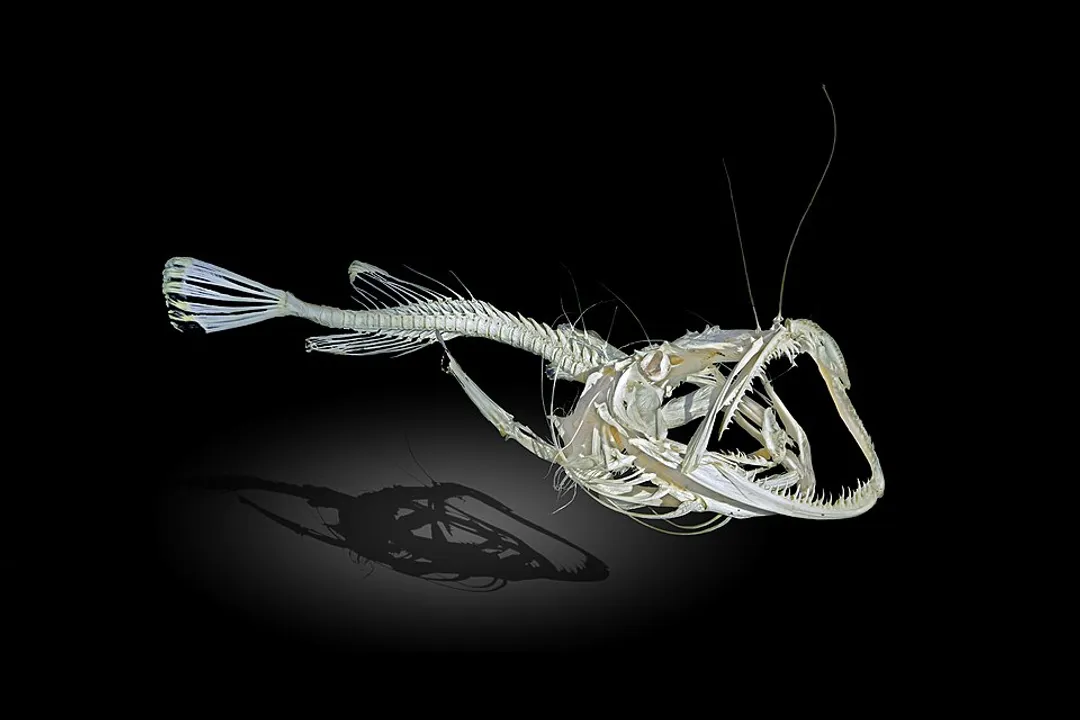
Survival in the deep-sea environment is dictated by the scarcity of available food resources. To counteract this challenge, deep-sea anglerfish have evolved a specialized internal mechanism: expandable stomachs. This unique anatomical feature allows them to capitalize opportunistically on infrequent feeding events by accommodating prey items that are significantly larger than themselves. Specifically, they have the capacity to swallow prey that measures up to twice their own size. This adaptation ensures that when a rare feeding opportunity arises, the energy gain is maximized to sustain them through the long periods between successful hunts.
Related Questions
What is the maximum lifespan projection established for female Lophius piscatorius in the wild?At what approximate age does the male Lophius piscatorius typically reach sexual maturity?What is the general maximum lifespan estimate sometimes cited for the dominant female deep-sea ceratioids?What biological event initiates the transformation of the deep-sea male anglerfish into a permanent appendage?What environmental pressures significantly reduce the potential lifespan of Lophius piscatorius in shallower waters?What specific physiological adaptation do deep-sea anglerfish possess to cope with food scarcity?Why does the concept of an individual male lifespan become almost irrelevant for deep-sea anglerfish like ceratioids?How long does the female Lophius piscatorius generally take to reach sexual maturity?What primary advantage does the parasitic attachment strategy offer the deep-sea male anglerfish?What fundamental difference characterizes the reproductive investment strategy of the shallow-water female versus the deep-sea male anglerfish?