What specific behavioral clue related to elevation strongly favors identifying a snake as an Olive Python?
Answer
Being coiled high in a tree branch overlooking dry scrubland
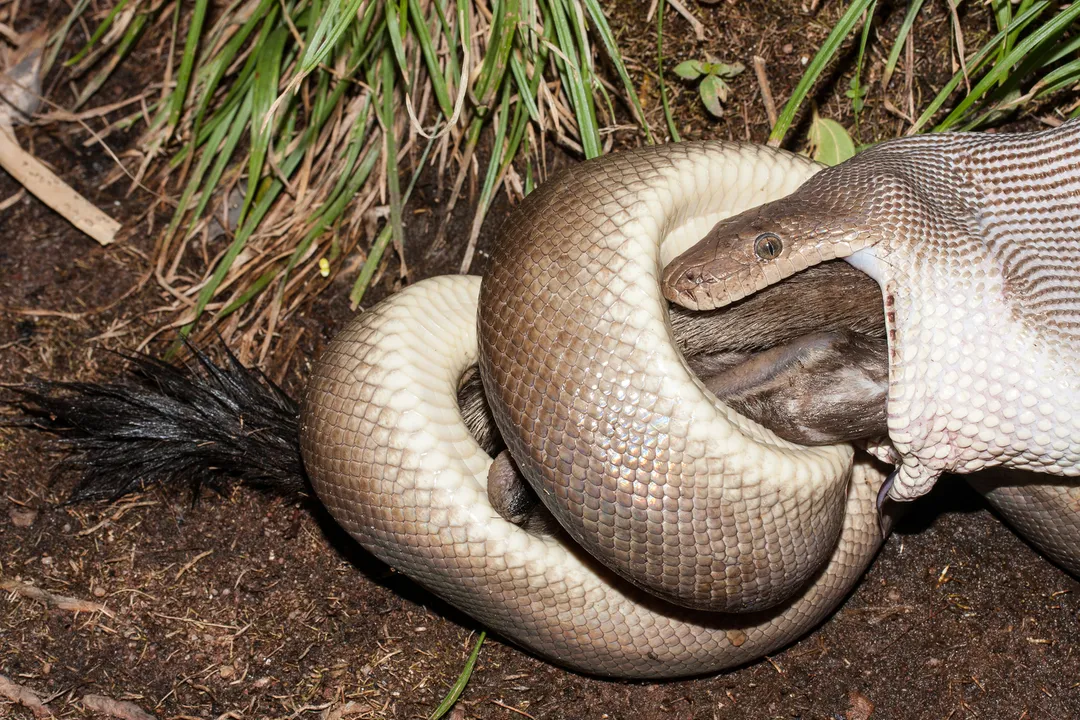
Behavioral observations, especially regarding vertical positioning, can resolve ambiguous identifications between these two species. The Olive Python displays a semi-arboreal inclination, meaning it is comfortable away from permanent water sources and frequently utilizes trees or elevated rock ledges for basking or surveying its territory. Seeing a substantial snake coiled high up in the canopy, particularly if the surrounding area is dry scrubland rather than an aquatic environment, is a very strong indicator that the specimen is *Liasis olivaceus*. The Water Python, by contrast, is primarily ground-dwelling and intrinsically tied to water sources.
Related Questions
What is the scientific classification provided for the Olive Python?What is the typical length range observed for adult male Olive Pythons?What characteristic coloration is typically seen in Olive Pythons from arid regions like the Pilbara subspecies?According to examination of head scales, how many supralabial scales do Olive Pythons typically have?How does the coloration distribution of the Olive Python generally contrast with the Water Python's patterning?What habitat feature is strongly associated with the Water Python (*L. fuscus*) that helps differentiate it from *L. olivaceus*?Why is the Pilbara Olive Python significantly paler than its tropical northern counterparts?How is the physical build of the Olive Python described when compared directly to the Water Python?What structural characteristic is used to describe the typical snout profile of the Olive Python?What specific behavioral clue related to elevation strongly favors identifying a snake as an Olive Python?