How does the coloration of juvenile Olive Pythons contrast with the typical muted palette of mature adults?
Answer
Young snakes exhibit dark bands or blotches across a lighter ground color.
Juvenile coloration serves as a survival strategy during early life when vulnerability to predation is higher, necessitating disruptive patterns. The text notes that young Olive Pythons are frequently adorned with dark bands or blotches set against a lighter ground color, sometimes appearing almost black and white or featuring yellow and brown shades. This pronounced patterning gradually fades as the snake matures, blending into the darker, more uniform olive-green or olive-brown adult coloration, illustrating a shift in necessary camouflage as the animal increases in size.
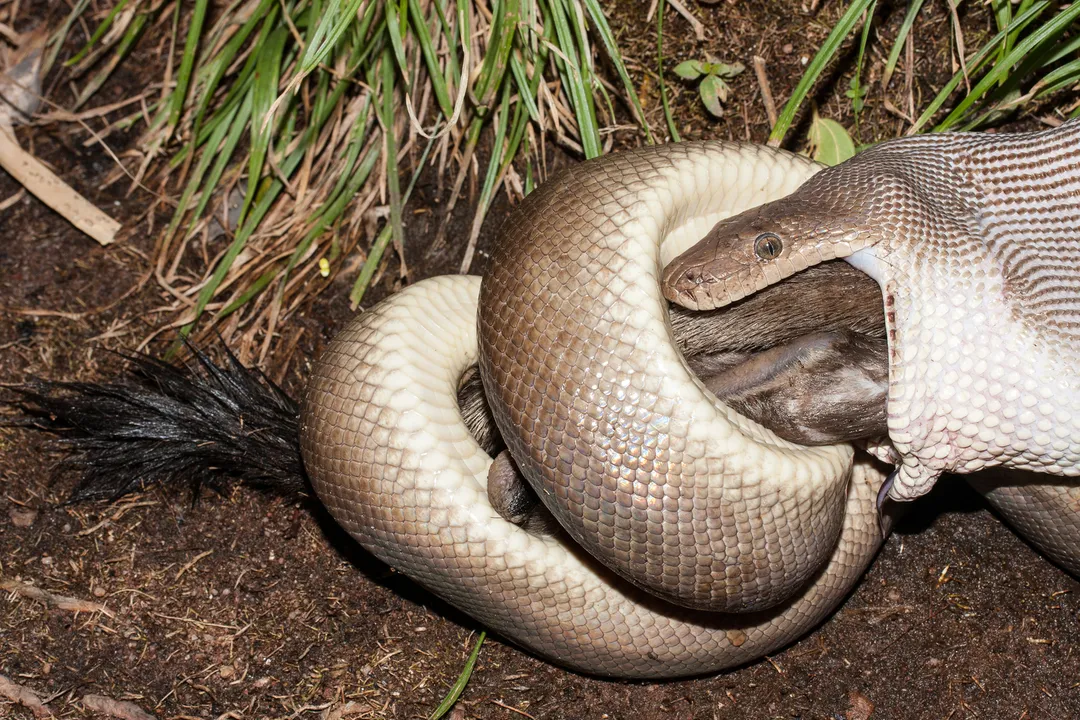
Related Questions
What older scientific classification was formerly assigned to the Olive Python, *Liasis olivaceus*?Which characteristic dictates that adult female Olive Pythons typically surpass their male counterparts in size?How does the coloration of juvenile Olive Pythons contrast with the typical muted palette of mature adults?What specific challenging environment has the Pilbara subspecies of the Olive Python adapted to successfully?What method of prey subjugation does the non-venomous Olive Python employ after seizing its victim?What major components constitute the primary diet of the Olive Python as a top-tier predator?If aggressively handled or cornered, what physical attribute, other than defensive hissing, can inflict serious injury upon a person?What term describes the reproductive strategy where the female Olive Python lays eggs rather than giving birth to live young?What specialized metabolic activity does the female Olive Python engage in while actively incubating her clutch of eggs?What combination of habitats illustrates the extensive environmental adaptability of the Olive Python across its broad distribution?