What is the physical appearance of a python?
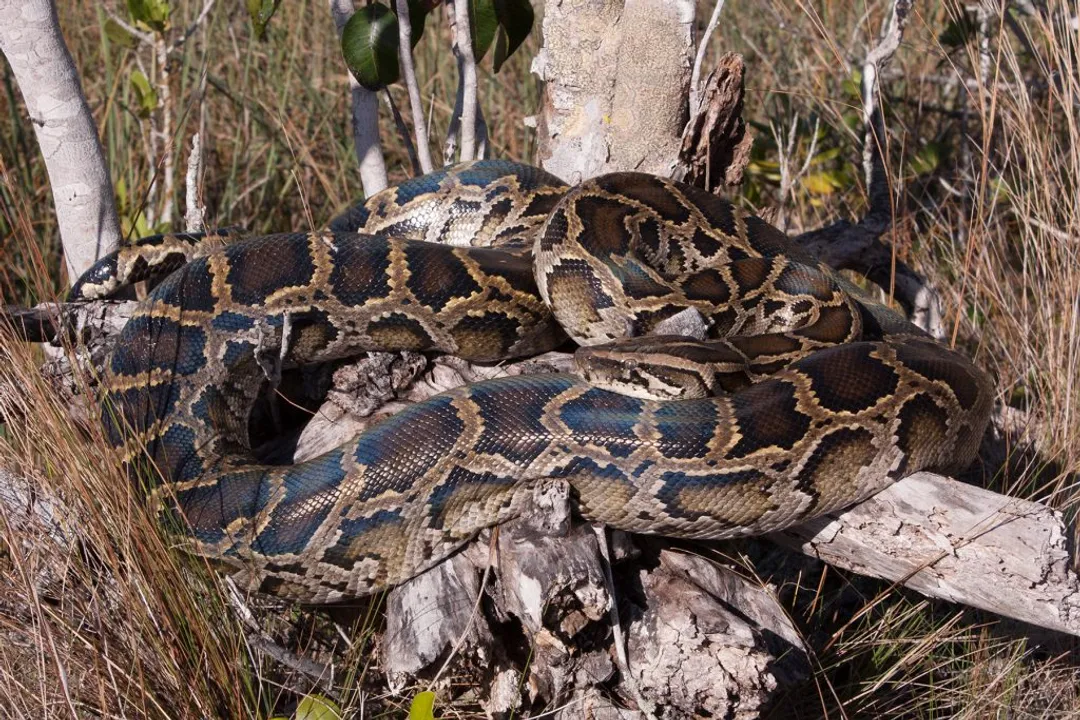
Pythons, members of the family Pythonidae, are instantly recognizable as some of the world's largest and most striking snakes, inhabiting the Old World tropics and subtropics across Africa, Asia, and Australia. [4][7] While the group encompasses about 40 species, with ten genera currently recognized, their collective physical description centers on their immense size potential and their specialized, non-venomous method of capturing prey through constriction. [4][7] Unlike their close relatives, the boas, pythons are oviparous, meaning they reproduce by laying eggs, a reproductive trait that often necessitates physical proximity to their clutch for incubation. [2][4]
# Primitive Structure
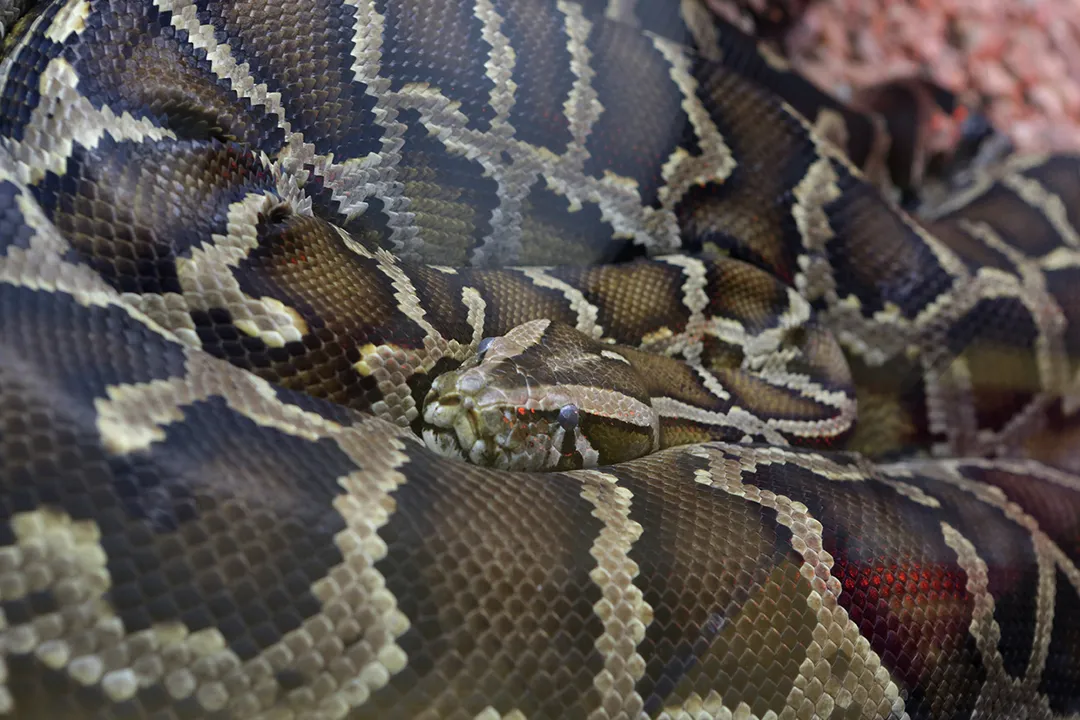
A fascinating aspect of python anatomy is that they are considered primitive snakes when compared to many other serpentine species. [2] This primitivism is physically manifested in two key ways: they possess two functional lungs, whereas most other snakes have only one. [1][2] Furthermore, they retain remnants of their evolutionary past in the form of vestigial hind limbs and associated pelvic bones, which appear externally as small spurs located on either side of the cloaca. [1][2] These retained structures offer clues to their lineage, even as their bodies have evolved for their current ecological role as apex ambush predators. [4]
Their hunting mechanism dictates much of their structure. Since they rely on physical restraint rather than venom—a method starkly different from a rattlesnake, for example, which bites and then releases the prey to suffer the venom's effects—the python must be built for strength and grip. [4][7] This involves their dentition; pythons possess sharp, backward-curving teeth designed not to inject toxins, but to secure a hold on the prey item. [2] Specifically, the upper jaw features four rows of these teeth, balanced by two rows in the lower jaw. [7] Once the hold is established, the snake uses its muscular body to coil around the victim, squeezing until cardiac arrest occurs, rather than crushing bones. [2][4][7]
# Sensory Appendages
The physical features related to how pythons sense their surroundings are particularly advanced for reptiles. While they rely on good senses of smell and sight, most species augment these capabilities with specialized heat-sensing pits located along their jaws. [2][4] These labial pits are infrared receptors that allow the snake to "see" the heat signature, or thermal shadow, of warm-blooded prey like mammals and birds, even in total darkness or dense vegetation. [2][4] This physical adaptation makes them exceptionally effective nocturnal hunters. [3][6]
This sensory array is paired with extraordinary jaw mechanics necessary for consumption. Pythons lack a fused chin, meaning their jaw bones are connected by flexible tissue. This anatomical feature, combined with the presence of a quadrate bone, allows the mouth to open to an extreme degree, both vertically and horizontally, enabling them to swallow prey items considerably wider than their own head whole. [3] To manage this feat without suffocating, pythons possess a specialized tube at the bottom of the mouth that remains open to the side, diverting air to the trachea while the rest of the mouth cavity is filled with food. [2][5]

# Coloration and Pattern
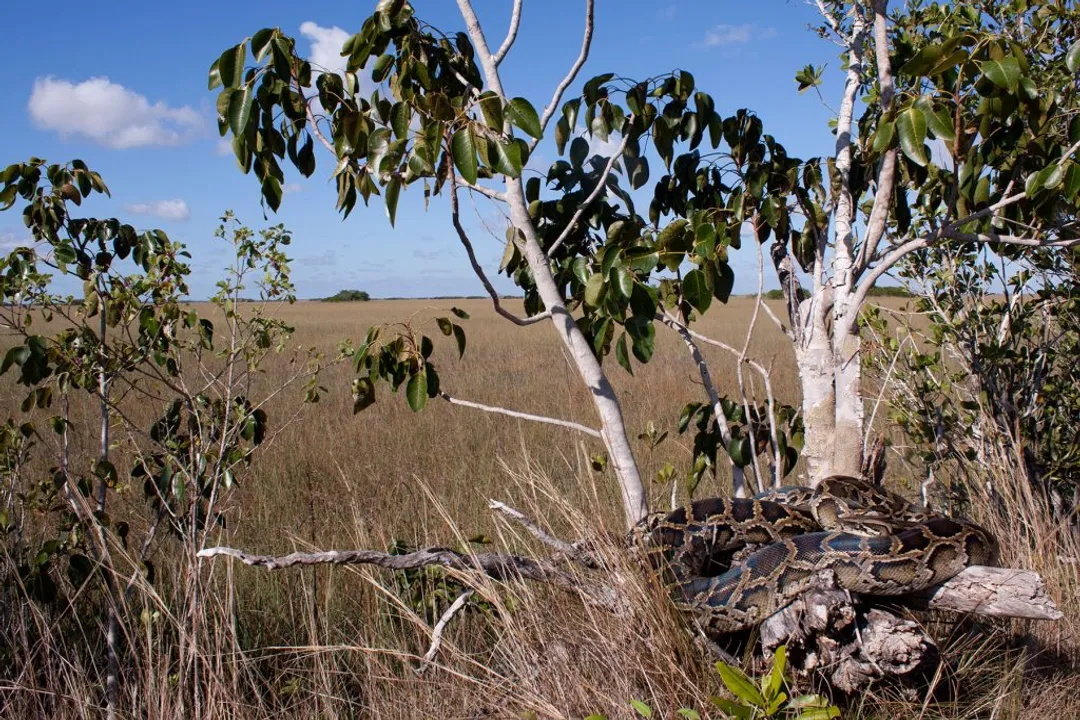
The physical appearance of a python is largely defined by its pattern and coloration, which vary significantly across the 40 species but generally serve a camouflage function within their native habitats, which can range from rainforests to grasslands and scrublands. [2][5] While they are all constrictors, the specific markings are a key differentiator between species.
The Burmese python (Python bivittatus), one of the largest snakes globally, typically presents a base color of pale tan, yellowish-brown, or gray. [3] Running down its long, stout body are large, dark brown or olive blotches which are characteristically outlined in cream or gold. [1][3] This pattern is present even in juveniles, though the young snakes display more vivid coloration. [6] A specific feature aiding identification is the head marking: the top is dark, featuring a light stripe on each side that passes through the eye before converging near the nose, creating a distinct dark V-pattern or spearhead shape. [6]
In contrast, the Ball or Royal Python (Python regius), the smallest of the python species, presents a more compact, medium-bodied appearance. Their primary coloration is described as predominantly black with scattered, asymmetrical blotches of tan and brown. Their head, relative to their stocky build, is considered small. When threatened, their physical defense is to curl into a tight ball, tucking their head centrally for protection—a behavior that lends them their common name. [2]
The diversity in python appearance suggests an evolutionary trade-off in skin texture based on locomotion. Terrestrial species, like the Burmese python whose smooth scales are noted, might rely on friction provided by the broad ventral scales for rectilinear movement, pushing forward by stiffening ribs and engaging those scales against the ground. [2][6] Arboreal species, such as the green tree python, likely possess scale characteristics that complement their ability to hold onto branches with a prehensile tail, allowing them to launch their bodies at prey. [2] This subtle difference in surface texture, though not fully detailed across all sources, directly influences how the snake interacts with its substrate, whether it be rough bark or flat earth.
# Scaling Size Extremes
The physical variance in size among pythons represents one of the widest extremes found in the snake world. [2] At one end are the giants. The Reticulated python (Malayopython reticulatus) is known as the longest, with typical adults measuring 7–8 meters (23–26.2 feet), although reports exist of individuals reaching 10 meters (32.8 feet). [4] The Burmese python is also among the six largest snakes, commonly reaching 10–16 feet, with females typically growing larger than males. [3]
At the other extreme is the Ant-hill or Pygmy python, which may measure only about 23 inches (60 cm) long and weigh as little as 7 to 7.4 ounces. [2] The Ball Python, though small by python standards, still represents a substantial snake, averaging 3 to 5 feet in length and weighing just a few pounds.
To visualize this dramatic range in physical scale within the family:
| Species Example | Approximate Adult Length Range | Key Physical Descriptor |
|---|---|---|
| Pygmy/Ant-hill Python | inches | Smallest member of the family [2] |
| Ball/Royal Python | 3 to 6 feet | Smallest common species; stocky body, black/tan pattern |
| Burmese Python | 10 to 16 feet (common) | Very large, heavy-bodied; dark blotches on pale background [3][6] |
| Reticulated Python | 23 to 33 feet (record reports) | The longest known python species [2][4] |
The sheer bulk of the largest species means their internal organs are correspondingly long, supporting their massive size. [3] When considering the relative scale, an adult Burmese python, often reaching 15 to 20 feet, is orders of magnitude larger than a Ball Python, whose average adult length is barely longer than the 2 to 3-foot average bed length often used as a relatable comparison point for domestic animals. [1][5]
# Integument and Maintenance
The external skin covering is crucial for a snake's protection and growth. Pythons, like other reptiles, periodically shed their entire outer layer of skin as they grow. [5] During the period leading up to a shed, typically every 4 to 6 weeks depending on growth rate, the snake becomes particularly defensive and reclusive for several days. A specific feature of the eye structure pertains to this shedding process: pythons do not possess true eyelids. [3] Instead, their eyes are protected by a thin, clear scale that is removed along with the rest of the shed skin. [3]
The retention of the vestigial lung in pythons, as noted earlier, contrasts with the single functional lung found in many other snakes. [1][2] While boas and pythons share the general trait of being non-venomous constrictors, the physical structure of the respiratory system—the presence of that second, albeit smaller, lung—might offer a slight physiological buffer. For an animal that must maintain immense, sustained muscular contraction during constriction, the ability to maintain better bilateral respiration might be an advantage, even if the secondary lung is reduced. This contrasts with many other snakes where maximizing lung space for better oxygen exchange during rapid, non-constricting movements might have favored a reduction to a single large lung, suggesting different evolutionary pressures shaped the torso anatomy based on primary hunting tactics.
Finally, their sensory equipment extends to their lips; the deep facial pits located between the scales along the upper lip are sophisticated organs that allow for the detection of infrared light, essentially granting them a thermal vision overlay on their visual perception of the world. [3][6] This complex sensory package—combining sight, smell via the tongue and Jacobson's organ, and thermal detection—is essential for a snake that frequently relies on remaining motionless until its unsuspecting prey is within striking range. [2]
Related Questions
#Citations
Python | Snake, Characteristics, Habitats, & Facts - Britannica
Python | San Diego Zoo Wildlife Explorers
Burmese python | Smithsonian's National Zoo and Conservation ...
Python | San Diego Zoo Animals & Plants
Burmese Python - Florida Museum of Natural History
Pythonidae - Wikipedia
Burmese Python Facts and Information | United Parks & Resorts
Ball (Royal) Python - Oakland Zoo