What anatomical feature marks pythons as primitive snakes compared to many other serpentine species?
Answer
Possessing two functional lungs.
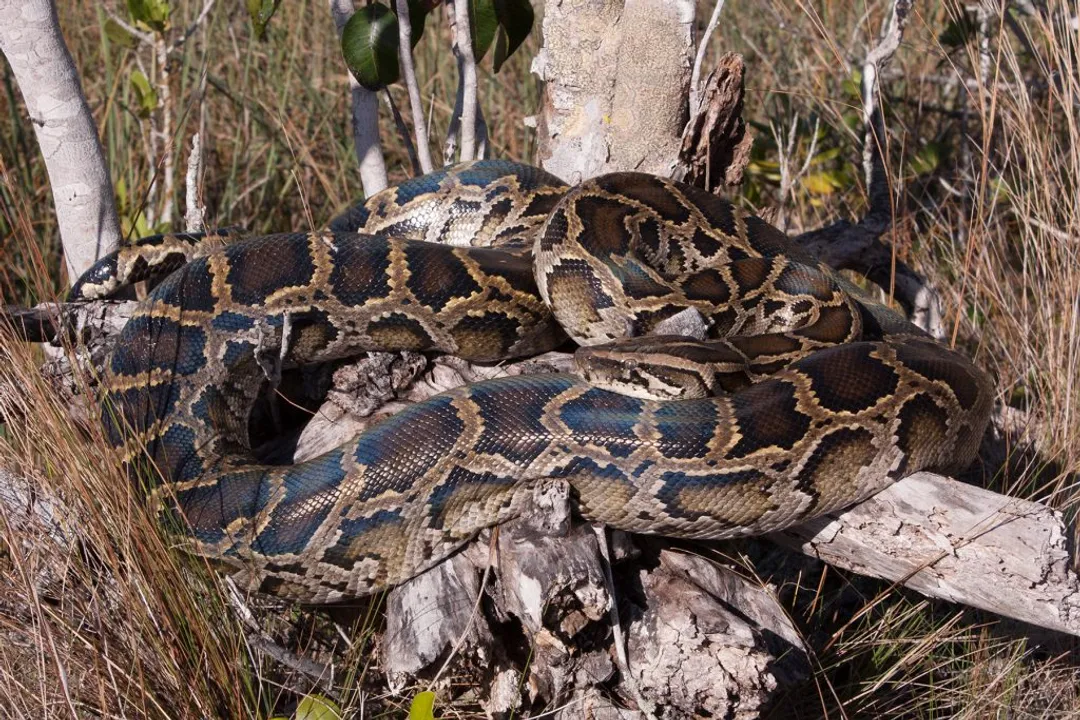
Pythons are considered primitive snakes due to several physical remnants reflecting ancient lineage. One of the most notable manifestations of this primitivism is the retention of two functional lungs, whereas most other snake species have evolved to possess only one lung. This suggests a different evolutionary trajectory for their respiratory system compared to more derived serpentine forms. Additionally, they exhibit vestigial hind limbs and associated pelvic bones, visible externally as small spurs near the cloaca. While they are apex ambush predators whose hunting method relies on strength, the dual-lung structure is a key indicator of their primitive classification within the serpentine order.
Related Questions
What anatomical feature marks pythons as primitive snakes compared to many other serpentine species?What specific outcome results from the python's constriction method on its prey, rather than crushing bones?Where are the specialized heat-sensing pits, which function as infrared receptors, typically located on a python?How is the characteristic pattern of the Burmese python (*Python bivittatus*) described regarding its base color and markings?How does the reproductive strategy of pythons fundamentally differ from that of their close relatives, the boas?Which python species is specifically cited in the text as being the longest known, with reports reaching 10 meters?What specialized anatomical adaptation prevents suffocation when a python swallows prey considerably wider than its own head?What physical defense mechanism lends the Ball or Royal Python (*Python regius*) its common name?Since pythons lack true eyelids, what structure protects the eye and is removed during the skin shedding process?How many rows of sharp, backward-curving teeth are present in the python's upper jaw designed for gripping prey?