What habitat feature is strongly associated with the Water Python (*L. fuscus*) that helps differentiate it from *L. olivaceus*?
Answer
Permanent water bodies such as swamps, rivers, and coastal areas
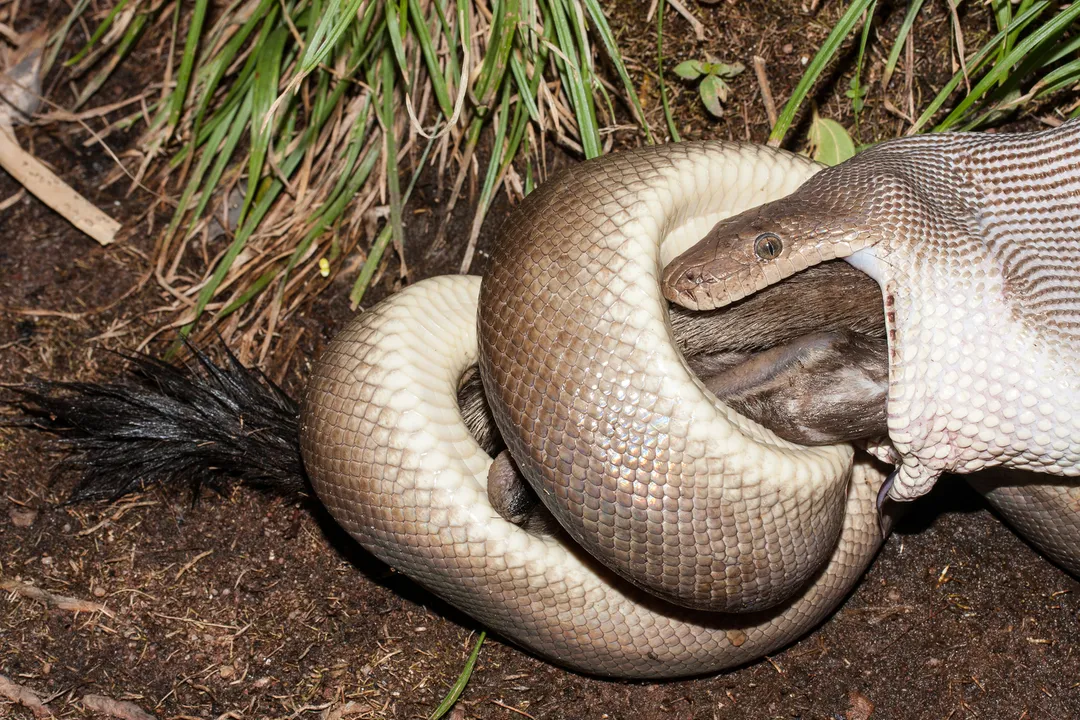
The primary habitat association serves as a crucial identifier between these two large constrictors. The Water Python (*Liasis fuscus*) is intrinsically tied to aquatic environments, relying on permanent water bodies like swamps, rivers, and coastal margins for its existence. In contrast, the Olive Python (*Liasis olivaceus*) is significantly more adaptable, thriving in dry, rocky terrains and arid savannas, and while it will drink, its core survival does not depend on proximity to permanent, deep water. Therefore, finding a large snake swimming or coiled directly at the edge of a swamp strongly points toward *L. fuscus*.
Related Questions
What is the scientific classification provided for the Olive Python?What is the typical length range observed for adult male Olive Pythons?What characteristic coloration is typically seen in Olive Pythons from arid regions like the Pilbara subspecies?According to examination of head scales, how many supralabial scales do Olive Pythons typically have?How does the coloration distribution of the Olive Python generally contrast with the Water Python's patterning?What habitat feature is strongly associated with the Water Python (*L. fuscus*) that helps differentiate it from *L. olivaceus*?Why is the Pilbara Olive Python significantly paler than its tropical northern counterparts?How is the physical build of the Olive Python described when compared directly to the Water Python?What structural characteristic is used to describe the typical snout profile of the Olive Python?What specific behavioral clue related to elevation strongly favors identifying a snake as an Olive Python?