What characteristic coloration is typically seen in Olive Pythons from arid regions like the Pilbara subspecies?
Answer
A much paler, lighter tan or yellowish-brown base color
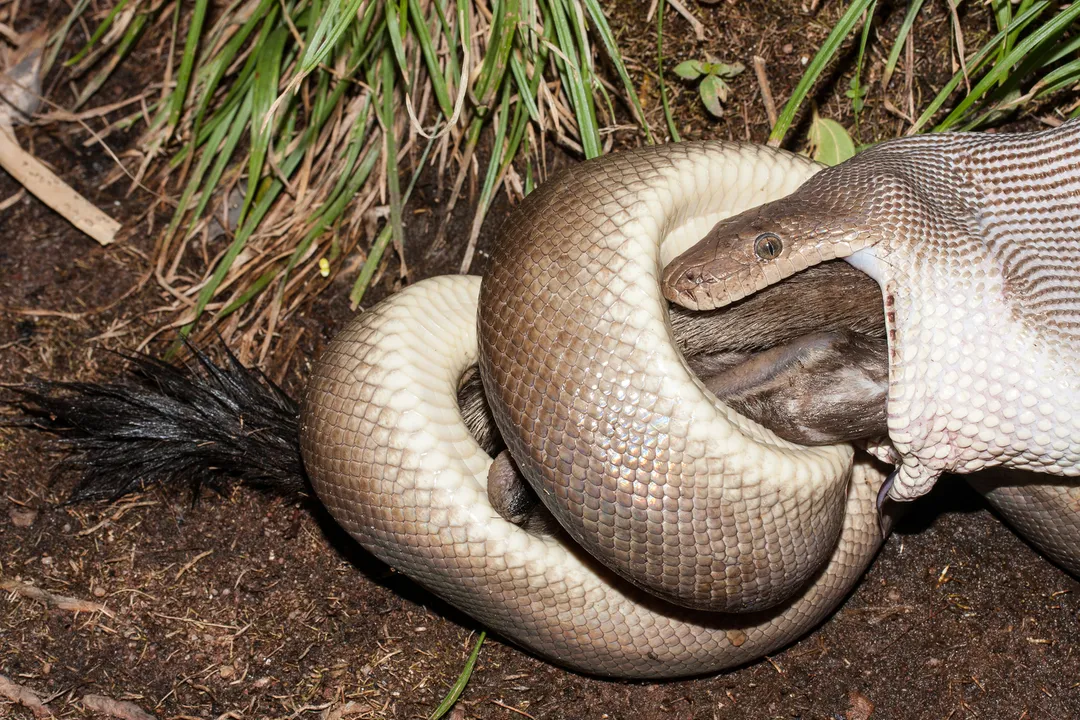
The coloration of the Olive Python is highly variable depending on its specific environment. While the common name suggests an olive-brown or olive-green shade, individuals inhabiting arid zones, exemplified by the Pilbara subspecies, develop a significantly different appearance. These desert-dwelling snakes often exhibit a base color leaning towards light tan, pale brown, or even sandy yellow. This adaptation allows them to achieve near-perfect camouflage within the rocky, sparsely vegetated terrain characteristic of the remote northwest of Western Australia, contrasting sharply with the darker morphs found in wetter, tropical habitats.
Related Questions
What is the scientific classification provided for the Olive Python?What is the typical length range observed for adult male Olive Pythons?What characteristic coloration is typically seen in Olive Pythons from arid regions like the Pilbara subspecies?According to examination of head scales, how many supralabial scales do Olive Pythons typically have?How does the coloration distribution of the Olive Python generally contrast with the Water Python's patterning?What habitat feature is strongly associated with the Water Python (*L. fuscus*) that helps differentiate it from *L. olivaceus*?Why is the Pilbara Olive Python significantly paler than its tropical northern counterparts?How is the physical build of the Olive Python described when compared directly to the Water Python?What structural characteristic is used to describe the typical snout profile of the Olive Python?What specific behavioral clue related to elevation strongly favors identifying a snake as an Olive Python?