What morphological feature helps distinguish *T. albacares* from a Skipjack (*Katsuwonus pelamis*) for regulatory use?
Answer
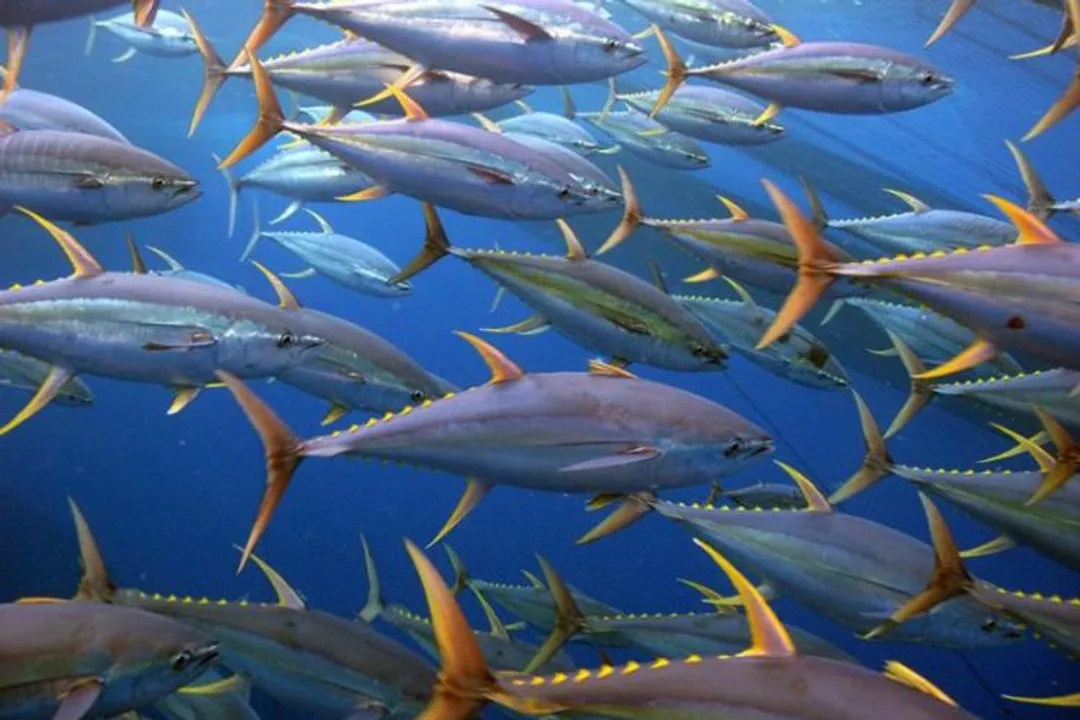
The presence of a dark lateral line and distinctive yellow fins.
For regulatory and management purposes, authorities rely on specific, visually identifiable physical characteristics to differentiate species. The text specifies that the features helping distinguish *Thunnus albacares* from the related Skipjack (*Katsuwonus pelamis*) include the presence of a dark lateral line along its side and the bright, brilliant yellow coloration of its fins and finlets. While the classification details (Genus *Thunnus*) and physiological traits (warm-bodied) are crucial for understanding its ecology, the visible morphological details are what facilitate practical identification in fisheries management contexts.
Related Questions
What class defines the Yellowfin Tuna, *Thunnus albacares*, by its fin structure?Which family groups the Yellowfin Tuna with mackerels and bonitos?What physiological adaptation primarily defines membership within the Genus *Thunnus*?What is the approximate Latin translation of the Yellowfin Tuna species name *albacares*?What feature characterizes membership in Phylum Chordata for *T. albacares* during development?What distinguishes the placement of *T. albacares* within the Order Perciformes?Which historical synonym was applied to what is now recognized as *Thunnus albacares*?What criteria define membership in Kingdom Animalia for the Yellowfin Tuna?What morphological feature helps distinguish *T. albacares* from a Skipjack (*Katsuwonus pelamis*) for regulatory use?How is the global distribution of *Thunnus albacares* generally described in relation to water temperature zones?