What is the classification of a bluefin tuna?
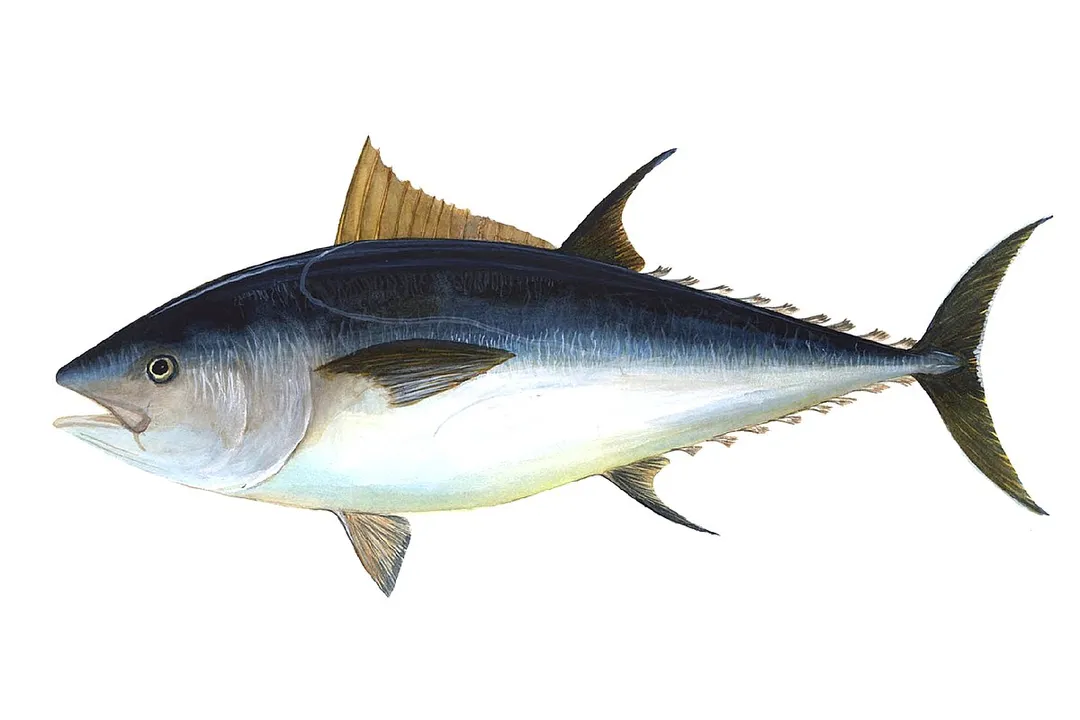
The classification of any creature, particularly one as magnificent and widely pursued as the bluefin tuna, places it precisely within the sprawling tree of life. For general readers, this fish is simply the bluefin, a powerhouse of the ocean often associated with the finest cuts of raw fish cuisine. However, scientifically, the term "bluefin tuna" refers not to a single entity but to a trio of highly migratory species, all grouped under the genus Thunnus. [5][9] To truly understand them, one must examine the Linnaean hierarchy that defines their place in the aquatic world.
At the broadest level, the bluefin tuna belongs to the Kingdom Animalia, [1][10] signifying they are multicellular, heterotrophic organisms. Following this, they reside in the Phylum Chordata, [1][7][10] a group characterized by having a notochord at some stage of development—a feature later replaced by the backbone in these vertebrates. Their placement within the Class Actinopterygii confirms their identity as ray-finned fishes, a vast class encompassing most modern bony fish. [1][4][7][10]
# Order Placement

The next step down into the order level reveals some nuance in scientific grouping depending on the authority consulted. Many major taxonomic databases, such as the World Register of Marine Species (WoRMS), place bluefin tuna within the Order Scombriformes. [1][4][7] Conversely, other authoritative sources like the Florida Museum of Natural History and OBIS-SEAMAP list them within the Order Perciformes, and more specifically, the Suborder Scombroidei. [3][5][8][10] This variation at the order level reflects ongoing scientific discussion and the historical reorganization of fish taxonomy. Regardless of the precise order designation, their placement leads them inexorably toward their immediate family.
# Family Traits
The defining grouping for all bluefin is their Family: Scombridae. [1][4][8][10] This family is commonly known as the mackerels, tunas, and bonitos, a grouping that immediately signals several shared, highly specialized biological characteristics. Members of Scombridae, especially the larger tunas, possess an astonishing capacity for sustained speed. This is physically manifested in their fusiform or torpedo-shaped body, the most accurate description of their hydrodynamic design. [5][6] This physical adaptation, combined with their highly efficient circulatory system—including one of the highest blood-hemoglobin concentrations among fish—allows for rapid oxygen delivery to the tissues. [4] This leads directly to an original point regarding their success: while all members of the tuna family are considered warm-blooded, or endothermic, [4][10] the bluefin tuna’s ability to thermoregulate is perhaps the most highly developed among its relatives. [4] This physiological advantage allows them to exploit richer, colder waters across vast oceanic distances, directly enabling the wide-ranging migratory life histories that necessitate international management efforts. [4]
Within Scombridae, the bluefin species are further categorized into the Subfamily Scombrinae, [1] and then into the genus that defines them: Genus Thunnus. [1][4][8][10]

# Three Species
The classification of the "bluefin tuna" breaks down into three distinct, recognized species, each primarily associated with different ocean basins:
- Thunnus thynnus: The Atlantic Bluefin Tuna. [4][8]
- Thunnus orientalis: The Pacific Bluefin Tuna. [2][9]
- Thunnus maccoyii: The Southern Bluefin Tuna. [4]
These distinctions are crucial for conservation and management, as each stock is managed separately by Regional Fisheries Management Organizations (RFMOs). [2][8]
# Atlantic Lineage
The Atlantic Bluefin Tuna, scientifically Thunnus thynnus (Linnaeus, 1758), is often referred to as the northern bluefin tuna, especially when the Pacific species was historically included under the same umbrella. [4] This species is native to both the western and eastern Atlantic Oceans, including the Mediterranean Sea. [4][8] In the western Atlantic, its range extends from Newfoundland down to the Gulf of Mexico. [3][8] Biologically, the Atlantic bluefin is renowned as the largest of the three species, with recorded weights rivaling 679 kg (1,497 lb) [4] and documented maximums reaching up to 910 kg (2,010 lb) in some reports. [4] Their appearance is defined by a dark blue-black back, silvery white lower sides, and distinctive colorless lines alternating with rows of colorless spots on their lower sides. [4][8]
# Pacific Divergence
The Pacific Bluefin Tuna, Thunnus orientalis (Temminck & Schlegel, 1844), shares a close evolutionary relationship with the Atlantic species, though they are recognized as distinct. [4] For many years, scientists viewed them as either the same species or as subspecies grouped under the single name "northern bluefin tuna". [4] Pacific bluefin is generally smaller than its Atlantic cousin, typically ranging between 80–200 cm in length. [2] Its geographic range is expansive across the North Pacific, spanning from East Asia to the North American West Coast. [2][6] This species is noteworthy for having the largest geographic distribution of all tunas. [2] Its conservation status is currently listed as Near Threatened (NT) according to a recent IUCN assessment. [9]
# Southern Split
The third species, the Southern Bluefin Tuna (Thunnus maccoyii), presents a fascinating case study in taxonomy and evolution. Historically, T. thynnus was often treated as encompassing the southern variety as a subspecies, T. thynnus thynnus, but modern understanding separates them. [4][1] Crucially, genetic studies suggest that the Southern bluefin is more distantly related to the Atlantic and Pacific species, with the morphological similarities observed being a result of convergent evolution—meaning similar adaptations developed independently due to similar environmental pressures, rather than shared recent ancestry. [4] This means that while they share the genus Thunnus, their evolutionary paths diverged significantly enough to warrant separate species status. [4]
This leads to an original insight: the evolutionary relationship within the Thunnus genus is not a simple linear split. The fact that Southern bluefin’s similarities to the northern species are attributed to convergent evolution, rather than direct lineage, underscores a key challenge in classifying highly adapted pelagic predators. Their need to survive in cold, open ocean environments drives similar body plans across distinct evolutionary branches, making pure morphological assessment insufficient without modern genetic verification.

# Scientific History
The naming of the Atlantic bluefin dates back to Carl Linnaeus in 1758, who originally described it as Scomber thynnus. [4][8] Over time, it was reclassified into various names, including Thynnus thynnus and Thunnus vulgaris, before Jordan and Evermann settled it into the currently accepted Genus Thunnus in 1896. [8] The recognition of the Atlantic and Pacific fish as truly separate species is a relatively recent scientific development. [2] The common name "tuna," derived from the Spanish atún, replaced older monikers like "tunny" in widespread use across the English-speaking world. [4][8]
# Classification Comparisons
To clearly distinguish these closely related, yet geographically and often genetically separate, species, it is helpful to summarize the taxonomic placement alongside key identifiers:
| Rank | Classification | T. thynnus (Atlantic) | T. orientalis (Pacific) | T. maccoyii (Southern) |
|---|---|---|---|---|
| Kingdom | Animalia | Animalia | Animalia | Animalia |
| Phylum | Chordata | Chordata | Chordata | Chordata |
| Family | Scombridae | Scombridae | Scombridae | Scombridae |
| Genus | Thunnus | Thunnus | Thunnus | Thunnus |
| Species | Accepted Name | T. thynnus | T. orientalis | T. maccoyii |
| Noted Range | Ocean | Atlantic/Mediterranean | Pacific | Southern Hemisphere |
| Relative Closeness | N/A | Closest to Pacific [4] | Closest to Atlantic [4] | More distant; convergent evolution [4] |
| Size Ranking | N/A | Largest [3][8] | Generally Smaller [2] | Generally Smallest [5] |
# Physiological Context
The classification within Thunnus also defines shared, high-level physiological traits that govern their ecology. For instance, the Atlantic bluefin uses a countercurrent exchange system in a structure called the rete mirabile to keep its core muscles warm against cold water—an adaptation that underpins its ability to dominate colder regions. [4] This ability to elevate body temperature above ambient water temperature, a characteristic shared by the family but highly developed in bluefin, is a critical biological feature tied directly to their position within the Scombridae family and their resulting ecological success as apex predators. [4][10]
This classification system, from the broad class of ray-finned fish down to the species level, is more than just an exercise in naming; it is a practical tool for management. Because T. thynnus spawns in the Gulf of Mexico and the Mediterranean, its management requires cooperation between bodies like NOAA Fisheries and the International Commission for the Conservation of Atlantic Tunas (ICCAT). [3][4] The Pacific species, meanwhile, falls under the jurisdiction of the Western and Central Pacific Fisheries Commission (WCPFC) and the Inter-American Tropical Tuna Commission (IATTC). [2] The very different conservation histories and management structures applied to T. thynnus and T. orientalis highlight how assigning them to separate species, rather than treating them as mere regional variants, is essential for tailored, effective conservation strategies across the globe. [2][4] If they were still universally lumped as one "northern bluefin," regulatory coherence across oceans would be nearly impossible.
# Habitat Grouping
Beyond the strict taxonomic hierarchy, bluefin tuna share several ecological classifications that describe how they live, reinforcing their family ties. They are uniformly classified as pelagic oceanic species, [1][5][8] meaning they inhabit the open ocean away from the sea floor, though they may seasonally approach coastal areas. [5][8] They are considered oceanodromous, [9] making extensive, long-distance migrations throughout their lives. [3][4][10] Their habitat preference is largely dictated by temperature tolerance, spanning tropical to temperate zones, [2][6][10] a trait facilitated by their internal heating mechanisms. [4] This need for vast, open space is why their classification dictates the need for international regulatory bodies rather than localized management alone. [4][8]
# Conclusion
The classification of bluefin tuna is a layered system that moves from the Kingdom Animalia down through the recognized species: Thunnus thynnus, T. orientalis, and T. maccoyii. Understanding these distinctions—especially the evolutionary divergence of the Southern species—is fundamental to appreciating their biology and the regulatory challenges they present. Their shared membership in the Scombridae family explains their magnificent, torpedo-shaped bodies and their superior physiological adaptations, such as high blood oxygen capacity and endothermy, which permit them to dominate the world's oceans and undertake the epic migrations that define them as creatures of classification and consequence. [4][10]
Related Questions
#Citations
Atlantic bluefin tuna - Wikipedia
Western Atlantic Bluefin Tuna | NOAA Fisheries
Atlantic bluefin tuna - Thunnus thynnus - OBIS-SEAMAP
Bluefin Tuna – Discover Fishes - Florida Museum of Natural History
Species Spotlight: Bluefin Tuna - AFTCO
Thunnus thynnus | NatureServe Explorer
Pacific Bluefin - International Seafood Sustainability Foundation
World Register of Marine Species - Thunnus thynnus (Linnaeus, 1758)
Thunnus orientalis, Pacific bluefin tuna - FishBase
Thunnus thynnus (horse mackerel) - Animal Diversity Web