What is the specific ecological niche the Yellowthroat employs when foraging for insects and spiders?
Answer
Foliage gleaning among dense, low vegetation like reeds and cattails
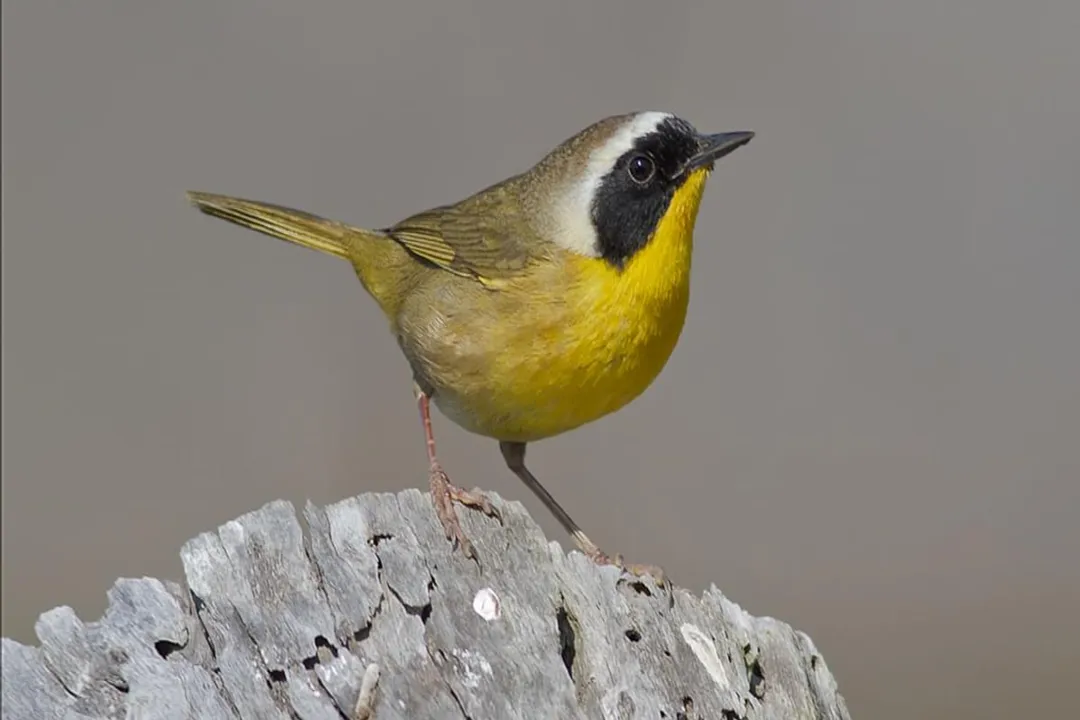
The bird's placement in the genus *Geothlypis* (ground-loving) directly reflects its foraging strategy and preferred habitat. These warblers are characterized as foliage gleaners. They pick insects and spiders off leaves, bark, and flowers, but crucially, they do this exclusively near the ground, utilizing dense, low cover such as cattails, reeds, and thickets at wetland edges. They are explicitly described as being non-canopy birds, confirming their reliance on the lower stratum of vegetation for sustenance.
Related Questions
Which warblers were transferred into the genus *Geothlypis* from *Oporornis* based on modern molecular studies?What do the Ancient Greek roots *geo-* and *thlupis* suggest about the nature of *Geothlypis*?What specific physical characteristic defines the male Common Yellowthroat (*G. trichas*) in comparison to relatives?What ecological situation causes conservation concern for the San Francisco Yellowthroat subspecies?How does the reproductive strategy of *G. trichas* expose it to terrestrial threats and brood parasitism?What characteristic song is used to identify *Geothlypis trichas* near marsh reeds?What was the original Linnaean designation, or protonym, for the Yellowthroat before its placement in *Geothlypis*?What primary evolutionary driver leads to the taxonomic instability seen between 12 and 15 recognized species within *Geothlypis*?What is the specific ecological niche the Yellowthroat employs when foraging for insects and spiders?What IUCN conservation listing does the global population of *G. trichas* currently hold, despite local decline issues?Which specific order classification places the Yellowthroat among the perching birds of North America?