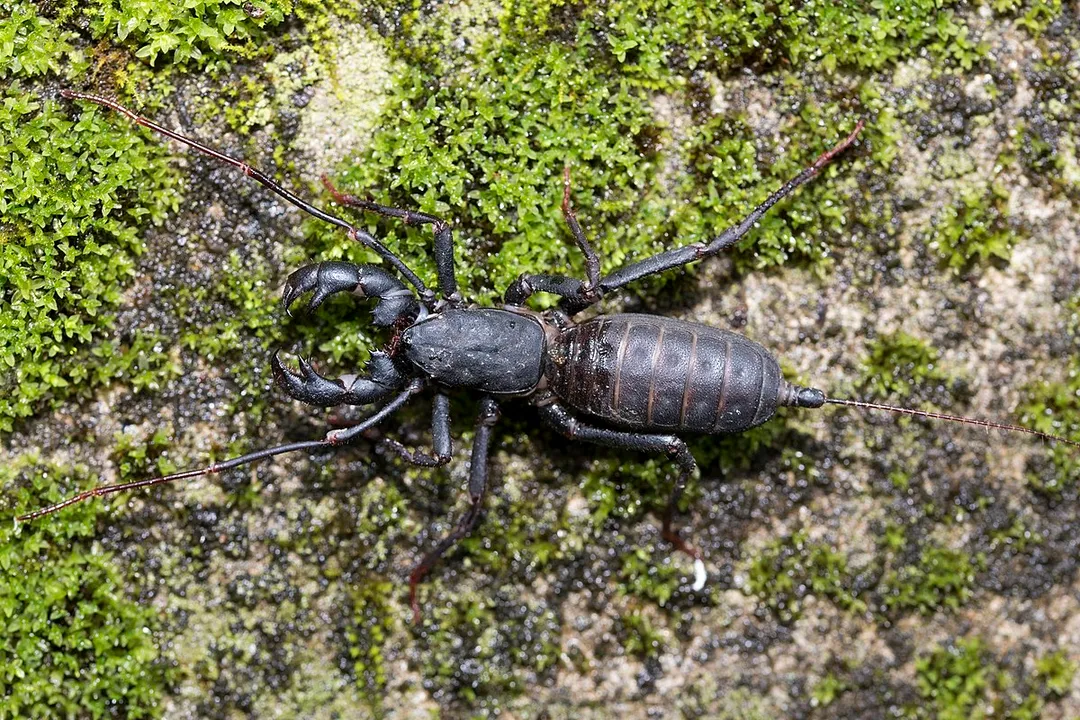
What anatomical structures do vinegaroons use to seize and crush their prey?
Answer
Powerful pedipalps
Vinegaroons rely on their robust, raptorial pedipalps to capture and secure prey. Once an arthropod prey item is caught, the vinegaroon uses these appendages to crush or chew it before consumption. This method of predation highlights their reliance on physical strength and specialized mouthparts rather than the delivery of venom, which is a common strategy in other predatory arachnids.
Related Questions
To which biological kingdom does the creature known as the vinegaroon belong?What specific class of animals includes vinegaroons?Which modern scientific order classification is used for the vinegaroon?What chemical substance is primarily released by a vinegaroon as a defensive mechanism?What is the name of the whip-like appendage found at the rear of a vinegaroon abdomen?Which genus contains the species Mastigoproctus giganteus, commonly known as the giant vinegaroon?How many body segments do vinegaroons possess, distinguishing them from insects?What anatomical structures do vinegaroons use to seize and crush their prey?What does the Latinate term giganteus in the scientific name Mastigoproctus giganteus refer to?What evolutionary niche do vinegaroons occupy within terrestrial environments?