If modeling a BFU of 100 for a comparable skull architecture, what was Thylacoleo's consistent relative bite force unit (BFU)?
Answer
A BFU of well over 100 relative to its smaller mass.
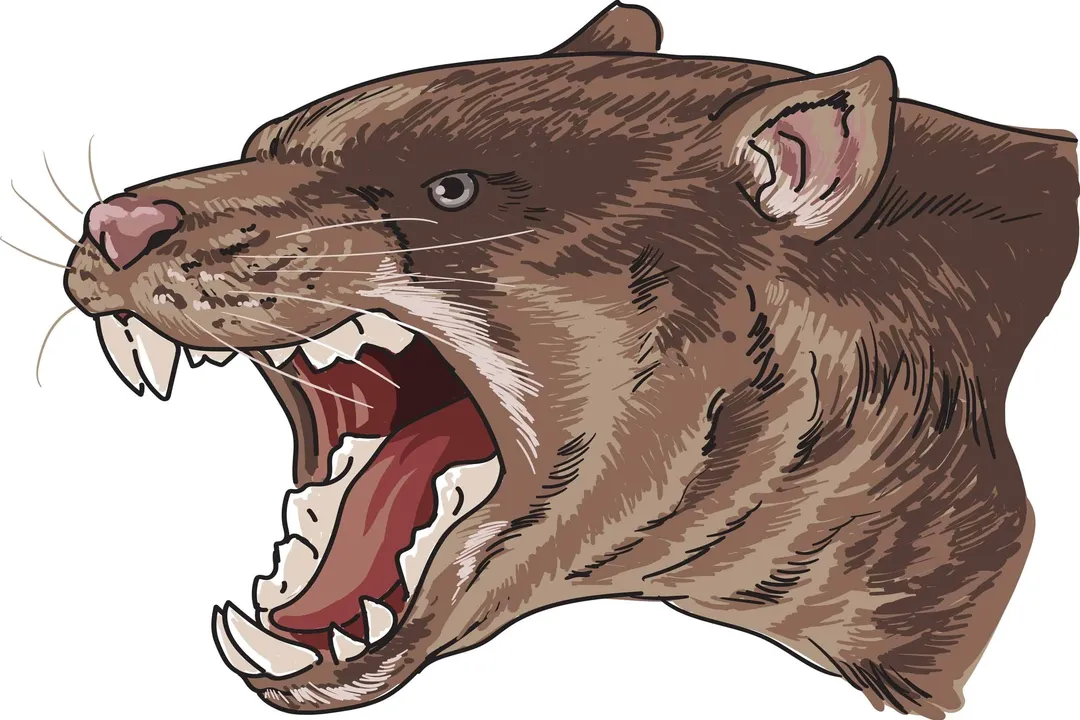
To illustrate the extreme mechanical efficiency achieved by Thylacoleo, researchers utilized conceptual scaling comparisons. If a hypothetical bite force unit (BFU) of 100 is assigned to a large modern predator with a similar general skull style, Thylacoleo consistently modeled to achieve a BFU significantly higher than that benchmark, despite its smaller physical stature. This concept demonstrates that the structural advantages—the mechanical leverage and efficient muscle channeling—translated an average muscular contraction into an exceptional output force concentrated precisely at the teeth. This result solidifies its position as an outlier in mammalian biting specialization.
Related Questions
How did Thylacoleo carnifex's dentition differ from slicing canines typical of modern cats?What trace fossils provide undeniable proof of Thylacoleo's bone-crushing capability?What critical metric highlights Thylacoleo's extraordinary bite performance relative to its size?What evolutionary principle explains the parallel development of powerful biting traits in Thylacoleo and placental carnivores?What functional structure allowed Thylacoleo's jaw musculature to translate force effectively into crushing impact?What material advantage did Thylacoleo gain by accessing nutrient-rich marrow via bone fracture?Which feature attached to the skull maximized leverage for Thylacoleo's clamp-down effect?To what extant bone-crushing specialist were Thylacoleo's bite force estimates sometimes compared?What was the primary goal of Thylacoleo's bite strategy, contrasted with prolonged grappling predators?If modeling a BFU of 100 for a comparable skull architecture, what was Thylacoleo's consistent relative bite force unit (BFU)?