How were the small, plate-like sclerites arranged across the dorsal surface of *Wiwaxia*?
Answer
In an overlapping or imbricated fashion, similar to roof shingles.
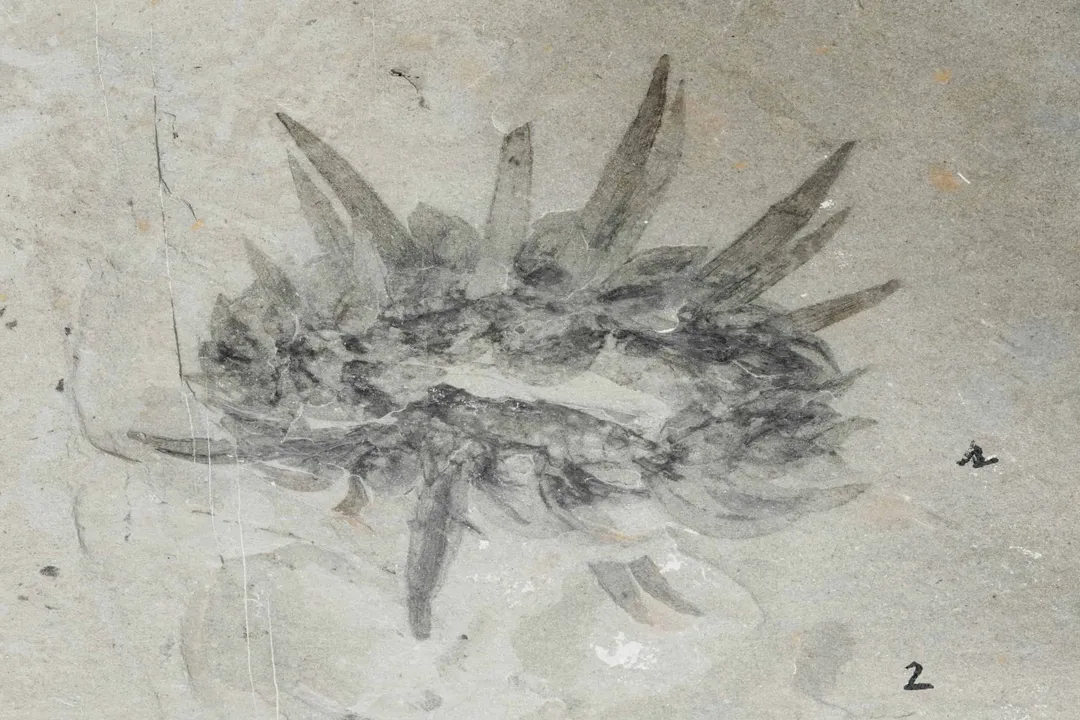
The protective layer on the back of *Wiwaxia* consisted of numerous small sclerites that were not merely laid side-by-side. Instead, their effectiveness as a shield came from their specific structural arrangement. These plate-like elements were organized in an overlapping manner, described precisely as being imbricated. This arrangement functions similarly to roof shingles, where one plate covers the edge of the one beneath it, creating an efficient, tightly bound barrier across the animal's entire upper body surface without leaving gaps vulnerable to predators.
Related Questions
What is the recognized pronunciation for the organism *Wiwaxia*?What characterizes the fundamental difference between the dorsal and ventral surfaces of *Wiwaxia*?What is the determined composition of the small, plate-like sclerites covering the dorsal surface of *Wiwaxia*?How were the prominent, curved spines arranged on the dorsal covering of *Wiwaxia*?What function is attributed to the two distinctive, crescent-shaped structures near the anterior region of *Wiwaxia*?What is the typical measured size range for most known specimens of *Wiwaxia* recovered?From which renowned fossil deposit and period do fossils of *Wiwaxia* originate?Based on its morphology, what lifestyle is strongly suggested for *Wiwaxia*?How did *Wiwaxia*'s protective plates differ fundamentally from those found on early arthropods like *Marrella*?What classification term is used to describe *Wiwaxia* due to the difficulty in pinpointing its evolutionary relationships?How were the small, plate-like sclerites arranged across the dorsal surface of *Wiwaxia*?