White Sturgeon Scientific Classification
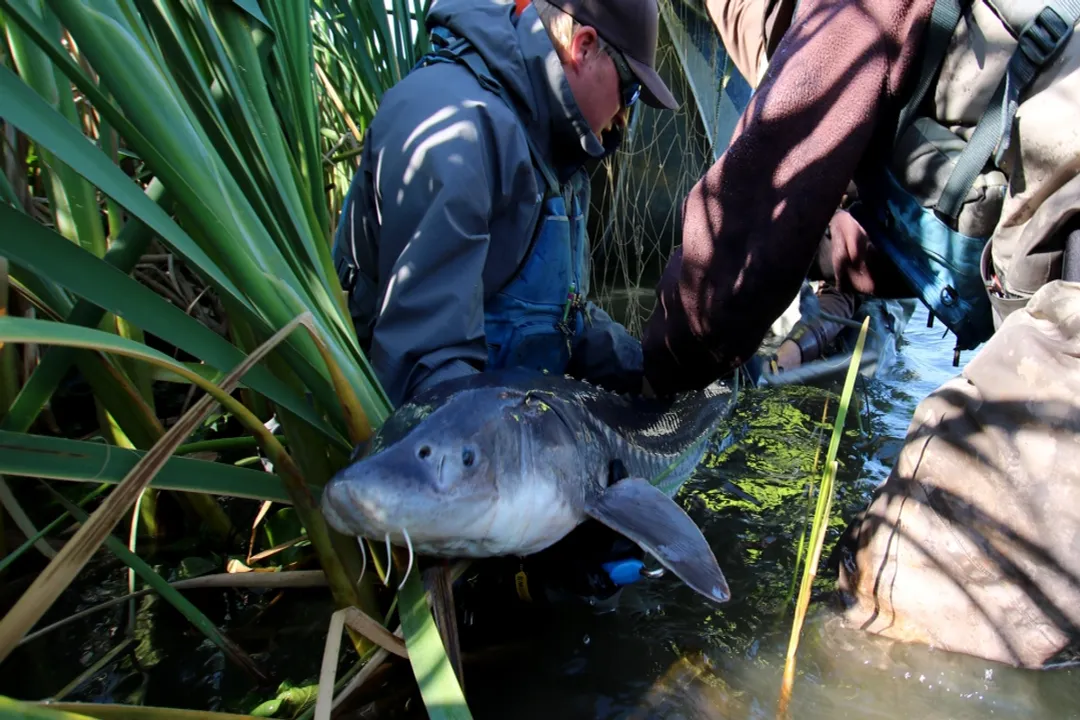
The scientific classification of the White Sturgeon, Acipenser transmontanus, places this massive, ancient fish within a highly distinct lineage of freshwater and anadromous species. Understanding its taxonomy reveals not just its closest relatives, but also hints at its remarkable evolutionary history and unique biological characteristics. [2][8] At the broadest level, the White Sturgeon belongs to the Kingdom Animalia, signifying it is a multicellular, heterotrophic organism. [1][2][5] This immediately separates it from plants, fungi, and microorganisms.
# Phylum Status
Moving deeper, the White Sturgeon fits into the Phylum Chordata. [1][2][5] This phylum is characterized by the presence of a notochord, a dorsal hollow nerve cord, pharyngeal slits, and a post-anal tail at some stage of development. [1] Within Chordata, it resides in the Subphylum Vertebrata, confirming it possesses a backbone, a feature that belies its cartilaginous-appearing skeleton composed largely of bony plates called scutes. [2]
# Fish Class
The Class designation for the White Sturgeon is Actinopterygii. [1][2][5] Members of this class are commonly known as ray-finned fishes, distinguished by fins supported by bony spines or rays. [1][5] This places it among the vast majority of living fish species, though the sturgeon's primitive body structure sets it apart from more derived bony fishes. Its body structure, featuring five rows of these bony plates, or scutes, running along its body—dorsal, lateral, and ventral—is a key distinguishing characteristic of its group. [2][9]
# Order Group
The Order level is where the sturgeon family truly begins to distinguish itself. The White Sturgeon is part of the Order Acipenseriformes. [1][2][5] This order contains the sturgeons and paddlefishes, groups renowned for retaining many primitive characteristics. Their lineage traces back to the Mesozoic Era, meaning the White Sturgeon shares a common ancestry with organisms that swam alongside dinosaurs. [2] This deep evolutionary history explains their longevity and slow maturation rates, often living for many decades and taking over a decade to reach sexual maturity. [2][9]
# Family Traits
Within Acipenseriformes, the White Sturgeon is placed in the Family Acipenseridae, which includes all true sturgeons. [1][2][5] Sturgeons are distinct from paddlefishes due to differences in their snout shape and their barbels, which are located in front of the mouth rather than behind it. [2] Key features that define the Acipenseridae family, and thus the White Sturgeon, include:
- An elongated, somewhat flattened body shape. [2]
- A heterocercal tail (the vertebral column extends into the upper lobe of the tail fin). [2]
- A lack of scales; instead, they possess the characteristic five rows of bony scutes. [2][9]
- A protrusible, jawless mouth on the underside of the head, used for bottom feeding. [2]
The genus Acipenser unites several species of sturgeons, including the White Sturgeon. [1][2][5][8] When considering the classification, it is interesting to note that the White Sturgeon has been historically referred to by other scientific names, such as Acipenser acutirostris, though Acipenser transmontanus is the currently accepted binomial nomenclature. [2][8] This historical naming variation underscores the challenges in definitively classifying ancient, wide-ranging species based on morphology alone. [2]

# Distribution Synonyms
While the core taxonomy remains stable, the common names used across its range demonstrate how geography influences public identification. In North America, it is recognized as the White Sturgeon, [5][6][9] but sometimes also as the Sacramento Sturgeon. [2] Its native range spans the Pacific coast from the Aleutian Islands in Alaska down to the San Joaquin-Sacramento-Delta in California, and it inhabits major river systems like the Columbia and Fraser Rivers. [2][4][5]
An observation that emerges when comparing regional data is how regulatory bodies have carved up the species’ range for conservation purposes, often leading to differing conservation statuses that reflect localized population health. For instance, the status assigned by the Idaho Department of Fish and Game might label the species as Threatened within state waters, [1] while the California Department of Fish and Wildlife lists the species as Endangered within state boundaries. [3][4] Similarly, in British Columbia, populations like those in the Fraser River are designated as Endangered. [5] This patchwork approach, where a single species classification (A. transmontanus) is subject to varied state or provincial legal interpretations, highlights the ecological fragmentation these long-lived fish face.
# Conservation Ranks
The global conservation standing, as assessed by NatureServe, generally classifies Acipenser transmontanus as G3, meaning it is Vulnerable globally. [7] However, this global ranking masks significant regional variation in status assessments, which are often reflected in state or provincial codes (S-ranks). [7] For example, while some jurisdictions list it as threatened or endangered based on local population trends and historical depletion, the overall species viability is deemed vulnerable. [7] This G3 status, coupled with its classification within the ancient Acipenseriformes order, suggests that while the species can persist, its low reproductive output and vulnerability to habitat change make recovery inherently slow—a biological reality often missed when only looking at the most recent fishing regulations or single-state listings. [2][9]

# Distinctive Features
The unique combination of its classification places the White Sturgeon in an interesting biological position. It is the largest freshwater fish in North America. [2][9] Its immense size potential—reaching lengths over 20 feet and weights exceeding 1,500 pounds—is a direct biological consequence of its placement within the ancient, slow-growing Acipenseriformes order. [2][9] Unlike many modern bony fish, the White Sturgeon retains a mostly cartilaginous skeleton, and its long lifespan, which can approach or exceed 100 years, means that reproductive success is tied to decades-long survival, a trait that makes populations extremely slow to rebound from overfishing or habitat loss.
When examining its diet, the classification as a bottom feeder is evident in its morphology. Its placement of four sensory barbels anterior to its mouth allows it to detect food buried in the substrate—crayfish, worms, and small fish—before drawing the food into its toothless, vacuum-like mouth. [2] This specialized feeding apparatus confirms its role as an opportunistic benthic predator within its ecosystem, a role dictated by its evolutionary placement within the Acipenseridae family.
This detailed look at the White Sturgeon’s scientific classification—from Kingdom Animalia down to Acipenser transmontanus—shows a creature adapted for an ancient world, whose modern challenges are reflected in the varied, jurisdiction-specific conservation statuses applied across its remaining habitats. [1][3][5][7] It is a living fossil whose Linnaean placement tells a story of resilience and deep time.
Related Questions
#Citations
Acipenser transmontanus (White Sturgeon) - Idaho Fish and Game
Acipenser transmontanus (Oregon sturgeon) - Animal Diversity Web
White Sturgeon Enhanced Status Report - CA Marine Species Portal
White Sturgeon (Acipenser transmontanus) | U.S. Fish & Wildlife ...
Acipenser transmontanus White Sturgeon - Species Summary
White sturgeon | Washington Department of Fish & Wildlife
Acipenser transmontanus | NatureServe Explorer
Acipenser transmontanus, White sturgeon - FishBase
White sturgeon (Acipenser transmontanus)