White Butterfly Scientific Classification
The simple, often ubiquitous white butterfly flitting over gardens and fields is, in most cases, the Cabbage White, known scientifically as Pieris rapae. [1][3] Its seemingly unremarkable appearance belies a fascinating and complex scientific placement within the vast tree of life. Understanding this classification is key to appreciating its biology, its historical spread across the globe, and its economic impact on agriculture. [2] To truly know this insect, we must trace its lineage through the established ranks of taxonomy, starting from the broadest grouping down to its specific species designation.
# The Hierarchy
The scientific classification system, devised by Carl Linnaeus, organizes life into nested ranks. For Pieris rapae, this descent reveals its closest relatives and fundamental characteristics. [7]
The organism begins in the Kingdom Animalia, placing it among multicellular, heterotrophic organisms that typically lack cell walls. [1] Moving down, it belongs to the Phylum Arthropoda, the invertebrate group characterized by segmented bodies, jointed appendages, and an exoskeleton. [1] This massive phylum encompasses insects, spiders, and crustaceans. Within Arthropoda, the class Insecta is reached, defined by having three body parts (head, thorax, abdomen), six legs, and usually one or two pairs of wings in the adult stage. [1]
The order Lepidoptera is a critical grouping, meaning "scale-winged". [1] This is the order that includes all butterflies and moths. A defining feature here is that their wings are covered in thousands of minute, overlapping scales, which provide color and structure—a characteristic that separates them from other flying insects. [1]
# Family Placement
The next step places the Cabbage White into the family Pieridae. [1][7] This family is commonly known as the "Whites and Sulphurs". [7][8] This grouping immediately suggests a close relationship with the yellow and orange butterflies often seen alongside them, such as the Clouded Sulphur (Colias philodice). [8] While the common name implies simplicity, the physical traits uniting the Pieridae family are more specific than just color—it relates to wing venation patterns and larval feeding habits. [7] For example, many members of this family are noted for utilizing plants in the mustard family (Brassicaceae) as host plants for their larvae. [1][9]
# Genus Definition
The genus level, Pieris, narrows the focus considerably. [1][7] Butterflies within the Pieris genus are generally medium-sized white butterflies. [7] This genus differentiates itself from other whites and sulphurs by specific structural features, often relating to the shape of the forewing apex or the pattern of dark markings on the wings. [7] It is within this genus that we find the key distinction for the Cabbage White versus its close relatives, such as the Large White (Pieris brassicae) or various North American native whites. [1]
# The Species Identity
The final, unique identifier is the species name: Pieris rapae. [1] The specific epithet, rapae, is derived from the Latin word for turnip or rape (a type of brassica), directly referencing its primary host plant, the cabbage, or plants in the Brassica genus. [9] This naming convention provides immediate ecological context, something not always obvious when looking at the higher, more abstract ranks like Kingdom or Phylum. [9]
| Taxonomic Rank | Classification for Pieris rapae | Defining Characteristic |
|---|---|---|
| Kingdom | Animalia | Multicellular, heterotrophic |
| Phylum | Arthropoda | Segmented body, jointed limbs, exoskeleton |
| Class | Insecta | Three body parts, six legs, wings |
| Order | Lepidoptera | Scale-covered wings |
| Family | Pieridae | Whites and Sulphurs |
| Genus | Pieris | Medium-sized white butterflies with specific wing traits |
| Species | Pieris rapae | The Cabbage White |
| [1][7] |
# Cosmopolitan Success
A particularly interesting aspect when viewing the classification of Pieris rapae is recognizing that its placement within the robust Pieridae family has aided its incredible global success as an introduced species. [2] While the classification system accurately places it within the framework of global biodiversity, its real-world experience contrasts sharply with many native species. P. rapae is considered cosmopolitan, meaning it is found nearly worldwide. [2] It is believed to have originated in Eurasia but has been introduced across North America, Australia, and New Zealand. [2]
The capacity for a species to spread so widely often hinges on traits linked to its classification. Butterflies in the Pieris genus are generally fast, strong fliers, and their larvae are generalist feeders on common agricultural crops—the Brassicas—which themselves have been spread globally by human agriculture. [9] This combination of inherent biological hardiness (the Pieris traits) meeting an abundant, human-cultivated food source creates an ecological phenomenon. The scientific classification acts as a biological blueprint for this success story; its placement in the Lepidoptera order gives it wings, and its species-level association with weedy plants gives it sustenance wherever humans farm those plants. [9]
# Life Cycle Stages
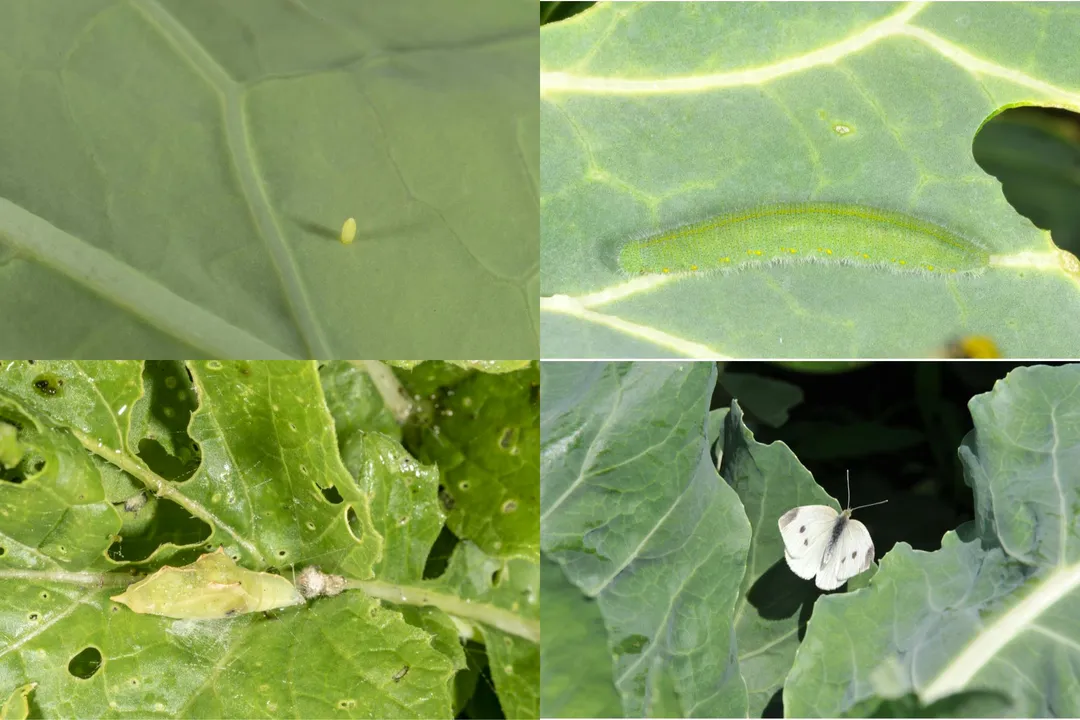
The classification places the insect firmly in the group undergoing complete metamorphosis. [1] This means the life cycle involves four distinct stages: egg, larva (caterpillar), pupa (chrysalis), and adult. [1][3] This reliance on different life forms to perform different functions—feeding versus reproduction—is a hallmark of the insect class and a key factor in the pest status of this species. [9]
# Larval Development
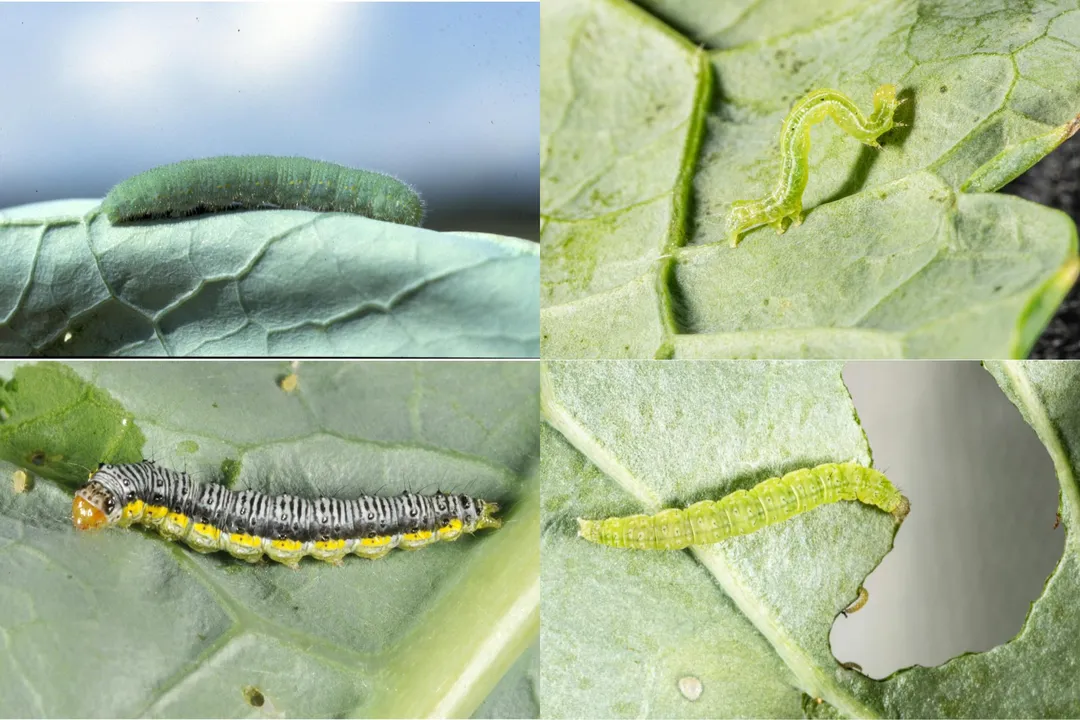
The larval stage, or caterpillar, is where the insect's classification as a pest becomes most apparent. [9] The female deposits eggs, typically singly, on the leaves of host plants like cabbage, broccoli, cauliflower, or wild mustard plants. [1][9] The resulting larvae are pale green with a faint yellow stripe down the back and tiny black dots. [3] They possess strong mandibles for chewing plant tissue. [1] Because they are specialists on a family of plants that humans cultivate intensively, they often experience rapid population growth when those plants are available, allowing them to exploit localized resources very efficiently. [9]
# Adult Appearance
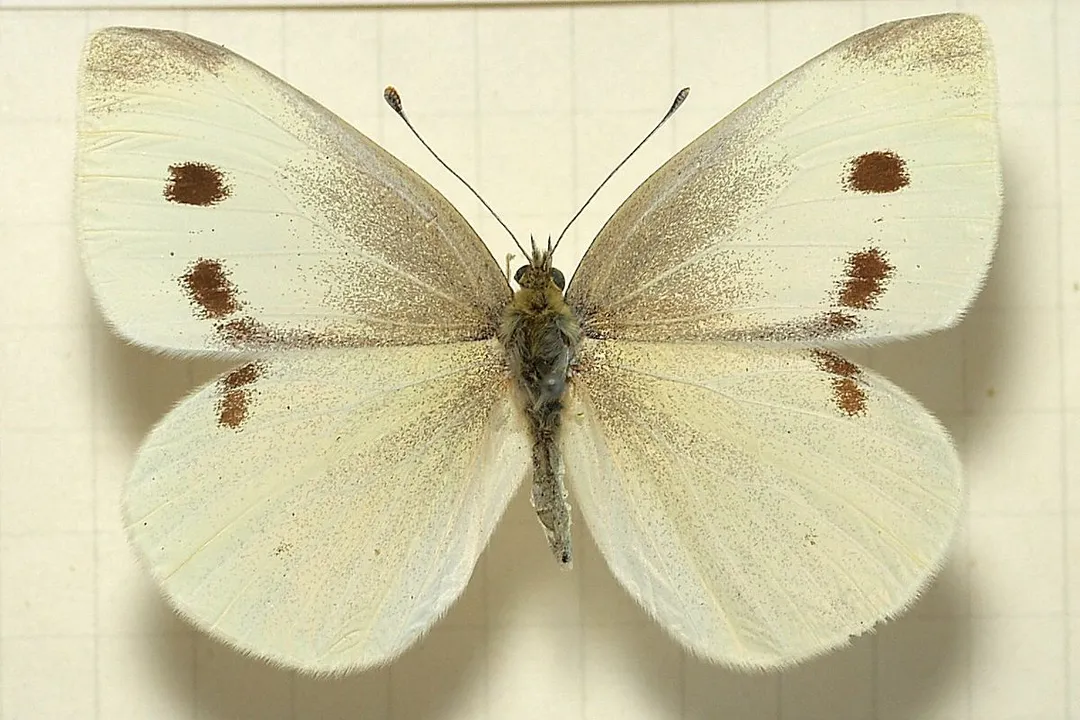
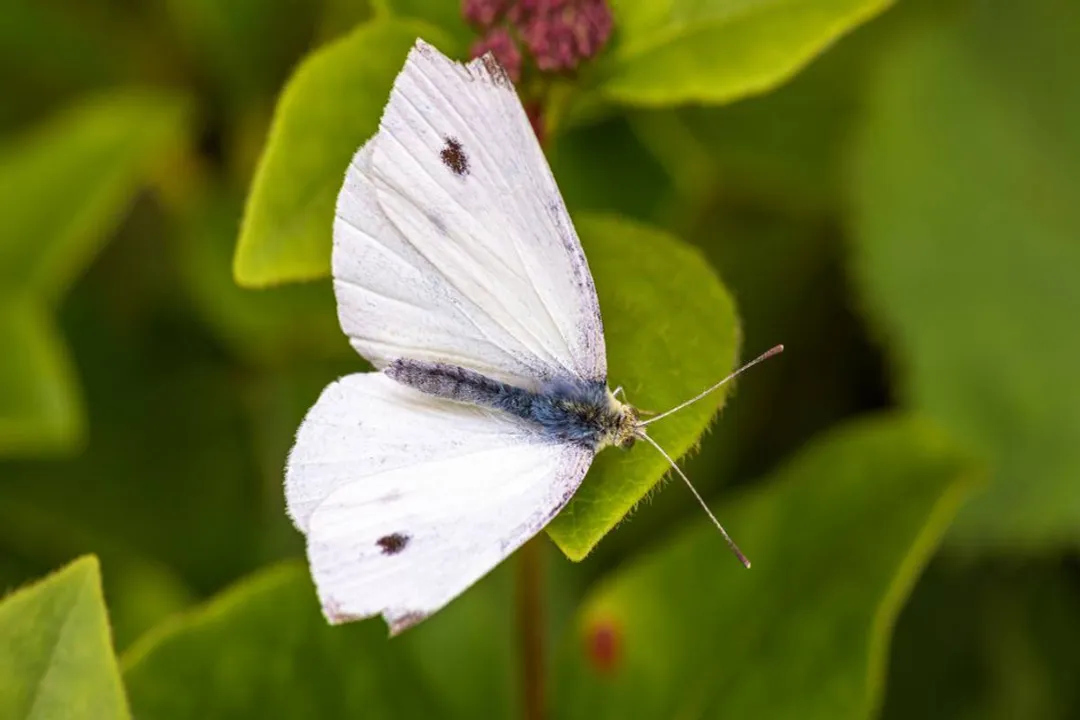
The adult butterfly, the form most people recognize, is a small to medium-sized white butterfly. [3] The male typically has one dark spot on each forewing, while the female usually has two spots on each forewing. [3] However, it is important to note that the intensity and presence of these markings can vary, leading to confusion with other species if one relies solely on spot count without considering wing shape or size. [7] The wingspan generally ranges from about 30 to 45 millimeters. [3] The species is often confused with native whites in North America, which requires careful observation of these subtle differences, such as the slightly rounded wing shape characteristic of P. rapae compared to some related species. [1][5]
# Distinguishing Whites
In many regions, several species of white butterflies coexist, making positive identification crucial, especially for gardeners concerned about pest damage. [5] While the Sulphurs are in the same family, they are separated into different genera (like Colias) and are easily distinguished by their yellow or orange coloration. [8]
Within the whites (Pieris genus), the key challenge is separating P. rapae from the Large White (Pieris brassicae) or the Checkered White (Pontia protodice). [1][5]
- Pieris rapae (Cabbage White): Generally smaller, with less extensive dark scaling on the wing tips and usually two spots on the female forewing and one on the male. [3]
- Pieris brassicae (Large White): Noticeably larger with much broader, often solid black tips on the forewings. [1]
When observing butterflies in a park or garden, a quick mental check might involve assessing flight style. The Cabbage White often exhibits a slightly erratic or jerky flight pattern, whereas some closely related species might fly more smoothly or soar higher. [5] Understanding the classification helps us predict behavior; as members of the Pieridae, both whites and sulphurs are diurnal (active during the day) and are often seen feeding on nectar from flowers, a behavior shared across the order Lepidoptera for energy replenishment. [1]
If you are trying to confirm if the white you see is indeed P. rapae causing damage in your vegetable patch, look closely at the eggs or the youngest larvae on the underside of the leaves of your brassicas. [9] Finding the small, pale yellow-green eggs is often the easiest way to link the adult butterfly you observe to the potential pest population that is classified as Pieris rapae. [3][9] The simple structure of the scientific name anchors the insect to a specific set of ecological requirements, regardless of where in the world you observe it.
Related Questions
#Citations
Pieris rapae - Wikipedia
large white butterfly (Pieris brassicae Linnaeus) - Invasive.Org
Pieris rapae | INFORMATION - Animal Diversity Web
White Butterfly Insect Facts - Pieris rapae - A-Z Animals
Species Pieris rapae - Cabbage White - Hodges#4197 - BugGuide.Net
Pieris rapae "Cabbage White" female? Crofton, Maryland - Facebook
Sulphurs & Whites of Kentucky
Insect Spotlight: Cabbage White Butterfly (Pieris rapae)