White Ferret / Albino Ferrets Scientific Classification

The sight of a ferret with stark white fur and deep red eyes immediately brings up questions about its origins, often leading people to inquire about its specific scientific standing. While the striking appearance—whether true albino or appearing white due to other color-diluting genetics—is highly visible, the animal’s place in the biological hierarchy remains fixed across these coat variations. All domestic ferrets, regardless of their specific coloration, share the binomial nomenclature Mustela putorius furo. This name confirms that the white ferret is not a separate species but rather a variation within the established domestic lineage.
# Classification Ranks
To appreciate where the white ferret fits, we must trace its classification through the established Linnaean ranks. Biologically, the ferret occupies the Kingdom Animalia, meaning it is a multicellular, heterotrophic organism. It belongs to the Phylum Chordata, possessing a backbone, and the Class Mammalia, being warm-blooded vertebrates that nurse their young.
The next significant grouping is the Order, where ferrets are placed in Carnivora. This order groups together animals adapted for diets consisting primarily of meat, including dogs, bears, seals, and weasels. Following the order, we find the Family Mustelidae. This family is vast and includes many familiar animals known for their long, slender bodies, such as badgers, otters, mink, and wolverines. Within Mustelidae sits the Genus Mustela, a group that contains many of the smaller, more agile members of the weasel family. Finally, the species is defined by the trinomial, Mustela putorius furo.
The use of three parts in the scientific name, Mustela putorius furo, is highly informative. It reveals the ferret's direct ancestral lineage. The putorius designation links it specifically to the European polecat, Mustela putorius. This suggests that the domestic ferret is essentially the domesticated form of that particular wild species. While many pet owners recognize the standard sable or silver-tipped ferrets, the white variants—the true albinos—are simply variations of this same foundational species.
# Genetic Coloring
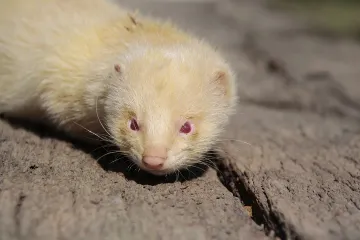
The term "white ferret" in the pet trade is often used generically, but genetically, it can refer to a few different conditions, the most absolute of which is true albinism. A true albino ferret is characterized by a complete lack of melanin pigment throughout the body. This profound lack of pigment results in white fur and, critically, pink or red eyes because the blood vessels in the iris are visible without any overlying color. This is a genetically recessive trait that must be inherited from both parents.
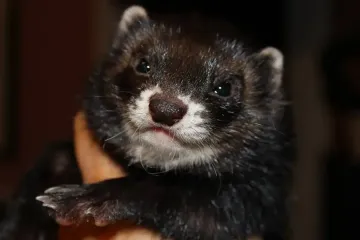
However, many ferrets described by owners as "white" are technically leucistic. Leucism is a separate genetic condition that causes a reduction or absence of pigment in the fur, but it does not usually affect the pigment cells in the eyes, meaning leucistic ferrets often possess blue eyes, which distinguishes them clearly from true albinos. Despite this genetic difference in pigmentation, neither the albino nor the leucistic ferret requires a change in their scientific classification species name; they both remain Mustela putorius furo. The classification system focuses on evolutionary relatedness and shared genetic heritage, not superficial coat color, which is governed by comparatively simple alleles.
It is a common oversight among new ferret enthusiasts to conflate all light-colored ferrets into one category. When observing a litter, understanding the difference between a true albino (pink eyes) and a white ferret with blue eyes (often a variation of the dilution or mask gene complex) helps predict future coat colors if one plans to breed. For example, knowing that the albino trait is recessive means both parent animals must carry the gene to produce an albino kit, whereas other white patterns might be dominant or sex-linked, demonstrating how subtle genetic variations within the domestic population can manifest.
# Related Species
The Mustelidae family connects the domestic ferret to a wide array of specialized predators. Understanding this kinship is important for appreciating the ferret’s innate behaviors, such as its propensity for burrowing and its high-energy hunting drive. The ferret shares its closest wild relatives with the European polecat, but its domestic history has separated it from them.
The family tree extends to include several well-known groups:
- Weasels: Known for their extreme slenderness.
- Mink: Often prized for their fur, mink are also highly aquatic members of the family.
- Badgers: Generally larger and more robust diggers than the ferret.
This association with known carnivores explains why ferrets require a diet rich in animal protein; their digestive systems are biologically geared toward processing meat, a characteristic inherited from their Mustelid ancestors.
# Domestic Status and Status Reporting
The scientific classification Mustela putorius furo officially designates the ferret as a domesticated animal. This domestication history is ancient, dating back thousands of years, initially for hunting rabbits—a process known as ferreting—and later for pest control.
Interestingly, while M. p. furo is managed as a companion animal globally, its environmental impact in certain non-native regions is taken seriously by conservation bodies. The IUCN's Global Invasive Species Database lists the ferret as an established invasive alien species in certain areas. This highlights a crucial duality in how the animal is scientifically perceived: it is a domestic species whose released or escaped individuals can negatively impact local ecosystems, leading to classification not just by its species name but also by its ecological impact designation. The contrast between its secure domestic status and its invasive potential in certain island or sensitive environments is a complex point often overlooked by casual observers focusing only on coat color.
# Genetic Markers and Identification
Although the physical markers like eye and fur color differentiate individuals, the taxonomic identification rests firmly on the DNA shared by Mustela putorius furo. Responsible record-keeping in breeding programs often requires genetic testing or detailed pedigree tracking to confirm lineages, especially when dealing with recessive traits like true albinism. While a common pet owner might simply observe the white coat and red eyes and label it "albino," professional breeders must track the specific alleles causing this presentation. For instance, understanding the specific locus responsible for the white coloration allows breeders to manage potential health risks associated with inbreeding depression, which can sometimes be more pronounced in lines heavily selected for extreme color expression.
Even when a ferret is descended from generations of selective breeding for white coats, the underpinning genetic structure, the genus, order, and family, remains unchanged. The white ferret, therefore, stands as a striking example of how dramatic superficial changes can occur within a recognized species group without necessitating a reclassification up the taxonomic ladder. It is a product of human selection acting upon the established genetic potential of the European polecat's domestic descendant.
Related Questions
#Citations
Ferret - Wikipedia
Mustela furo (ferret) | CABI Compendium - CABI Digital Library
Mustela putorius furo (domestic ferret) - Animal Diversity Web
Mustela putorius furo - GISD
Domestic ferret - Happy Hollow Park & Zoo
White Ferret / Albino Ferrets Facts & Photos - Wowzerful
Mustela putorius - an overview | ScienceDirect Topics
Ferret - History, Classification, Characteristic, Behaviour and Types
Ferret - Pretty Bird