White Marlin Physical Characteristics
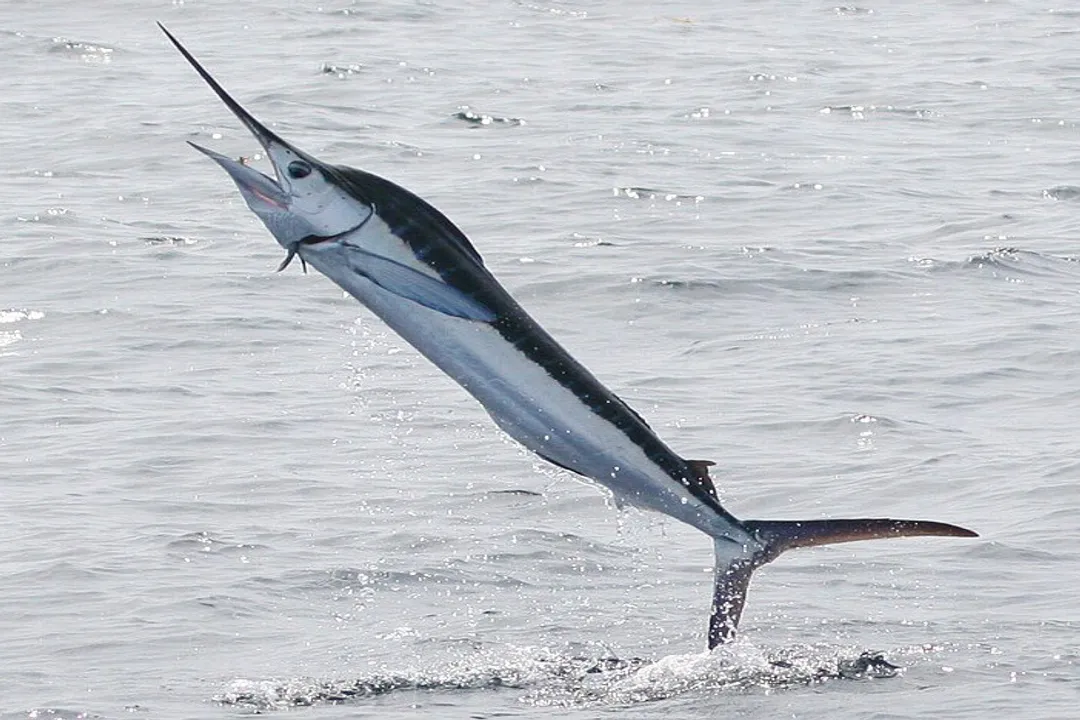
The White Marlin, scientifically known as Kajikia albida, presents a striking profile in the open ocean, often recognized by its relatively slender build compared to its larger cousins like the Blue Marlin. [4][7] This pelagic species, frequently encountered in tropical and subtropical waters worldwide, [6] possesses a sleek, elongated body built for high-speed pursuit. [5] While often overshadowed in popular culture by the larger billfish, its specific physical traits distinguish it clearly for the knowledgeable observer. [1][7]
# Body Shape
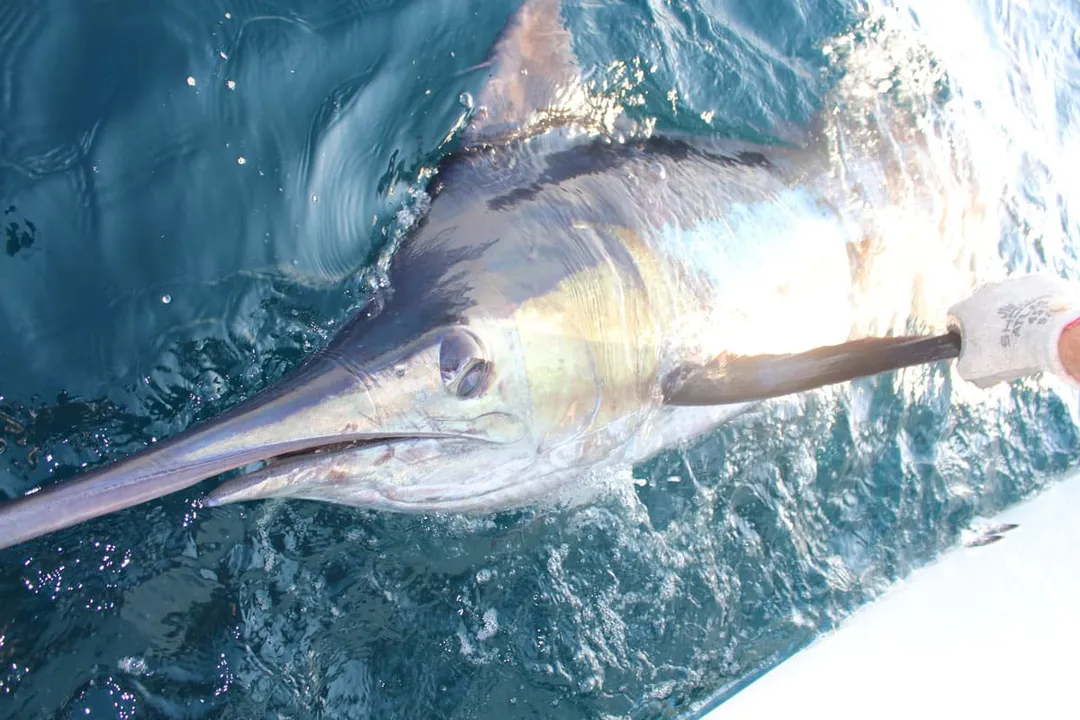
The overall conformation of the White Marlin is characteristically streamlined, tapering gracefully from a muscular body core to its tail. [5] It features a distinctive, sharp, and pointed bill, which is generally shorter and stouter when compared directly to the bill of the Atlantic Blue Marlin. [1][4][5] One of the most important markers for field identification involves assessing the bill's length relative to other features; specifically, the bill length is often described as being shorter than the length of the first dorsal fin's base. [1][5][7] Like other marlins, it possesses a distinct lateral line running straight along its side, a feature that helps confirm its identity against other related fish that might have a more curved line. [1][7]
# Coloration Pattern
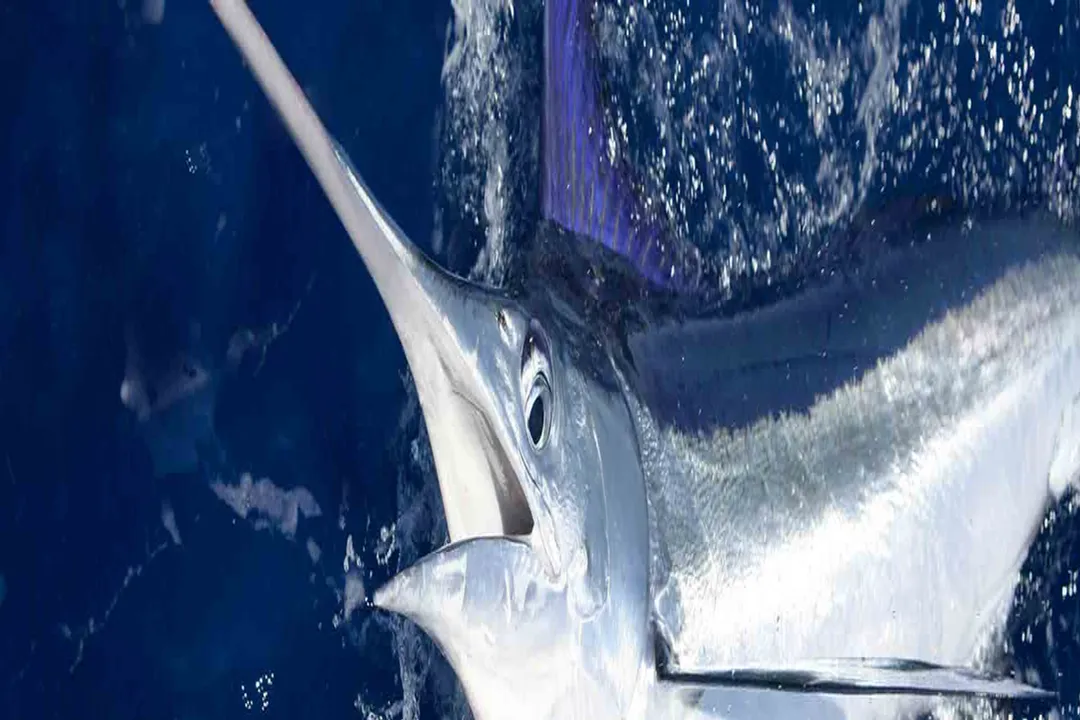
The pigmentation of the White Marlin contributes significantly to its common name, though its coloration is more nuanced than pure white. [5] The dorsal surfaces, including the back and upper flanks, typically display a dark color, often described as deep blue, purplish, or brownish. [1][4][7] This darker upper coloration transitions sharply to a bright silvery or white shade on the fish’s belly and lower flanks. [1][5] This countershading—dark above, light below—is a classic camouflage adaptation for pelagic life, helping the fish blend into the deeper water when viewed from above and the bright surface when viewed from below. [7] In freshly caught specimens, the dark dorsal color often appears highly iridescent. [5]

# Head Features
The head structure is dominated by that pointed, sword-like bill, or rostrum, which is the most defining characteristic of the billfish family. [2][5] While possessing a formidable spear, the White Marlin’s bill is generally shorter than that of the Blue Marlin. [4] This difference in bill proportions is a critical diagnostic feature used by anglers and biologists alike. [1][4] The mouth is large, reflecting its predatory nature, and the eyes are relatively large, providing excellent vision in the sunlit upper layers of the ocean where it hunts. [7]
# Fin Structure
The fins of the White Marlin are specialized structures that aid in high-speed maneuvering and stability. [7] The first dorsal fin is notably long but relatively low compared to the larger marlin species. [1][4] It is deeply notched, giving it a somewhat sail-like appearance, though less tall than the true sailfish. [1][5] The pectoral fins are long, curved, and are typically held somewhat fixed away from the body, often extending past the lateral line. [1][5][7] Unlike some other billfish, the pectoral fins on the White Marlin are not fully retractable against the body contour, a feature that may influence its hydrodynamic profile during slower cruising speeds. [7] Towards the rear, the anal fin is smaller and is usually accompanied by two or three small finlets near the caudal peduncle. [1][5][7] Finally, the caudal fin, or tail, is large, stiff, and crescent-shaped (lunate), providing the immense thrust needed for rapid acceleration. [5][7] This combination of fixed pectorals and a powerful, rigid tail suggests an adaptation favoring sustained, high-velocity swimming rather than the short, explosive bursts associated with species that can fully retract their fins into streamlined grooves.

# Size Metrics
White Marlin are medium-sized billfish, certainly smaller than the massive Black or Blue Marlins they share habitat with. [7] The maximum recorded length approaches about 11 feet (3.35 meters). [1][7] However, most individuals encountered in sport fishing or scientific sampling are significantly smaller. [7] They are capable of reaching weights of up to 161 pounds (73 kg), [1] although weights exceeding 200 pounds are sometimes reported. [5]
For comparison and clarity regarding typical mature size versus maximum potential:
| Characteristic | Common/Typical Range | Recorded Maximum |
|---|---|---|
| Length | Under 10 feet [7] | 11 feet (3.35 m) [1][7] |
| Weight | Varies widely | 161 lbs (73 kg), [1] sometimes over 200 lbs [5] |
When an angler measures a newly hooked fish, noting the precise length of the bill in relation to the dorsal fin base is a faster way to gain confidence in the ID than waiting for a scale reading; a bill shorter than the dorsal fin base strongly points toward the Kajikia genus, separating it from the longer-billed Makaira species. [1][4]
# Key Differences
Distinguishing the White Marlin from other common Atlantic billfish, particularly the Blue Marlin, relies heavily on these physical metrics. [4] While color patterns can fade rapidly post-mortem or shift based on stress, certain skeletal and fin measurements remain constant markers of species identity. [5] The relatively short bill is the primary giveaway. [4] Furthermore, the Blue Marlin typically exhibits a much taller, more prominent first dorsal fin, creating a more dramatic silhouette in the water than the lower, more subdued dorsal profile of the White Marlin. [4] The pectoral fins, though long in both species, often present a slightly different sweep when observed closely, adding another layer to the visual identification process. [7] Understanding these subtle dimensional differences is key, as misidentification can lead to incorrect reporting or management of catch statistics, given the differing conservation statuses of these species. [7]
Related Questions
#Citations
Maryland Fish Facts - White Marlin
White Marlin | NC DEQ
White Marlin – Discover Fishes - Florida Museum of Natural History
White marlin - Wikipedia
Species Profile – White Marlin - SatFish
White Marlin - Ocean Conservancy
Natural History: Atlantic White Marlin - Center for Biological Diversity
White Marlin | Fishopedia - Louisiana Charter Boat Association
White Marlin Global Sport Fishing Guide - San Diego Tuna Fishing