Western Kingbird Facts
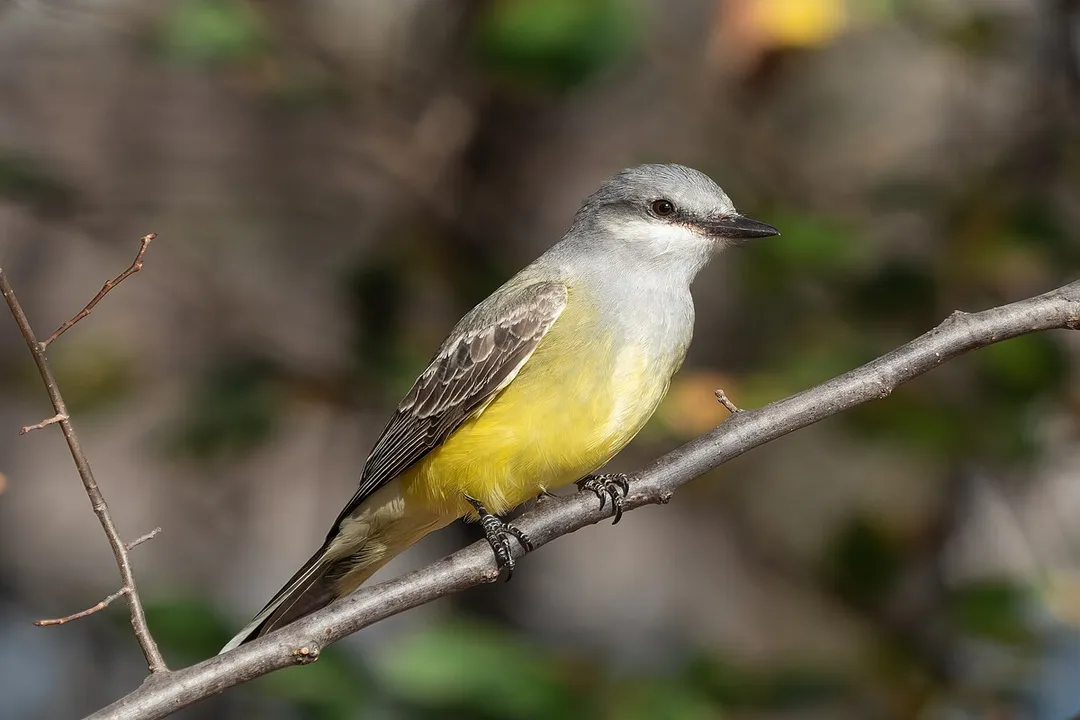
The Western Kingbird is a visually striking, energetic flycatcher of the American West and Southwest, immediately recognizable by its contrasting plumage and assertive behavior. [1][2] This bird often announces its presence with a distinctive, high-pitched call before you even spot the flash of its pale gray head against a brighter yellow breast and belly. [6] While superficially similar to its eastern cousin, the Cassin's Kingbird, separating the two requires paying close attention to subtle markings around the bill and tail tip. [1]
# Coloration Details
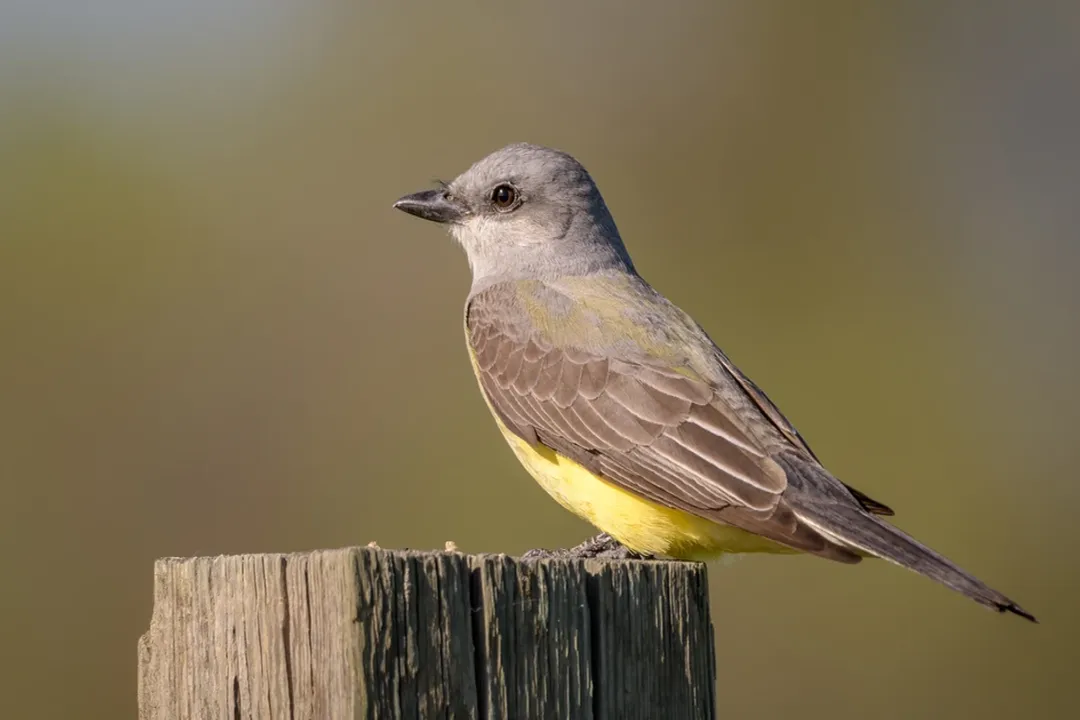
The primary colors defining the Western Kingbird are shades of gray, white, and yellow. [4] Adults typically show a pale gray head and back, contrasting sharply with a bright white throat. [1][2] Beneath this white bib, the breast usually shows a pale yellow wash that deepens across the belly. [6] The tail is dark, sometimes appearing black, and is often edged with white, though this white edging can be faint or absent depending on the viewing angle and the bird's specific subspecies or age. [1] The bill is relatively stout and dark, perfectly suited for snagging insects mid-air. [2] Juvenile birds often present a more muted palette, sometimes appearing brownish-gray above, and their yellow underside may be less brilliant than that of the mature adults. [1]
# Voice and Sound
If you are searching for a Western Kingbird and cannot immediately see one, its vocalizations often give it away. [7] They are known for being rather noisy when agitated or defending territory. [2] The most common sound is a sharp, high-pitched, often repeated “pip” or “kleep” call. [1] During aggressive displays or territorial disputes, these calls become more rapid and scolding. [2] Unlike some related species, the Western Kingbird does not have a complex, musical song; rather, its vocalizations are characterized by these short, sharp, functional calls necessary for communication and warning. [1]
# Range and Migration
The geographic distribution of the Western Kingbird is strongly tied to the western half of North America, though its presence in any one location is often seasonal. [3] During the breeding season, they occupy a wide swath of the western United States and southern Canada, preferring open country. [1][7] Their breeding range extends generally from central Canada south through the western US, reaching into Baja California and the northern parts of Mexico. [3]
When autumn arrives, these birds undertake significant migrations, moving south to spend the non-breeding season in Mexico and Central America, sometimes reaching as far as northern South America. [1][3] This migratory pattern means that observers in places like Texas might primarily encounter them as spring and fall migrants, although some populations do breed in the state. [5] Conversely, finding one deep in the eastern United States outside of an unusual vagrant event is rare, making the sighting itself a marker of western or transitional habitats. [7]
If you track their passage across different latitudes, you notice a fascinating pattern: areas that experience harsh, prolonged winters see the birds depart swiftly, while more temperate areas further south might host lingering individuals well into the fall migration push. [1] For instance, while breeding birds in the northern Rockies are gone by September, a late-season birder in southern Arizona might still catch sight of a foraging bird staging before its final leg south. [4]
# Habitat Preference
Western Kingbirds thrive in open, often sun-drenched environments. [7] They favor areas with scattered trees, posts, or wires that serve as elevated perches, interspersed with open ground for hunting. [4][6] Agricultural areas, ranch lands, desert scrub, parklands, and the edges of marshes or rivers fit their preferred niche perfectly. [1][7] They are generally absent from dense forests, preferring clear sightlines for spotting prey. [4]
A practical tip for locating this species, especially during the summer months in the Intermountain West, is to scan the highest, most exposed vertical element in an otherwise flat landscape, such as a lone utility pole or a prominent dead snag near a fence line. [4] They are not birds that prefer to sit concealed; they want a commanding view of their hunting territory, which often means perching in the most conspicuous spot available. [1]
# Diet and Hunting
The Western Kingbird is a dedicated insectivore, relying heavily on aerial insects captured in flight. [6] Their diet consists primarily of grasshoppers, beetles, wasps, flies, and bees caught through a hunting strategy known as sallying. [1][3] A typical foraging bout involves sitting on an exposed perch, scanning the area, and then launching into a rapid, acrobatic flight to intercept prey. [2] Once the insect is caught, the bird usually returns directly to its original perch or a nearby one to consume its meal. [1]
While insects form the bulk of their diet, they are known to occasionally consume small fruits or berries, particularly late in the season or during migration when insects are less abundant. [3][6] This dietary flexibility is important, allowing them to adapt their intake based on local availability, but their physical structure—the broad bill and agile flight—clearly marks them as masters of aerial predation. [1]
# Nesting Cycle
The breeding season for the Western Kingbird usually begins in late spring, with nest building commencing around May or June, though timing varies significantly based on latitude and elevation. [5][8] They construct their nests in an exposed location, often situated on a horizontal tree branch, on a post, or sometimes tucked into a niche on a building or structure. [1][8] The nest itself is a rather bulky cup shape, incorporating twigs, grass, and occasionally mud or other binding materials, often lined with softer plant fibers or even feathers. [2][5]
Nests are generally situated from about 6 to 40 feet above the ground, though lower nests are found in areas where suitable high perches are scarce. [1][8] The female typically lays a clutch of three to five pale, creamy eggs marked with brown spots. [1][8] Incubation lasts for about fourteen days, with both parents sharing the duty. [8] Once hatched, the nestlings remain dependent on their parents for roughly another seventeen days before they fledge. [8]
Considering the typical incubation period of about 14 days and the nestling period lasting approximately 17 days, the minimum time elapsed from the first egg being laid until the young are capable of leaving the nest for the first time is roughly 31 days. [8] Given that many pairs attempt two broods per season where conditions allow, this tight schedule places significant pressure on the parents to locate sufficient insect protein throughout the entire summer period, a demanding feat in the often-hot, open environments they inhabit. [5]
# Identification Confusion
The potential for misidentification, particularly in regions where the Western Kingbird overlaps with the Cassin's Kingbird, is a common concern for birdwatchers. [1] Both species are gray, white, and yellow, and both are aggressive defenders of their territory. [3] The key difference lies in the head and tail pattern. [1] A Western Kingbird has a pale gray head that contrasts distinctly with a white throat, whereas the Cassin's Kingbird has a darker head that appears almost black, meeting a gray throat with no distinct white bib. [1][2] Furthermore, while both have dark tails, the Western Kingbird usually exhibits white outer tail feathers, which are visible when the tail is spread, whereas the Cassin's tail is entirely dark. [1] When viewing birds migrating through areas where ranges overlap, such as parts of the central US, these subtle field marks become very important distinctions for accurate identification. [5]
# Populations and Conservation
In terms of population status, the Western Kingbird is generally described as common across its extensive range. [1][2] However, like many species associated with open country and agricultural interfaces, its numbers can fluctuate depending on habitat management and insect availability. [7] While the species as a whole is not currently considered globally threatened, localized declines have been noted in areas where suitable open nesting and foraging habitats are converted or lost. [7] The BirdLife International assessment, as referenced in some guides, often classifies it as Least Concern, reflecting its broad distribution and large estimated population size. [3] Sustained observation of breeding bird surveys, like those conducted by state agencies, remains essential for monitoring long-term trends within specific regional populations. [5]
Related Questions
#Citations
Western Kingbird Overview, All About Birds, Cornell Lab of Ornithology
Western Kingbird | Audubon Field Guide
Western kingbird - Wikipedia
Tyrannus verticalis - Western Kingbird - Utah Field Guides
WESTERN KINGBIRD | The Texas Breeding Bird Atlas
How to Identify a Western Kingbird - Birds and Blooms
Western Kingbird | State of Tennessee, Wildlife Resources Agency
Western Kingbird - Friends of Woodland Park