Western Kingbird Physical Characteristics
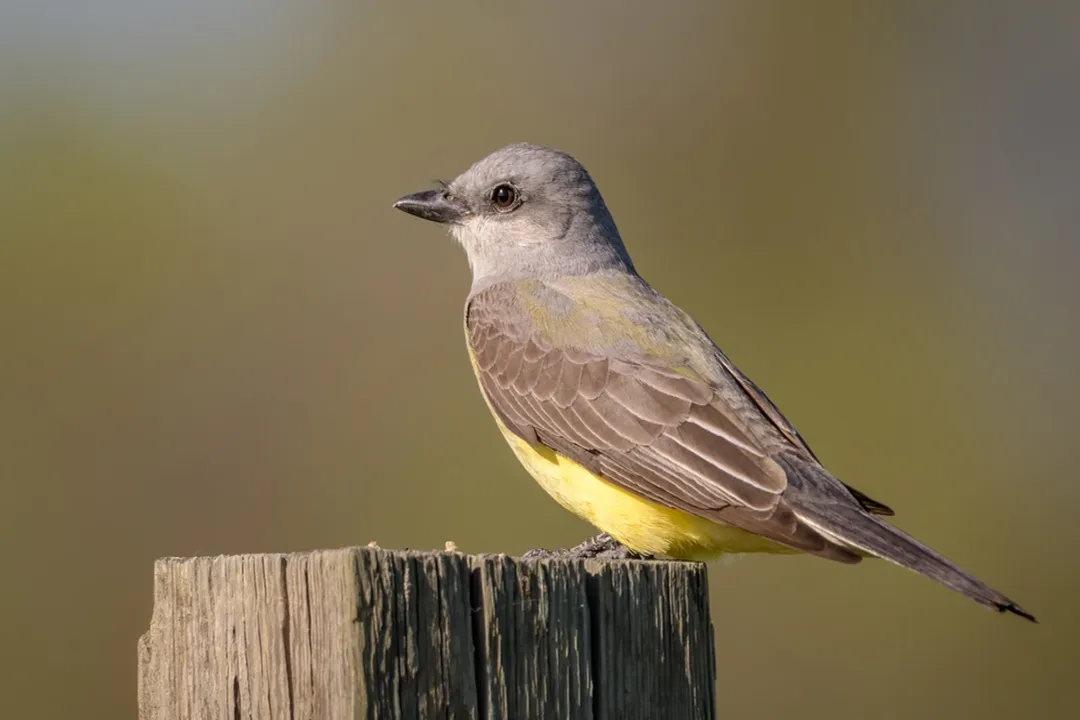
The Western Kingbird presents a striking, if subtly patterned, figure among North American flycatchers, a bird easily identified once its key physical markers are understood. This medium-sized species, typically measuring between 7.5 and 9 inches from bill to tail tip, carries itself with an upright posture characteristic of the Tyrannus genus. [1][2][6] The overall impression in the field is often one of a gray-headed bird with a conspicuously bright underside, a pattern that serves as a reliable field mark across much of its extensive range. [1]
# General Stature
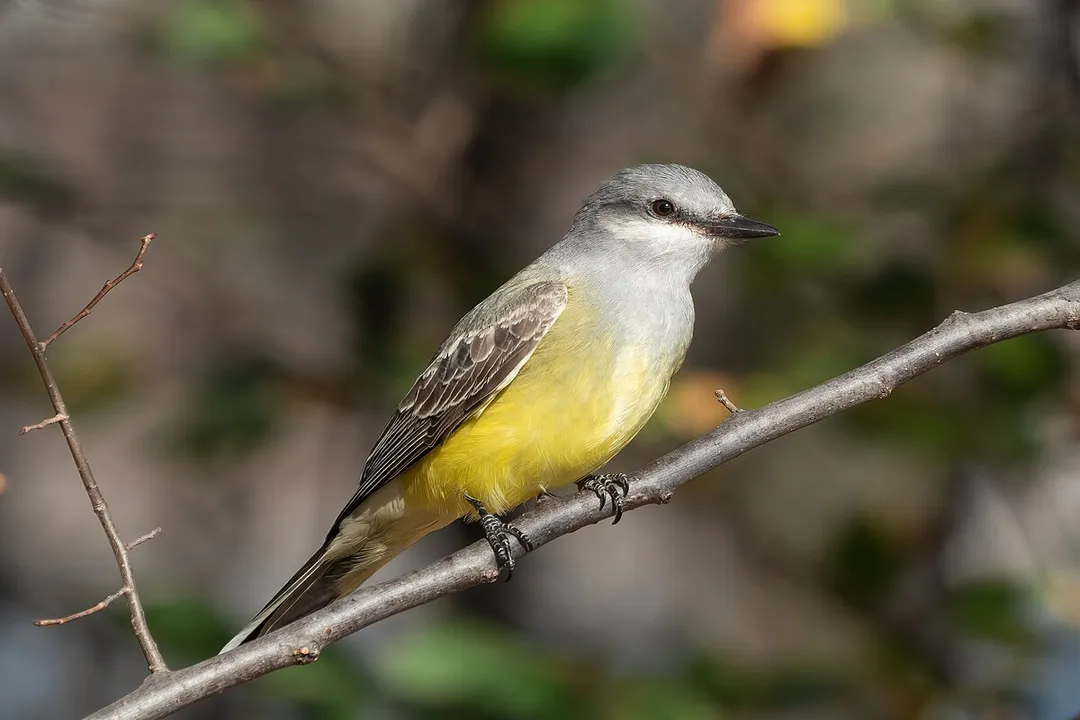
The body structure is lean and streamlined, perfectly adapted for its aerial hawking lifestyle. [5] Relative to its overall length, the Western Kingbird possesses a noticeable tail, which contributes significantly to its silhouette, especially when perched or in flight. [2][6] While often described simply as a "medium flycatcher," its structure suggests a bird built for sustained aerial pursuits rather than the short sallies typical of smaller tyrant flycatchers. An interesting way to appreciate this structure is to consider its tail length in proportion to its body. A slight overbalance toward tail length, especially when spread during braking or maneuvering, implies an aerial agility optimized for catching insects on the wing across open country. [1]
# Adult Plumage Details
The plumage of an adult Western Kingbird is characterized by a clear division between the upperparts and the underparts, though the transition zones require close observation. The head and throat are a pale gray, sometimes appearing almost white depending on the light, though this area is distinctly darker than the whitish vent region. [1][3] This light head coloration contrasts sharply with the darker gray of the back, mantle, and wings. [3]
The most arresting feature of the adult's coloration is undeniably its underside. The breast is a soft, pale gray, smoothly blending into a vibrant, clear yellow that covers the belly and undertail coverts. [1][2][6] This yellow is generally bright and clean, setting it apart from many other similarly sized gray-and-white birds. Sexes look remarkably alike; the male and female share this basic pattern, showing little to no sexual dimorphism in color or size, which can sometimes make separating pairs a challenge without behavioral cues. [2][3]
The wings are dark, appearing dusky or blackish, but close inspection reveals important edging. The flight feathers are often edged with white or pale gray, which can create subtle paneling visible in flight, though these are not the bold wing bars seen on some other species. [4]
# Tail Structure and Coloration
The tail is a critical identification feature for the Western Kingbird, helping to distinguish it from the closely related Cassin's Kingbird, for example. The tail is relatively long and appears squared-off or slightly notched when fully fanned. [2] The feathers themselves are dark, usually blackish, but the outer tail feathers carry conspicuous white edging. [1][6] This white border is a key field mark. It is important to note the difference in coverage: the white is present only on the outer edges of the outermost feathers. [4] When the bird fans its tail during a display or while catching prey, these white edges flash prominently against the dark center of the tail.
When assessing this feature in the field, an observer accustomed to other tyrant flycatchers might initially expect heavy white on the tail. However, the Western Kingbird's tail pattern is more restrained—a white edging rather than broad white outer webs, which can lead to misidentification if the bird is not seen in good light or in a manner that fully displays the tail. [4]
# Head and Bill Features
The bill of the Western Kingbird is stout, relatively short for a flycatcher, and entirely black. [5] It is broader at the base, conforming to the typical shape required for capturing insects in the air. [4][5] While the bill itself is black, the base of the lower mandible may sometimes appear slightly paler, though this is rarely obvious from a distance. [4] The eyes are dark and appear set against the pale gray of the head. [3] The legs and feet are also black. [5]
The pale gray hood extends over the crown, lores (the area between the eye and bill), and the throat, creating a clean, relatively unstreaked appearance on the head, a feature that separates it easily from species with streaked breasts or crown stripes. [1][3]
# Immature Plumage
Juvenile Western Kingbirds present a noticeably different look than the adults, a common pattern in many passerines where young birds exhibit cryptic or transitional patterns. The bright yellow of the adult belly is muted in the young birds; the underparts are generally a duller yellow or yellowish-white, often washed with gray on the throat and breast. [1][4]
The most striking difference in the juvenile is on the wings. Unlike adults, which may show only faint edging, young Western Kingbirds possess prominent pale wing bars. [4] These bars are formed by the pale tips of the median and greater coverts, appearing as two distinct whitish or buffy stripes across the dark wing surface. [4] Additionally, the tail feathers in juveniles have broader, paler buffy or whitish tips compared to the narrow white edging seen on the adults' tail feathers. [1][4] These differences in wing markings and tail tipping are crucial for aging individuals encountered during the late summer and early fall months before the first prebasic molt is complete. [4]
For an observer interested in aging birds without relying solely on tail wear, focusing on the wing pattern provides a quick confirmation: the presence of two obvious, pale wing bars almost certainly indicates a bird hatched in the current year. [4] Once the post-juvenile molt occurs, these individuals will start acquiring the sleeker, more clearly defined yellow belly and distinct tail edging of the adult plumage.
# Distinguishing Features Summary
To summarize the essential physical characteristics for identification, one must focus on the combination of three primary elements:
- Yellow Belly: A bright, extensive yellow on the belly contrasting with a pale gray breast and head. [1][2]
- Tail Edging: Dark tail feathers with distinct white borders on the outer feathers. [1][6]
- Lack of Streaking: A general absence of heavy streaking on the breast or strong wing bars (in adults). [4]
While the yellow belly is shared with the related Cassin's Kingbird, the Cassin's bird exhibits a darker, dusky-gray belly and a much less contrasting head pattern, lacking the clear pale gray throat/dark breast separation seen in the Western Kingbird. [1] Furthermore, the Cassin's Kingbird has a dark tail that is nearly entirely black, lacking the broad white edging characteristic of T. verticalis. [1] If you are working in an area where both species overlap, the quality and extent of the tail white is often the most dependable structural difference, provided the bird is not viewed from directly above or too far away. [1]
# Size Comparison Context
While the provided literature establishes the Western Kingbird's size range generally, it is useful to place this measurement into context relative to common backyard birds. At up to 9 inches, the Western Kingbird is significantly larger than an American Robin (which averages around 10 inches but has a much bulkier build) and substantially larger than a House Sparrow (around 6.3 inches). [1] Its length is comparable to a small Mourning Dove. This size, combined with its slender build and longish tail, gives it a distinct profile when perched on utility wires or fence posts against the western sky, where it frequently establishes its territory. [6][8] This visibility, aided by its relatively large size for a flycatcher, aids in its consistent identification, even across varying light conditions that might obscure precise color details like the exact shade of yellow. [9]
Related Questions
#Citations
Western Kingbird Overview, All About Birds, Cornell Lab of Ornithology
Western Kingbird | Audubon Field Guide
Western kingbird - Wikipedia
Tyrannus verticalis (western kingbird) - Animal Diversity Web
Western Kingbird - BirdWeb
Western Kingbird behaviors and fun facts in Omaha, Nebraska
Western Kingbird | State of Tennessee, Wildlife Resources Agency
How to Identify a Western Kingbird - Birds and Blooms