Walleye Fish Evolution
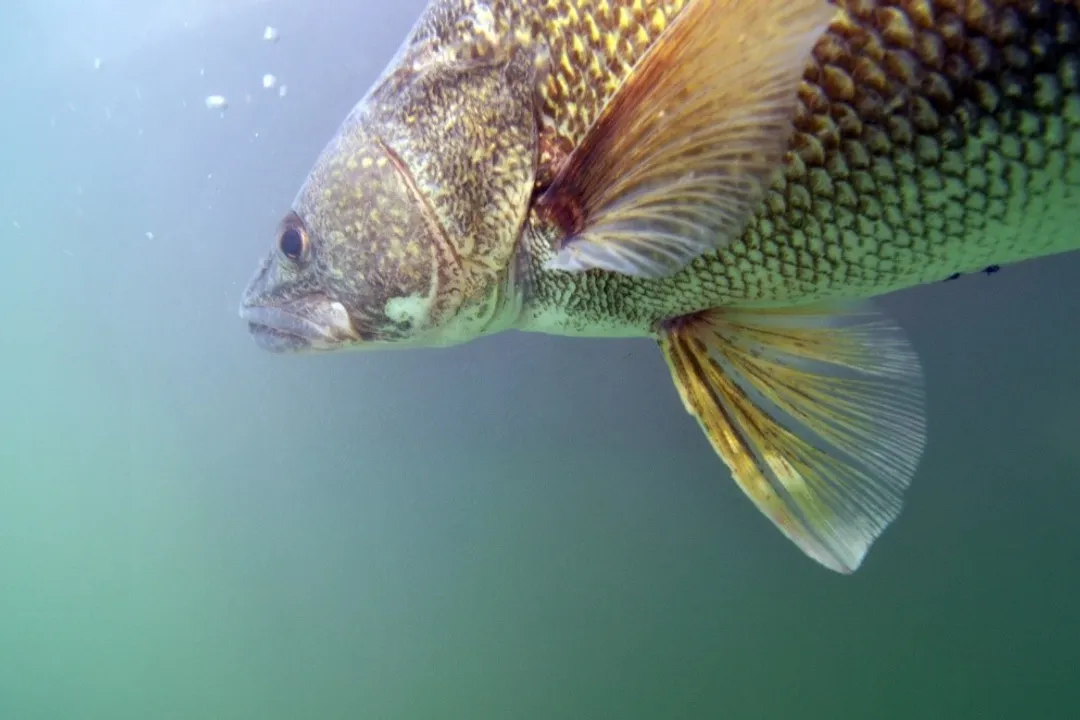
The story of the walleye, Sander vitreus, is deeply etched into the aquatic landscapes of North America, representing millions of years of adaptation to changing climates and environments. This prized sport fish, known for its ghostly, vitreous eyes that allow it to hunt effectively in low light, is a testament to successful evolutionary pressures shaping morphology, behavior, and life history. [1] Understanding its evolutionary path requires piecing together clues from its genetic makeup, its relationship to other fish, and the powerful environmental filters that have dictated which traits persist across its vast native range. [9]
# Taxonomy Lineage
The walleye belongs to the family Percidae, which encompasses familiar species like perch and sauger. [1] Within this family, the walleye is classified in the genus Sander, alongside its smaller, often muddier-water dwelling cousin, the sauger (Sander canadensis). [1] This close kinship suggests a relatively recent divergence from a common ancestor, with the evolutionary split driven by specialization into different ecological niches—perhaps differential tolerance to water clarity, temperature, or depth. [1] Analyzing these relationships, sometimes through phylogenetic study, helps scientists map out the ancestral traits the lineage carried forward and the novel adaptations that defined the walleye as a distinct, successful predator. [4][9]
# Genetic Structure
Evolution is written in DNA, and modern genetic techniques reveal the complex population structure that defines the walleye's evolutionary history. Research confirms that the species is not a single, homogenous unit across its massive distribution, which stretches from the Great Slave Lake drainage system down to the Mississippi River basin. [7] Instead, distinct genetic groups exist, reflecting historical barriers to gene flow. [4] These separations often trace back to geological events, most notably the Pleistocene glaciations. When continental ice sheets covered much of the continent, walleye populations survived in isolated southern and western refugia. [7] The subsequent retreat of the ice allowed these lineages to expand northward, but the genetic signatures of those ancient hiding places remain. [9] Studies examining this phylogeography often find significant divergence between eastern and western groups, or even between those occupying the Great Lakes system versus interior river systems. [4]
The ecological implications of this genetic structure are substantial. A population that evolved under the intense selective pressures of the Great Lakes—large water volumes, fluctuating temperatures, and historically distinct prey bases—may possess a different adaptive potential than a population adapted to the smaller, shallower, and potentially warmer conditions of a landlocked reservoir. [2]
For example, while the historical distribution covers many types of large freshwater bodies, the Federal government's screening process notes that walleye generally prefer cooler, clear water environments, suggesting that populations that adapted to warmer, turbid conditions might represent evolutionary outliers or highly specialized local adaptations. [2][7]
When conservation managers discuss stocking or protecting walleye, recognizing these underlying genetic units is crucial to avoid introducing individuals whose evolved traits may not be suited for the recipient environment, potentially creating maladaptation rather than boosting local numbers. [4]
# Growth Legacies
Evolution shapes not just what a fish is, but how it lives and grows. In walleye, the way an individual grows over its lifespan is influenced by events occurring very early in life, demonstrating a strong evolutionary trade-off embedded in its biology. [5] This concept, often termed a "lengthy legacy," means that the conditions experienced as a larva—such as the temperature of the spawning waters or the initial availability of zooplankton—can influence body size, survival rates, and age at maturity decades later. [5][6]
Natural selection acts powerfully on these growth trajectories. In environments where predation risk is high, there is an evolutionary advantage to rapid early growth, pushing individuals quickly past vulnerable size classes. [6] Conversely, in environments with highly variable food supplies, a more conservative, plastic growth strategy might be favored, even if it means slower initial development. [5] The metabolic costs associated with growth versus maintenance are finely tuned by evolution to maximize lifetime reproductive output based on local predictions of survival. [6] This balancing act means that the average growth curve for a walleye stock in, say, Lake Winnipeg may be genetically and phenotypically distinct from one in a smaller, southern Canadian Shield lake, reflecting differing long-term selective regimes. [5]
An interesting consideration here is the interplay between genetics and developmental plasticity. If the environmental cues that trigger rapid growth are only occasionally present, the evolutionary pressure might favor individuals genetically predisposed to respond strongly to those cues (high plasticity), rather than individuals programmed for one fixed, fast-growth rate. [5]
# Environmental Filtering
The vast geographic area inhabited by the walleye underscores its adaptability, but this adaptability is bounded by physiological tolerances—the essence of environmental filtering in evolution. [7] The species’ preference for water with low turbidity and high dissolved oxygen fundamentally restricts its colonization potential. [2] This suggests that key evolutionary innovations in the Sander lineage likely involved improving efficiency in low-light, cooler environments, enabling them to exploit niches unavailable to more sun-dependent or warm-water adapted species. [1]
When considering non-native introductions, which have occurred widely, the failure or success of those transplanted populations provides a real-time observation of evolutionary limits. If a population introduced to a system with consistently warm, anoxic bottom waters fails to establish, it strongly suggests that the evolved physiological limits of the species cannot cope with those sustained conditions. [2] The successful populations, conversely, carry the genetic heritage that allowed them to adapt to the specific thermal and chemical signatures of their natal basin. [7]
If we look closely at the physical traits, the large, forward-facing eyes are the most obvious specialization, granting superior vision in the crepuscular hours (dawn and dusk) or deep waters, giving them a decisive hunting advantage over prey that rely on sight. [1] This trait appears to be under stabilizing selection across the range, as any significant reduction in visual acuity would likely result in reduced foraging success and reproductive fitness.
# Population Dynamics
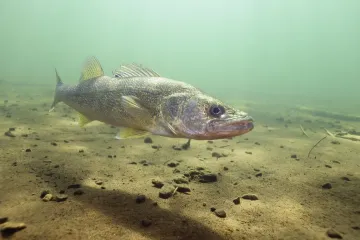
The evolutionary processes shaping walleye are constantly interacting with current demographic realities. For instance, studies examining the recruitment success and subsequent age structure in different fisheries hint at density-dependent evolutionary pressures. [8] High densities of young walleye can lead to increased intraspecific competition for food, which selects for individuals capable of efficient foraging under crowded conditions or those that mature slightly earlier if food scarcity is chronic. [8] Conversely, in systems where fishing pressure selectively removes the largest, oldest individuals, selection might favor traits leading to earlier maturity at a smaller size—a phenomenon known as "harvest-induced evolution". [3] While this may not constitute a change in the species’ fundamental evolutionary trajectory, it certainly modifies the current selective landscape dramatically. [3]
Considering the long-term success of the walleye, it is clear that its combination of low-light hunting prowess, adaptability to large lake environments, and flexible growth strategies have allowed it to occupy a dominant apex predator niche across the northern half of the continent. [1][7]
While specific fossil records detailing the split between walleye and sauger are sparse, the genetic and ecological data paint a picture of a lineage that successfully navigated the severe environmental bottlenecks of the Ice Ages, diversified into distinct groups tailored to local hydrology, and maintained high fitness through finely tuned life history trade-offs that balance rapid growth against long-term survival costs. [4][5] This evolutionary success story is still being written every time a new generation hatches in a different lake system across Canada and the United States. [9]
Related Questions
#Citations
Walleye - Wikipedia
[PDF] Walleye (Sander vitreus) ERSS - U.S. Fish and Wildlife Service
Size reductions and genomic changes within two generations in wild ...
The decline of walleye populations: an ecological tipping point?
Lengthy legacies affect growth in Walleye - Animal Ecology in Focus
Abundance, growth, and life history characteristics of sympatric ...
[PDF] A Biological Synopsis of Walleye (Sander vitreus) - Canada.ca
Distribution and population genetics of walleye and sauger
relation to historic walleye and the extinct “blue pike” S. v. “glaucus”