When faced with a close-range disturbance, what behavioral strategy do pygmy rattlesnakes often employ instead of retreating?
Answer
Freezing, relying on camouflage
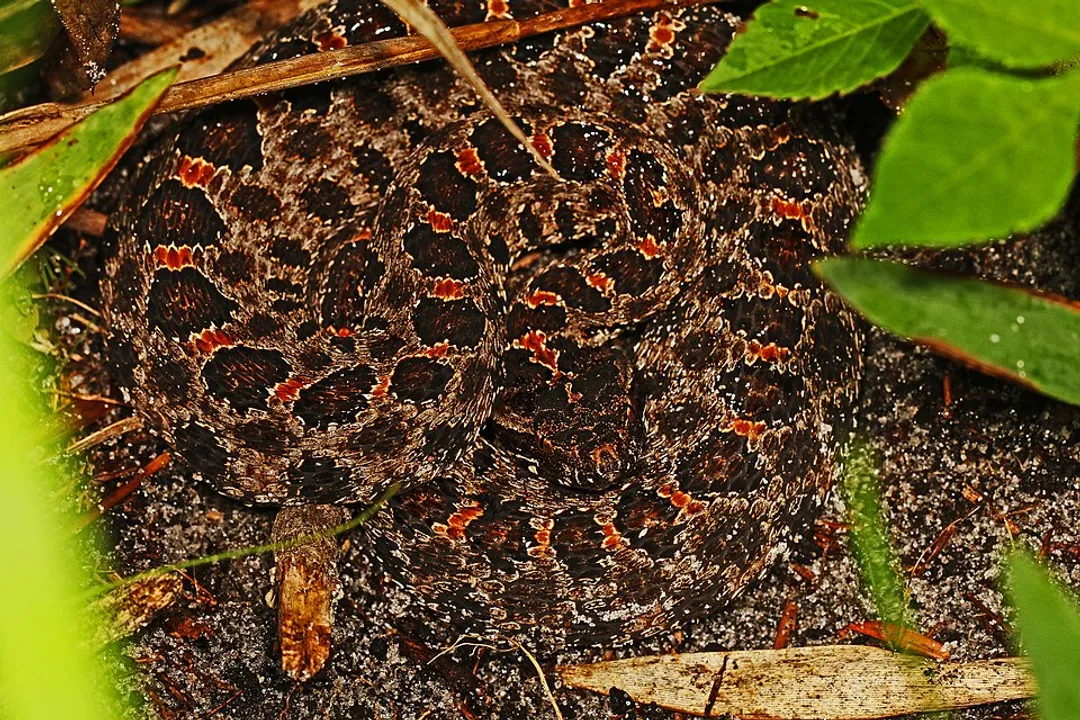
Pygmy rattlesnakes are often described as being more likely to flee than larger rattlesnakes, but their small size means they often freeze instead of retreating when disturbed at close range, relying entirely on their excellent camouflage.
Related Questions
How many officially recognized subspecies comprise the species *Sistrurus miliarius*?Which subspecies is primarily associated with the Atlantic Coastal Plain, such as in North Carolina and Georgia?What characteristic coloration typically distinguishes the dorsal blotches of the Carolina Pygmy Rattlesnake?What is the usual maximum length rarely exceeded by specimens of *Sistrurus miliarius*?What ecological feature do pygmy rattlesnakes frequently utilize for shelter from temperature extremes and predators?How is the rattle sound of the Pygmy Rattlesnake often described?Which subspecies is known for exhibiting a darker, sometimes almost blackish or dusky ground coloration?When Pygmy Rattlesnakes are bitten, why is antivenom often not indicated for medical management?What alternative name is sometimes used for the *Sistrurus miliarius putnamus* subspecies?When faced with a close-range disturbance, what behavioral strategy do pygmy rattlesnakes often employ instead of retreating?