What is the difference between a midget faded rattlesnake and a prairie rattlesnake?
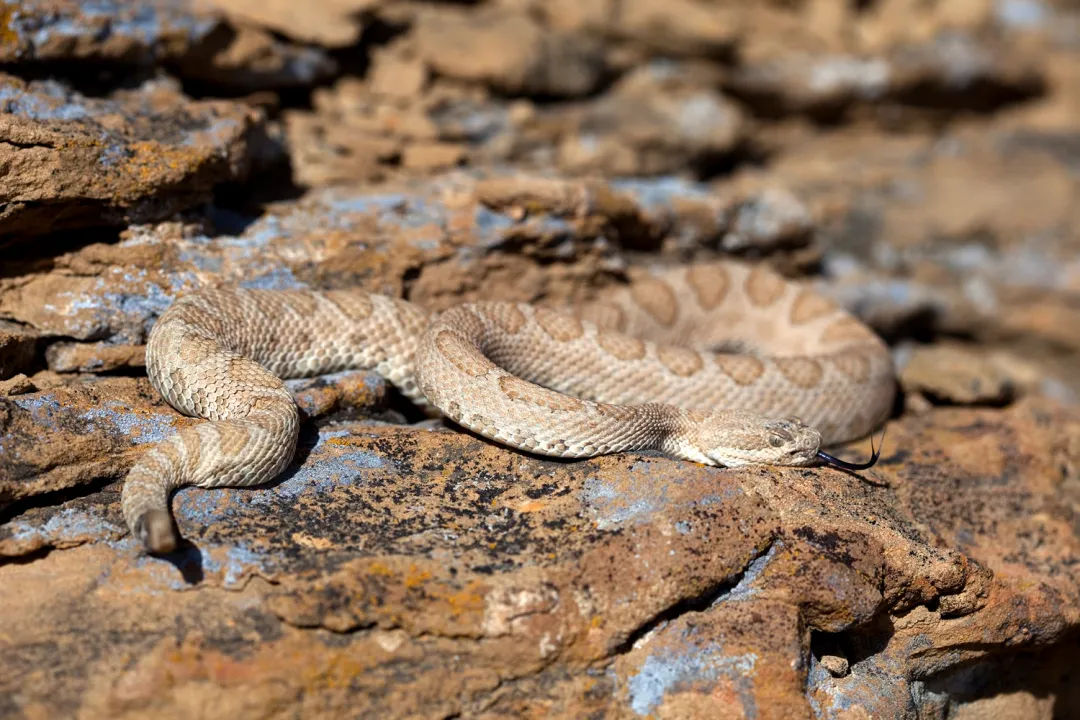
Distinguishing between two closely related venomous reptiles, such as the Midget Faded Rattlesnake and the Prairie Rattlesnake, requires a close look at subtle characteristics that field observers might easily overlook when they look very similar in a fleeting glance. While both snakes are found in the American West, particularly within Colorado, their specific ranges, preferred habitats, and even their appearance shift in ways that help experts differentiate them, although suspected interbreeding in border areas can complicate matters. [1] Recognizing these differences is important for understanding regional ecology and ensuring safety in the field.
# Size and Shape
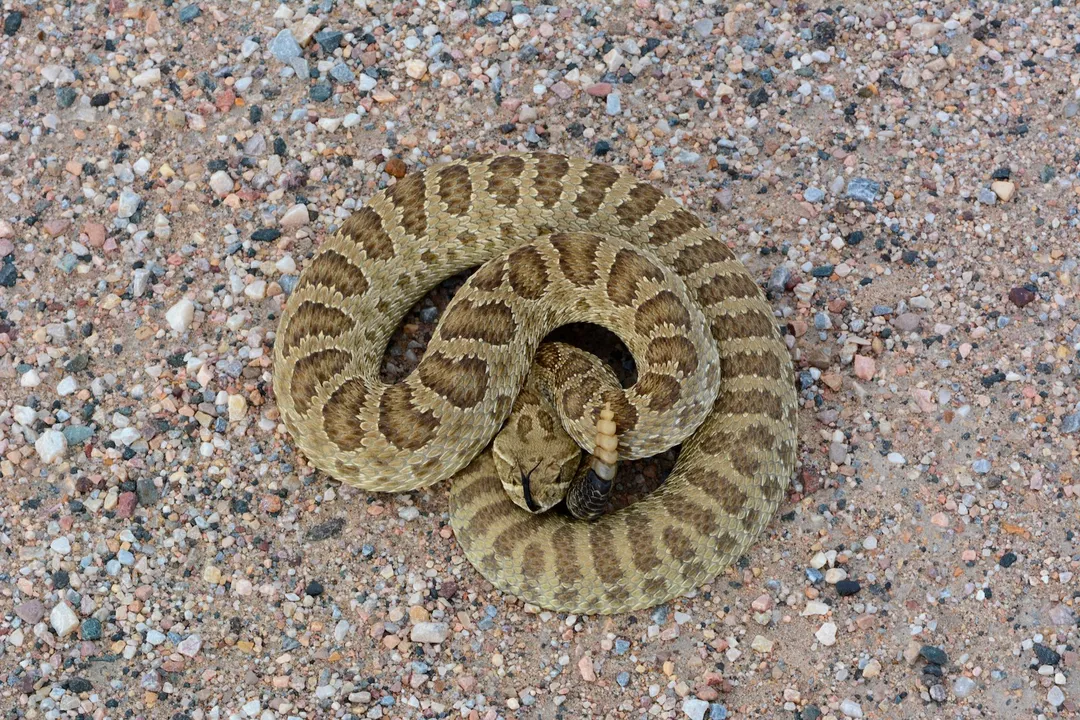
One of the most immediate, though sometimes unreliable, distinctions between these two species involves sheer size. The Prairie Rattlesnake (Crotalus viridis) is generally the larger of the pair and is often cited as the largest and most common rattlesnake found across Colorado. [2][4] Mature Prairie Rattlesnakes typically measure between 35 and 45 inches in length. [2]
In contrast, the Midget Faded Rattlesnake (Crotalus oreganus concolor) earns its "midget" moniker because it is significantly smaller. [4] This species generally stays under 3 feet long, with adults averaging around 2 feet in length, rarely exceeding 25 to 29.5 inches in total length. [1][4] This size difference is a crucial clue, especially when encountering a snake that appears smaller than expected for the general rattlesnake population in an area. [2]
# Pattern Fading
Coloration and pattern offer a more technical means of telling these snakes apart, especially in areas where their ranges might overlap, such as near the Lake Powell region. [1] The Prairie Rattlesnake typically exhibits a camouflage pattern of brown, gray, or sage-green, characterized by dark blotches that are distinctly white-bordered against a lighter background. [2] Furthermore, the Prairie Rattlesnake possesses visible white stripes both above and below the eye. [2]
The Midget Faded Rattlesnake presents a much more muted appearance, which is reflected in its name, "faded". [4] Its base color is highly variable—it can range from gray, tan, or reddish-brown to shades of orange or pinkish. [1] While juveniles possess a bolder, more visible pattern, the key feature is that these markings become reduced, very faded, or entirely absent as the snake ages. [1][4] Where the Prairie Rattlesnake sports distinct white borders around its blotches, adult Midget Faded Rattlesnakes in areas like Wyoming are differentiated by having dark borders around their dorsal blotches with little or no white edging. [3] This loss of pattern intensity is an evolutionary adaptation likely tied to their specific rocky canyon habitats. [5] Another subtle indicator is the tail tip: the Midget Faded Rattlesnake often has a tail tip at the base of the rattle that is dark brown or black. [1]
# Facial Stripes Comparison
Looking closely at the head can provide significant confirmation. The Prairie Rattlesnake is noted for its prominent white stripes running both above and below the eyes. [2] The Midget Faded Rattlesnake, however, exhibits two pale diagonal stripes on the side of the face: an upper stripe running from behind the eye to the jaw corner (which can fade with age), and a distinct lower stripe that is notably wider (spanning 3 to 4 scales) and runs from in front of the eye to the upper lip. [3] If that lower stripe is noticeably broad, it strongly suggests the snake belongs to the C. o. concolor group, rather than the more commonly found C. viridis. [3]
| Feature | Midget Faded Rattlesnake (C. o. concolor) | Prairie Rattlesnake (C. viridis) |
|---|---|---|
| Typical Adult Size | Small, averages ~2 feet (max often <30 in) [1][4] | Larger, 35–45 inches [2] |
| Dorsal Pattern | Blotches fade significantly or disappear with age; dark borders [1][3] | Distinct dark blotches, usually white-bordered [2] |
| Facial Markings | Two pale stripes; lower stripe is wide (3–4 scales) [3] | Distinct white stripes above and below the eyes [2] |
| Tail Tip | Dark brown or black at the base of the rattle [1] | Dark ring markings near the rattle [2] |
# Range and Environment
The geographic scope for these two snakes illustrates a division between specialist and generalist species. The Prairie Rattlesnake is the generalist in this comparison; it is the most widespread rattlesnake in Colorado, with populations documented in nearly every area of the state below about 9,500 feet elevation. [2][4] They thrive in varied terrain, including plains, grasslands, woodlands, and riparian zones, sometimes even venturing into suburban environments where their primary prey—rodents—congregate. [2]
The Midget Faded Rattlesnake is decidedly the specialist. Its range is restricted to specific drainages: the Green River Basin and the Colorado River Basin in western Colorado, extending into eastern Utah and southwestern Wyoming. [1][2][4] Its habitat preferences mirror this restriction; they are strongly associated with arid canyonlands, semidesert shrublands, pinyon-juniper woodlands, and crucially, rocky outcrops and cliff faces that provide essential crevices for dens. [1][4] This reliance on specific geological features makes populations vulnerable to localized threats. [3]
This difference in habitat preference can provide a crucial insight for someone recreating in the Rockies. If you are encountering a rattlesnake on a high, exposed, sun-drenched prairie miles from significant rocky canyons, it is statistically more likely to be a Prairie Rattlesnake. If you are deep within a sandstone canyon system common in the western part of the state, the probability shifts toward finding the Midget Faded Rattlesnake. [2][5]
# Biological Intensity and Conservation
Beyond looks and location, there are notable differences in their venom profiles and life history traits. The Midget Faded Rattlesnake carries a reputation for highly potent venom, containing neurotoxins and myotoxins that rival the toxicity levels of other vipers found across North America. [2][4] A significant detail is that juvenile Midget Faded Rattlesnakes deliver venom just as toxic as adults, as they do not exhibit the ontogenetic shift in venom composition seen in some other pit vipers. [4] While the Prairie Rattlesnake's venom is also dangerous—sometimes noted as being more toxic than some cobras—the Midget Faded subspecies is often highlighted for the sheer potency of its mixture. [2]
Another biological divergence relates to shelter. While all rattlesnakes brumate, the Midget Faded Rattlesnake appears to rely on specific communal dens and rock crevices for overwintering, gestation, and shedding more heavily than many other relatives. [2] Research on this subspecies in Wyoming indicated that genetic diversity can be low, and fragmentation from human-built features like dirt roads can limit gene flow between these den sites, effectively isolating small family groups. [3][5] This dependency on stable, specific shelter sites—which they reuse across years—means that habitat disturbance in their localized zones poses a severe, concentrated threat to local survival, justifying their listing as a Species of Special Concern in Colorado and a Sensitive Species in Wyoming. [4] For the much more widespread Prairie Rattlesnake, localized habitat loss is less likely to cause total extirpation across its entire range, as it utilizes a much broader array of ground cover. [2][4]
When encountering any of these venomous reptiles, the best immediate action remains consistent: give the animal a wide berth and retreat slowly, as they are primarily defensive and prefer to avoid conflict. [2] However, understanding that the smaller, faded snake is potentially a C. o. concolor found in restricted canyon country should prompt extra caution regarding habitat preservation in those specific western basins, as their specialized needs make them less able to adapt to disturbances than their widespread Prairie cousins. [5]
Related Questions
#Citations
Discover 4 Types of Rattlesnakes in Colorado - A-Z Animals
(species) crotalus oreganus - WY Field Guide
Midget Faded Rattlesnake? [Grand Junction, CO] : r/whatsthissnake
Colorado Rattlesnakes: What Sportsmen Should Know
Midget Faded Rattlesnake - The Reptiles and Amphibians of Utah
Snakes on a plain - High Country News
Midget Faded Rattlesnake
Are there rattlesnakes in Colorado?