What specific morphological variation is noted in crocodiles from Lake Turkana, Kenya?
Answer
More osteoderms on ventral surfaces
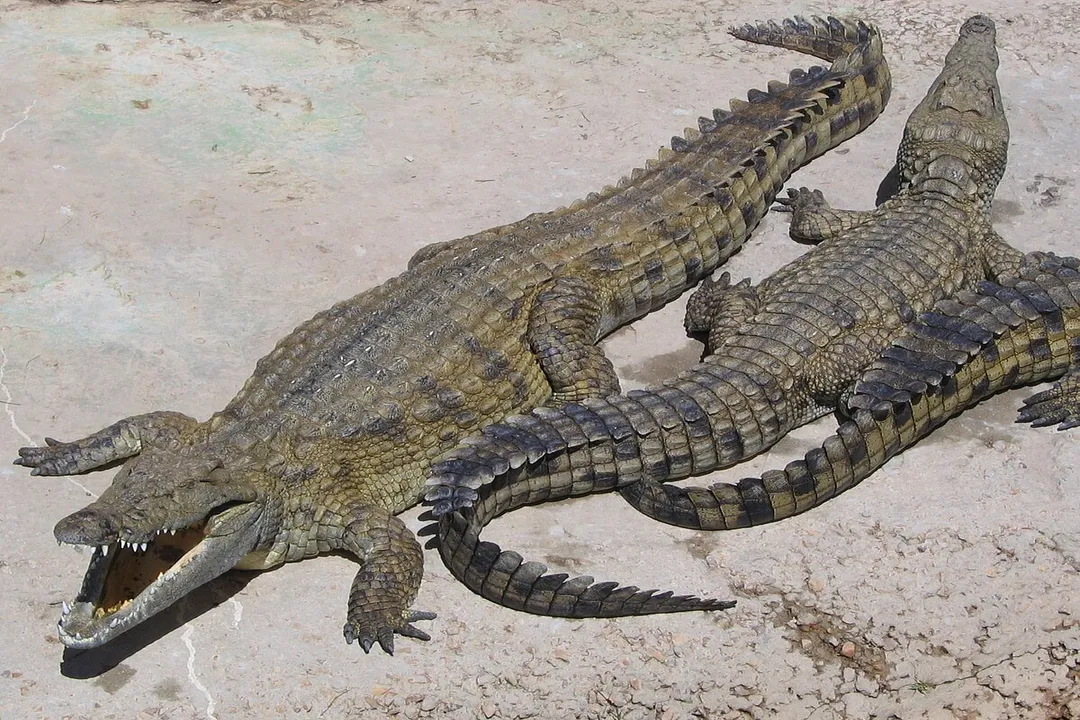
Crocodiles residing in Lake Turkana, Kenya, exhibit a unique morphological characteristic, possessing a greater number of osteoderms, which are bony plates, on their ventral (underside) surfaces compared to other known populations.
Related Questions
What does the Greek part of the binomial name $\textit{Crocodylus niloticus}$ describe?During which geological era did the extant Nile crocodile first appear according to East African fossils?Approximately how many million years ago (Ma) do fossils recovered from Kenya date the first appearance of $\textit{Crocodylus niloticus}$?What morphological feature did massive extinct relatives like $\textit{C. anthropophagus}$ possess?To which modern crocodile species is $\textit{Rimasuchus lloydi}$ actually more closely related, despite its size?Which region was historically part of the Nile crocodile's expansive northern range but is now largely extirpated due to habitat change and pollution?In what year did genetic studies formally recognize the West African crocodile populations as a separate species, $\textit{Crocodylus suchus}$?What specific morphological variation is noted in crocodiles from Lake Turkana, Kenya?Approximately how recently is the colonization of Madagascar by Nile crocodiles thought to have occurred?What feature suggests the ancestral stock leading to $\textit{C. niloticus}$ dispersed westward across a connected landscape?