What specific foraging behavior is frequently associated with the Song Thrush, helping to rule out the Redwing?
Answer
Hammering a snail against a specific stone to break it open
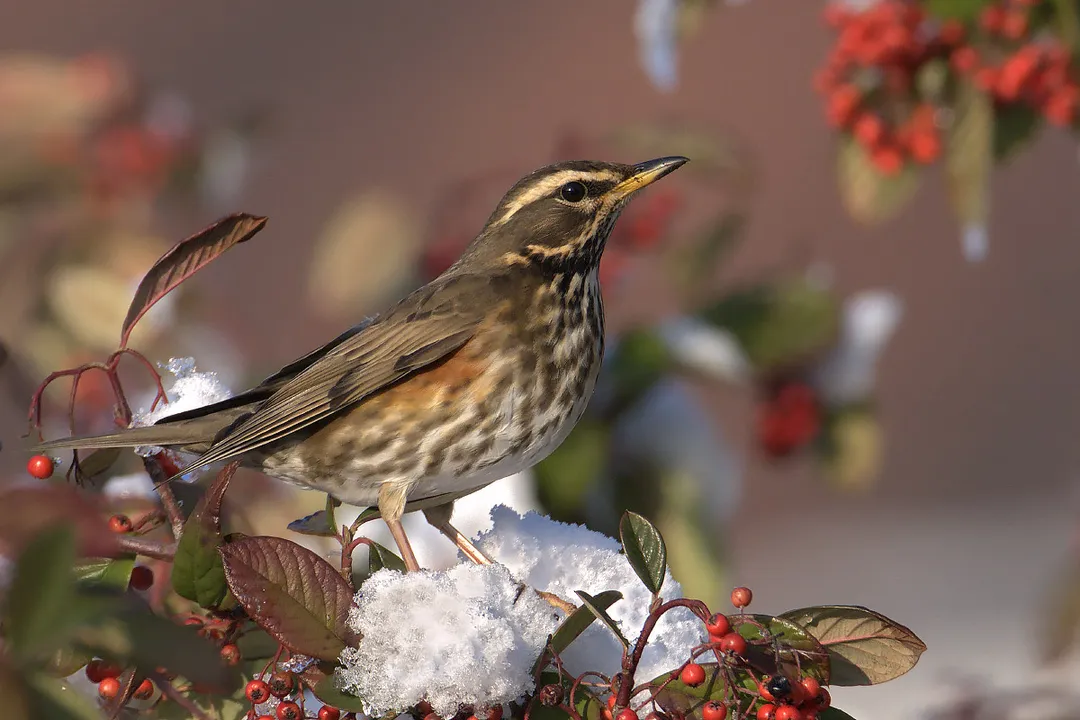
A highly characteristic behavior often noted in the Song Thrush is its method of consuming hard-shelled prey, such as snails. This species frequently utilizes a specific, hard surface, often a stone, as an anvil upon which it repeatedly hammers the snail until it breaks open, allowing access to the contents. This behavior directly contrasts with the feeding habits mentioned for the Redwing during winter, whose diet is noted to lean more towards insects and berries, making this observed snail-breaking action a strong indicator that the bird in question is a Song Thrush and not a Redwing.
#Videos
BTO Garden BirdWatch - Telling apart Redwing and Fieldfare
Related Questions
What is cited as the absolute best field mark for positive identification of a Redwing (*Turdus iliacus*)?How does the Fieldfare (*Turdus pilaris*) reveal a feature in flight that the Redwing lacks?What visual characteristic defines the breast spotting pattern of the Song Thrush?Which feature indicates that a spotted thrush observed is a Mistle Thrush rather than a Song Thrush?What specific feature of the Redwing (*Turdus iliacus*) is noted to be potentially more reliable for identification than its flank patches when the bird is stationary?What specific foraging behavior is frequently associated with the Song Thrush, helping to rule out the Redwing?When comparing the breast coloration of the Fieldfare and Redwing, how is the Fieldfare's breast described relative to the Redwing's?Which non-thrush species is mentioned as a potential source of confusion for North American observers when identifying the Redwing?What distinguishing feature marks the Fieldfare's head, setting it apart from the Redwing's prominent facial stripe?What general characteristic is cited as the defining feature of the thrush family breast pattern in many regions?