What is the difference between Bananaquit and Great Kiskadee?
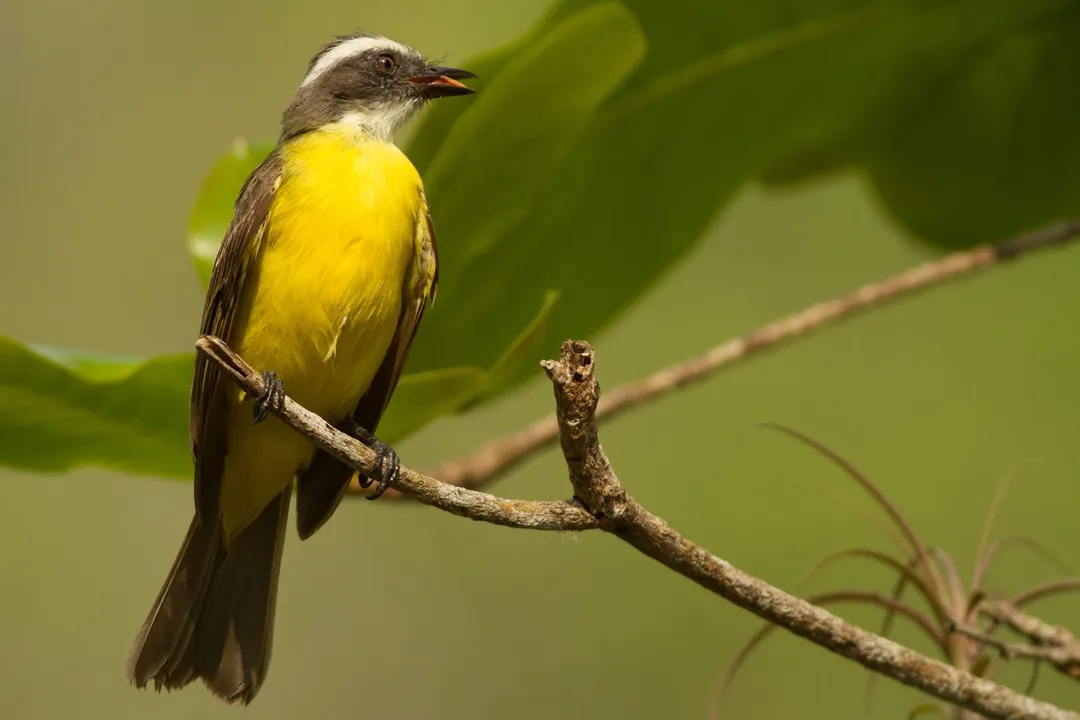
Distinguishing between two birds with bright yellow underparts can be a common challenge for many naturalists, especially when the birds inhabit similar tropical and subtropical environments. The Bananaquit and the Great Kiskadee, while both possessing that sunny splash of yellow, represent vastly different niches within the avian world, differing dramatically in size, feeding strategy, and overall temperament. Paying close attention to structure and vocalization quickly separates these two charismatic species.
# Size Disparity
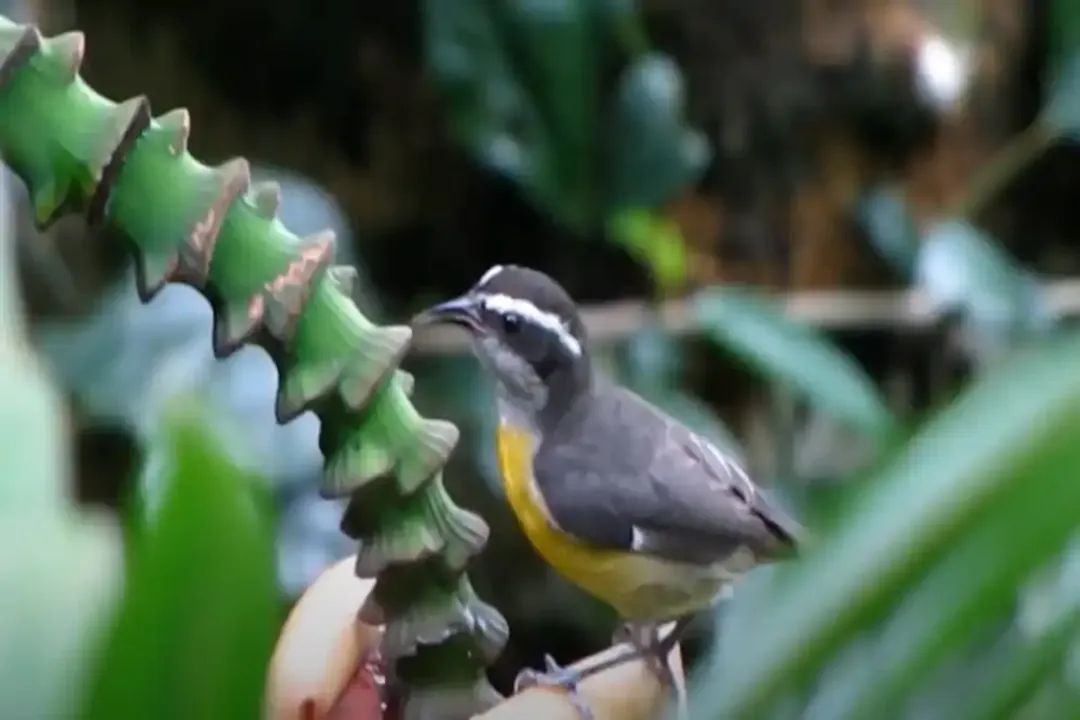
The most immediate and striking difference between the Bananaquit and the Great Kiskadee is their sheer size. These two birds occupy entirely different weight classes. The Bananaquit is a diminutive creature, truly a tiny burst of energy. It measures approximately $4.7$ to $5.1$ inches ($12$ to $13$ cm) in length and weighs only about $0.19$ to $0.67$ ounces ($5.5$ to $19$ grams). To put this into perspective, the Bananaquit is very light, feeling like a feather in motion, and can often fit easily within the palm of an adult hand.
The Great Kiskadee, conversely, is a much larger, bulky flycatcher. Its length typically ranges from $9.8$ to $11.0$ inches ($25$ to $28$ cm), making it significantly longer and heavier than its smaller counterpart. Measurements for the Kiskadee often place its weight between $1.87$ and $2.52$ ounces ($53$ to $71.5$ grams). If we calculate the difference, the Great Kiskadee is roughly twice the length and ten to fifteen times the weight of an average Bananaquit, creating a massive structural contrast in the field. This size difference means the Kiskadee feels far more commanding and chunky when observed, while the Bananaquit appears sleek and fast-moving.
# Head and Plumage

While both share that vibrant yellow on their lower bodies, their head patterns are key identifiers.
The Bananaquit is generally characterized by a body that features a bright yellow belly contrasting with dark gray or black upperparts. A very helpful field mark is the distinctive white stripe above the eye, which lends the bird an alert, inquisitive expression. While there are over 40 subspecies, this yellow-underpart/dark-above look with the eye-stripe is consistent.
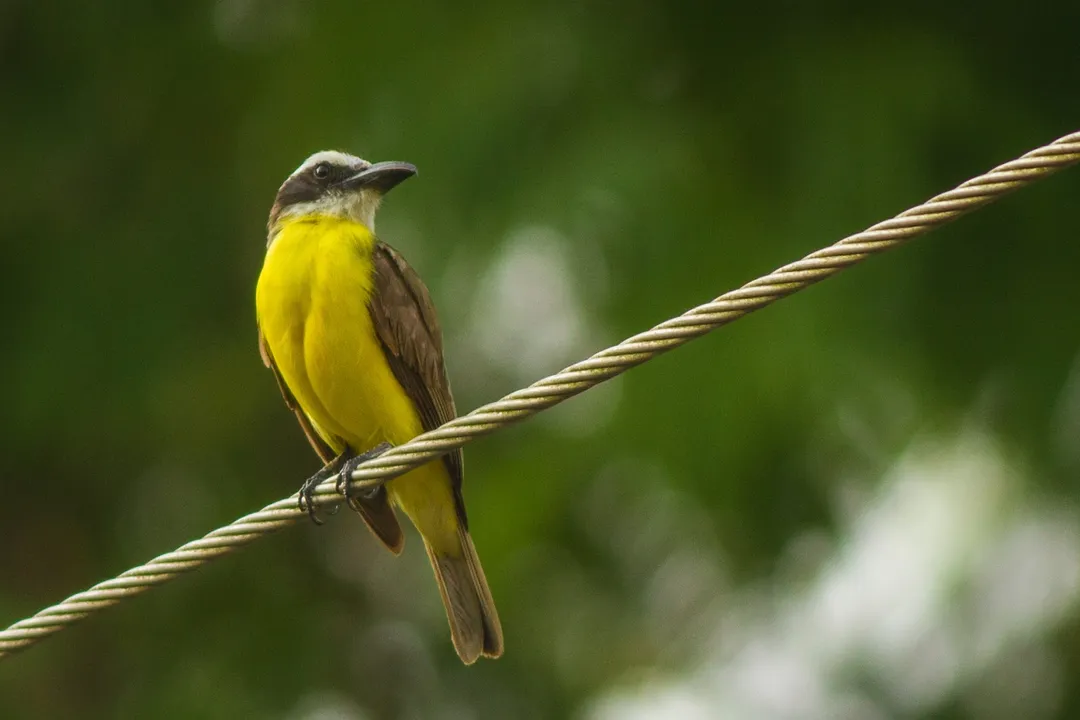
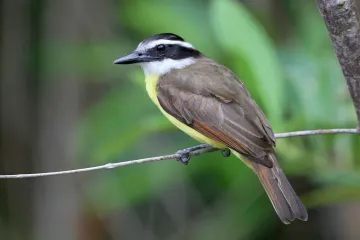
The Great Kiskadee sports a much bolder, more complex pattern on its head, which sets it apart immediately. It is a mix of black, white, and yellow. It possesses a black crown (which can reveal a hidden yellow/orange stripe when excited or alarmed) strongly contrasted by a bold white eyebrow stripe and a bright white throat. The back and wings are a warm reddish-brown, especially noticeable in flight, differentiating it from the Bananaquit's generally dark back. Its bill is also a crucial differentiator: the Kiskadee has a thick, stout, black bill suited for a hunter, whereas the Bananaquit has a short, slightly curved beak built for sipping nectar. Furthermore, the Kiskadee’s dark mask serves an optical function, operating similarly to the eye-black worn by athletes to reduce glare from bright sunlight or reflections off water surfaces—an adaptation perfectly suited to its hunting style.
# Diet and Foraging
The difference in diet reflects their respective body types and behaviors. One is a specialized nectar feeder; the other is an opportunistic omnivore and hunter.
The Bananaquit is primarily a nectarivore. It moves with quick hops and flits from flower to flower, perching briefly to sip nectar using its specialized paddle-shaped tongue. While known as the "sugar bird" because it eagerly visits feeders for sugar water or fruit slices (like bananas or oranges), it also consumes small insects and spiders. Importantly, the Bananaquit perches while feeding; it does not hover like a hummingbird, though it is sometimes mistakenly grouped with them due to its flower-visiting habits. Some individuals are known to be "smart foragers," piercing the side of a flower to get nectar quickly, which may bypass the pollination process.
The Great Kiskadee is a textbook flycatcher, known for its powerful, active hunting style. Its diet is incredibly varied: insects, fruit, small reptiles, amphibians, and even small fish. It utilizes the classic "perch and pounce" technique, sitting on an exposed branch—often high up and sometimes over water—watching intently before darting out to snatch prey mid-air or pluck it from the surface. The Kiskadee’s thick, strong bill is built to handle larger prey, and it has been observed eating items as varied as tadpoles and even bread from feeders. This predatory behavior contrasts sharply with the gentle sipping of the Bananaquit.
# Temperament and Vocalization
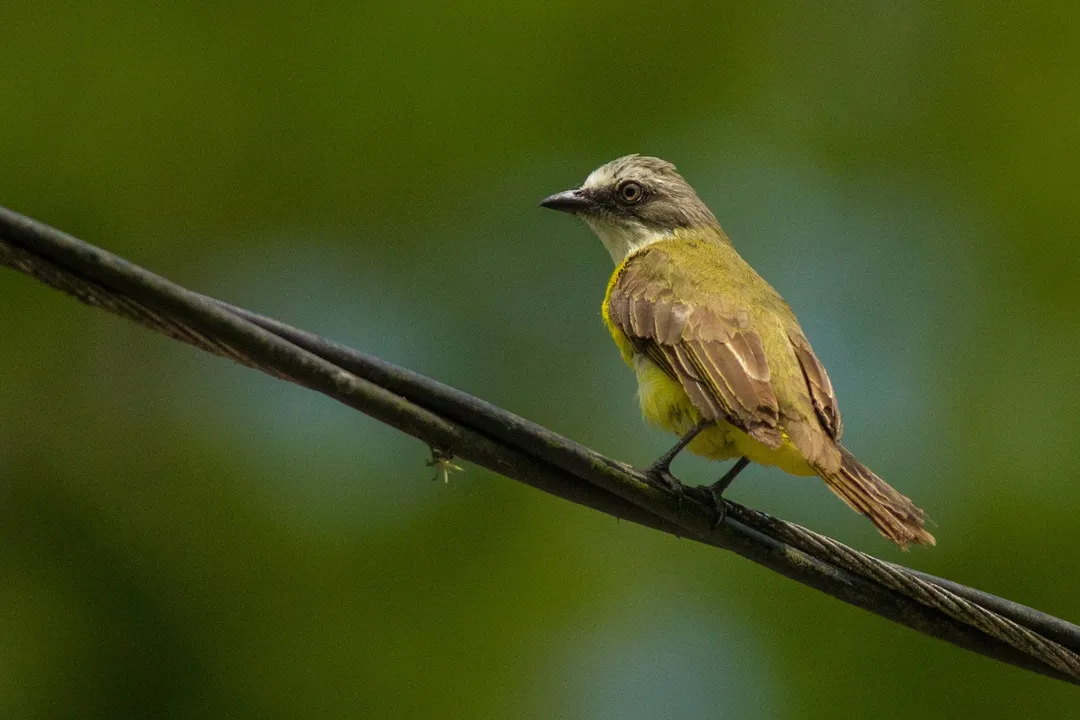
The sonic landscape of a tropical garden is often defined by the calls of these two birds, which are as different as their sizes.
The Great Kiskadee is arguably the louder and bolder of the pair, an extrovert that announces its presence proudly. Its signature call is unmistakable and piercing: a loud, ringing "BEE-tee-WEE!". This call is used for territorial defense, mating displays, and general communication, and it carries far. Kiskadees are known to be fearless; an observer might witness one aggressively chasing away birds much larger than itself, such as crows or even hawks, making it a formidable presence in its territory. In some cultures, its call is linked to superstition, leading to nicknames like the "whistling informer".
The Bananaquit, in contrast, is generally more reserved, though still curious. Its song is much quieter, consisting of high-pitched, cheerful "tsee-tsee" chirps that are more melodic than commanding. While shy in the sense that it prefers cover when resting, it can be quite bold around feeders, sometimes chasing slightly larger birds away from sugar water spots. Its defense mechanism is typically quick flight and concealment rather than confrontation.
# Habitat and Range
Both birds thrive in areas close to human habitation across the tropical Americas, but their specific preferences differ slightly.
The Great Kiskadee has a very broad range, stretching from southern Texas down through Mexico, Central America, and across much of South America into Argentina. It favors open woodlands, suburban areas, parks, and is often found near water bodies or even on urban structures like lampposts and rooftops for perching. It adapts readily to city life.
The Bananaquit also occurs across the tropical Americas and the Caribbean, but it tends to favor more vegetated, semi-open habitats. It is a common sight in gardens, bushes, and the edges of forests, but it generally avoids the deep, dense interior of primary forests. This preference means that while both might be found in a large city park, the Bananaquit is more likely the visitor around the dense shrubbery and flowering bushes, whereas the Kiskadee prefers the prominent, exposed branches overlooking clearings. An interesting note from birding logs in places like Costa Rica is that while the Kiskadee is a well-established flycatcher, the Bananaquit is sometimes tentatively categorized under the Tanager family. The adaptability of both species is evident in their success, though one does it with a shout and the other with a subtle flit.
# Nest Construction Insights
The architecture chosen by these two species provides another clear area for distinction, showcasing their different needs for security and materials.
The Great Kiskadee constructs a large, conspicuous, bulky nest that is dome-shaped and invariably features a side entrance. These nests are often built in trees, on utility poles, or on buildings—structures that offer exposure and a commanding view for the male guard.
The Bananaquit builds a much smaller, more discreet structure: a spherical nest, often looking like a ball, also usually with a side entrance. They use materials like grass, twigs, and even human-made trash, tucking their tiny homes into trees or trellises, relying on camouflage rather than sheer size for protection. When observing a nest, seeing one as large as a small thrown ball on an exposed branch strongly suggests a Kiskadee, while a compact, almost perfectly round structure tucked into dense foliage points toward the Bananaquit.
# A Comparative Checklist
For quick field reference, it is helpful to distill these differences into a direct comparison based on immediate sensory input:
| Feature | Bananaquit | Great Kiskadee |
|---|---|---|
| Size | Tiny (approx. $12$ cm) | Large (approx. $27$ cm) |
| Primary Diet | Nectar and fruit juice; sips | Insects, frogs, fish; hunts/pounces |
| Head Pattern | Dark crown, prominent white eyebrow | Black mask, white throat and eyebrow |
| Vocalization | Quiet, high-pitched "tsee-tsee" | Loud, piercing "BEE-tee-WEE!" |
| Behavior | Flits, zips, gathers; shy but curious | Perches, dives, chases larger birds; bold |
| Bill | Short, pointed, thin | Stout, thick, strong |
| Nest | Small, spherical, well-hidden | Large, dome-shaped with side door |
# Initial ID Strategy
When facing a potential identification dilemma, especially when one bird might be confused with other similar flycatchers—such as the Social Flycatcher or the Lesser Kiskadee—a birder must approach the observation systematically. If you are in an area where both the Kiskadee and Bananaquit are present, the first rule is often sound over sight, if possible. The Kiskadee’s proclamation is so loud and unique that if you hear the "BEE-tee-WEE!", you have your bird, regardless of the yellow on its belly. If the bird is silent, then focus on structure: if it is a large, somewhat blocky bird with a thick neck, it is the Kiskadee. If it is small enough to be mistaken for a large warbler or tanager, and you see that clear white stripe above the eye against a darker back, you are looking at the Bananaquit. Relying on this hierarchy—sound, then size/structure, then fine details like the black mask or the shape of the beak—will ensure a confident identification between these two common residents.
Related Questions
#Citations
Tulum, Mexico. Is this a bananaquit or a great kiskadee? Merlin ID ...
Bananaquit vs Great Kiskadee : 9 Main Differences - Earth Of Birds
Great Kiskadee Identification - All About Birds
Incredible Birds of Costa Rica - part 4 || Flycatchers, Warblers ...
5 (and a half!) things you didn't know about the Great Kiskadee
Great Kiskadee and Lookalikes - outdoor photography