What is the difference between thrush and Redwing?
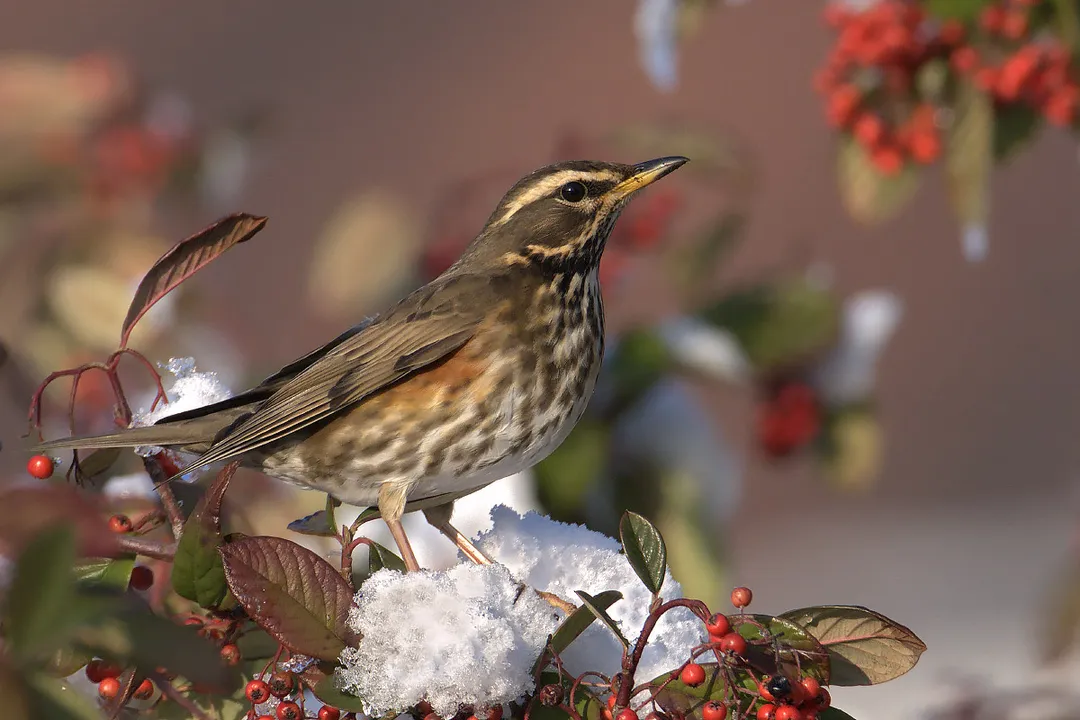
The birds we generally group under the umbrella term 'thrush' represent a fascinating collection of species, often sharing a similar body shape and a preference for speckled underparts, which frequently leads to identification challenges for the casual observer. [3] Among these beautiful, often migratory, birds, the Redwing stands out, requiring a keen eye to differentiate it from its close relatives like the Fieldfare, Song Thrush, or Mistle Thrush. [8][9] While all belong to a common family known for their rich songs, the Redwing possesses specific visual markers that set it apart from its European counterparts. [1][3]
# Thrush Family Traits
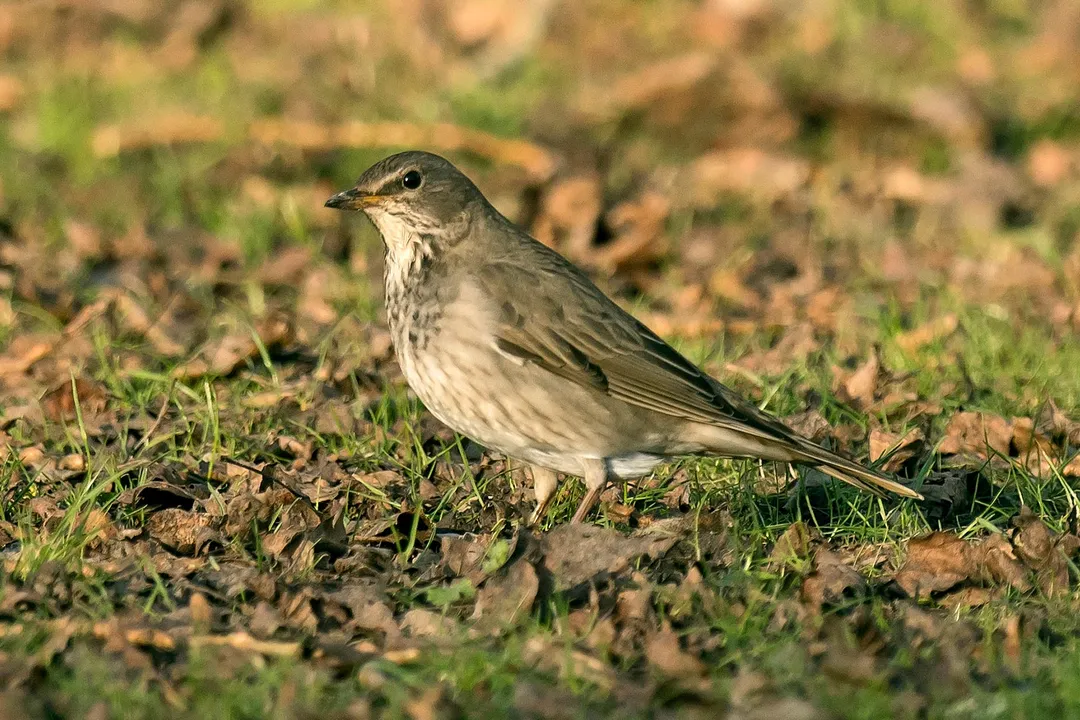
In many regions, the defining characteristic of the thrush family is that familiar breast pattern: a pale ground colour marked heavily with dark streaks or spots. [3] This similarity is one of the main reasons why even experienced birders sometimes hesitate when differentiating between species, particularly when the lighting is poor or the bird is moving quickly through scrub. [7] Species like the Song Thrush are famous for this spotting, often showing heavy, distinct black markings across a creamy or yellowish background. [3][9] The Mistle Thrush also shares this spotted look, though generally, its spots are larger and sparser, and the bird itself is bulkier than the Song Thrush. [9] Understanding the pattern of the spotting—how heavy, how sharp, and how far up the throat it extends—is often the first step in correctly placing the bird in hand. [9]
# The Redwing
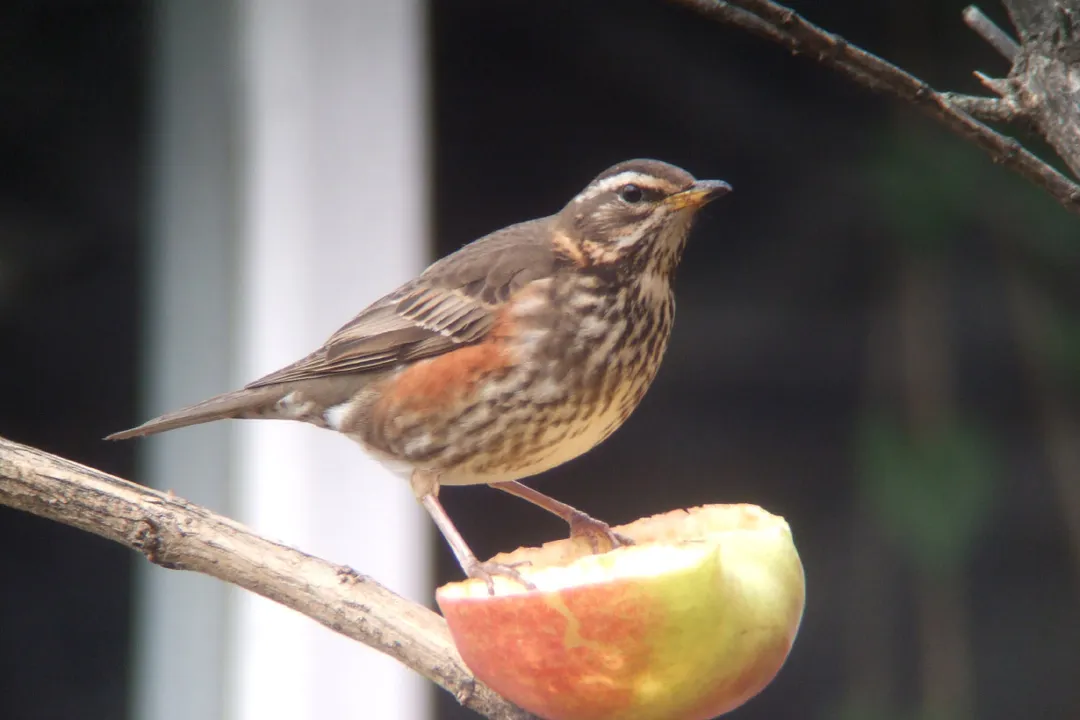
The Redwing (Turdus iliacus) is a smaller thrush compared to the Mistle Thrush, though often confused with the Song Thrush or the slightly larger Fieldfare. [1][8] Its name gives a hint to one of its most stunning features, though it’s often hidden: the bright rusty-red patch on its flanks (sides). [8] However, the absolute best field mark for positive identification, even at a distance or in flight, is the striking cream or pale yellow supercilium—the stripe above the eye—which contrasts sharply with the dark eye-stripe beneath it. [8] This strong facial pattern is key. [5] Furthermore, when the Redwing takes flight, the hidden colouration of the underwing flashes a brilliant, unmistakable reddish-orange hue, which is perhaps more reliable than the flank patches when the bird is standing still among leaf litter. [1][8] This underwing flash is a characteristic feature that separates it instantly from the Song Thrush or Mistle Thrush, whose underwings lack such vibrant colouration. [3]

# Close Relatives Fieldfare
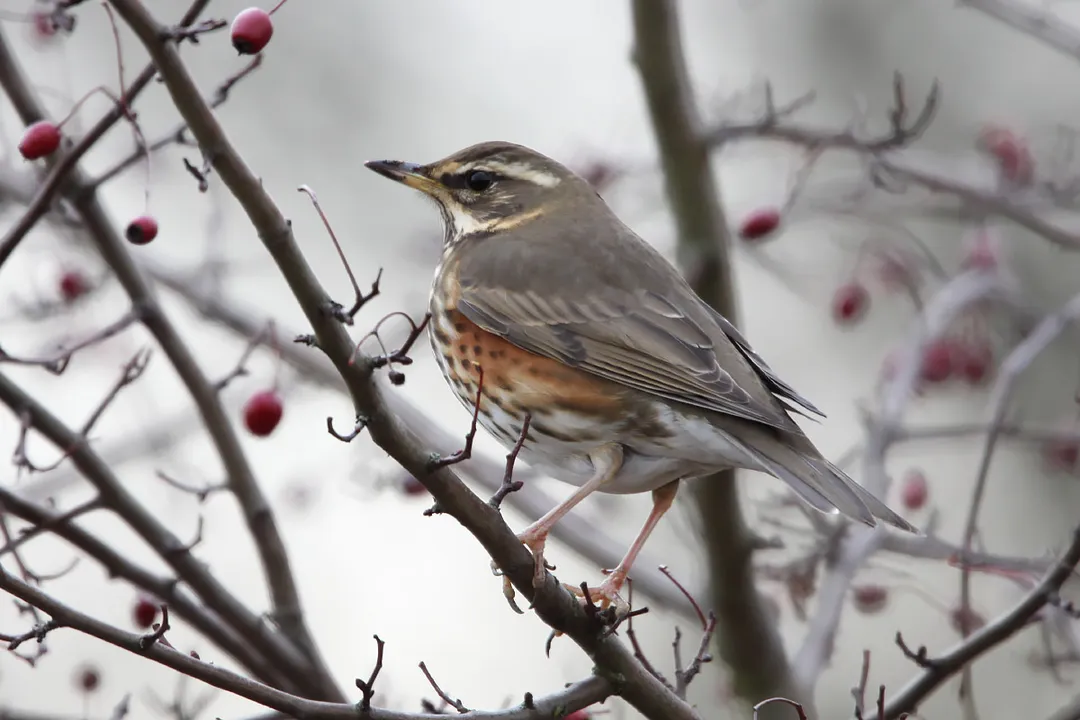
The Redwing often associates with the Fieldfare (Turdus pilaris), especially during migration or when foraging on the ground in winter flocks, making confusion between the two very common. [1] Both birds show reddish tones, but they manifest differently. The Fieldfare has a more distinctly pale, greyish head and nape, contrasting with a more buffy or washed-out breast compared to the Redwing's richer, more heavily speckled front. [1] While the Redwing's supercilium is long and creamy, the Fieldfare's is present but often appears paler, perhaps more whitish, and less prominent against its grey head. [1] In flight, the Fieldfare reveals a distinctive pale rump, a feature absent in the Redwing. [1] If you ever see a large, pale-rumped thrush pulling worms from a lawn, you are almost certainly looking at a Fieldfare, not a Redwing. [1] It is fascinating to watch a mixed flock of these two species; the Fieldfare tends to move and forage in larger, more cohesive groups, often kicking up leaves in a more aggressive, almost chaotic manner, whereas Redwings, while gregarious, sometimes appear a little more reserved in their movements when near a large Fieldfare contingent. [2]
# Other Spotted Thrushes
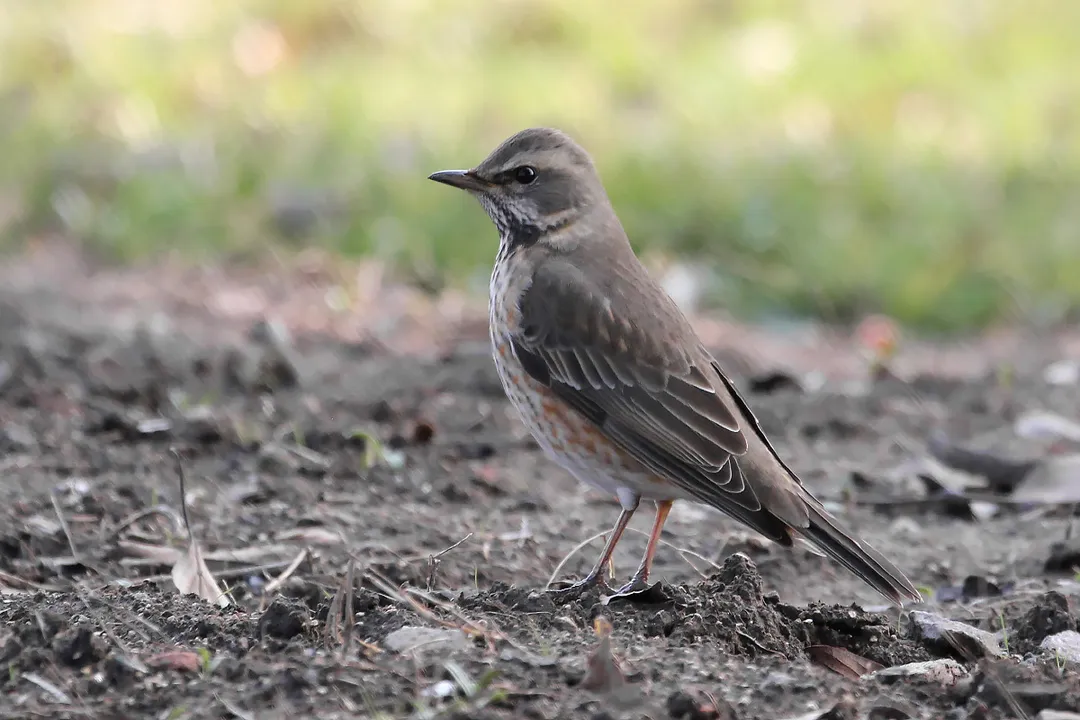
Distinguishing the Redwing from the resident Song Thrush and the larger Mistle Thrush requires focusing on the facial pattern and the extent of the spotting.
| Feature | Redwing | Song Thrush | Mistle Thrush |
|---|---|---|---|
| Breast Spotting | Fine streaks/spots, concentrated on flanks | Heavy, sharp V-shaped or arrow-shaped spots | Large, sparse, round spots |
| Supercilium | Prominent, creamy/yellowish, well-defined | Less obvious, usually buffy or washed out | Faint or indistinct |
| Flank Colour | Distinct rusty/red patches | Pale background with spotting | Pale background with spotting |
| Size | Medium-sized thrush | Medium-sized thrush | Largest of the three |
The Song Thrush shows very distinct, almost painted-on spots that often look like inverted 'V's pointing down towards the legs, set against a yellowish breast wash. [3][9] The Redwing’s spotting is generally finer and more streaky, often confined more to the flanks than the broad chest of the Song Thrush. [7] The Mistle Thrush, being the largest, often appears plainer overall; its spots are thicker and rounder, and crucially, the spotting often doesn't extend as high up the throat or on the upper breast as it does in the Song Thrush. [9] If you see a bird hammering a snail against a specific stone—a behaviour often associated with Song Thrushes—you can rule out the Redwing for that moment, as the Redwing's diet leans more toward insects and berries, particularly during the winter months. [3]
# Subspecies Variation
While the key field marks—the red flanks and pale supercilium—hold true across most of Europe, observers noting migrants should be aware that subspecies exist, though telling them apart in the field is notoriously difficult. [5] For instance, the Scandinavian race, Turdus iliacus iliacus, is generally considered to have slightly richer red flanks and a brighter supercilium compared to the Icelandic or Siberian forms. [5] For the average birder encountering a transient flock, focusing on the primary visual identifiers remains the most efficient identification strategy, rather than trying to parse subtle shade variations between subspecies. [5]
# Confusing Duplicates
A final point of caution, particularly for those who spend time in North America or are reviewing cross-continental field guides, is the potential confusion arising from similarly named species, though these are not closely related thrushes. [6] For instance, the Red-winged Blackbird is entirely different, a blackbird (Agelaius) with distinct red and yellow shoulder patches, while the Northern Waterthrush is an American warbler. [6] These instances highlight that when distinguishing between similar-looking Turdus thrushes—the Redwing, Fieldfare, Song Thrush, and Mistle Thrush—the focus must remain squarely on the fine details of the head pattern and underwing colouration to achieve a confident ID. [1][3][8] The specific texture of the markings, whether they are fine streaks or bold spots, provides a more reliable separation than overall size when birds are partially obscured or seen only briefly. [9]
#Videos
BTO Garden BirdWatch - Telling apart Redwing and Fieldfare
Related Questions
#Citations
Identifying Redwings and Fieldfares - BTO
redwing vs song thrush? or something else? found in leicestershire, uk
How to identify the UK's thrushes, including two special winter visitors
BTO Garden BirdWatch - Telling apart Redwing and Fieldfare
Distinguishing the subspecies of Redwing - Sibley Guides
Northern Waterthrush or female red winged blackbird? : r/birding
redwing or song thrush or hybrid? [Pictures] (Greece) - BirdForum
Redwing and rarer relatives photo ID guide - BirdGuides
Mistle Thrush vs Redwing - Birdbuddy WIKI