What is the difference between Great Kiskadee and Lesser Kiskadee?
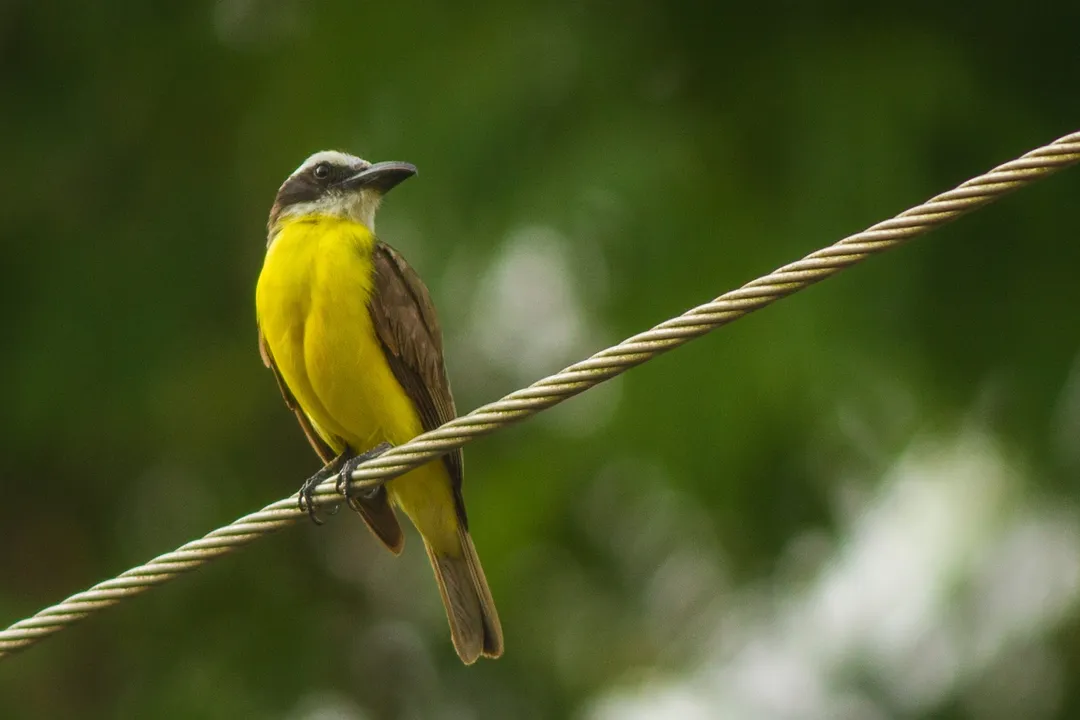
The calls of the Tyrannidae family often carry an assertive volume for birds of their size, and few are louder or more noticeable than the Kiskadees. Birders throughout the Americas frequently encounter two closely related species that can cause initial confusion: the Great Kiskadee (Pitangus sulphuratus) and the Lesser Kiskadee (Pitangus lictor). While both boast striking yellow undersides and bold head patterns, subtle structural differences, particularly around the face, are the keys to telling them apart successfully.
# Size Estimate

The most immediate, though sometimes deceptive, factor separating these two flycatchers is sheer size. The Great Kiskadee is the larger of the pair. Field guides place the Great Kiskadee at lengths around 10 to 10.5 inches. Conversely, the Lesser Kiskadee is noted as being noticeably smaller than its Great counterpart. When observing them side-by-side, this size disparity is clear, but when encountered alone, size can be hard to gauge without a reference point. However, the Great Kiskadee’s greater bulk gives it a generally more robust profile than the more delicate Lesser Kiskadee.
# Facial Markings

For many observers, especially those outside the Great Kiskadee's northernmost range, facial pattern analysis is the most reliable identifier, despite both birds sharing black and white head stripes.
# Head Stripes
The structure of the black lines on the head offers a critical diagnostic feature. The Great Kiskadee possesses a distinct black eye stripe that begins near the bill and runs through the eye. In contrast, sources describing the Lesser Kiskadee indicate that its black facial stripes meet above the bill, rather than extending all the way to it. This difference in the connection point—whether the stripes converge above the beak or a distinct black band runs fully from the bill to the eye—is a primary field mark. Additionally, the black band on the face of the Lesser Kiskadee is described as being narrower than that on the Great Kiskadee.
# Crown Flash
Both species share a hidden patch of bright color on their crown, used during territorial displays or excitement. For the Great Kiskadee, this concealed patch is described as bright orange-red. This color is usually hidden beneath the black crown feathers, only flashing into view when the bird becomes agitated or is posturing. While the Lesser Kiskadee also has a crown patch, it is generally described as smaller and more orange compared to its larger relative. Recognizing this patch, when displayed, can instantly confirm the species, provided the bird is exhibiting the corresponding behavior.

# Plumage Details
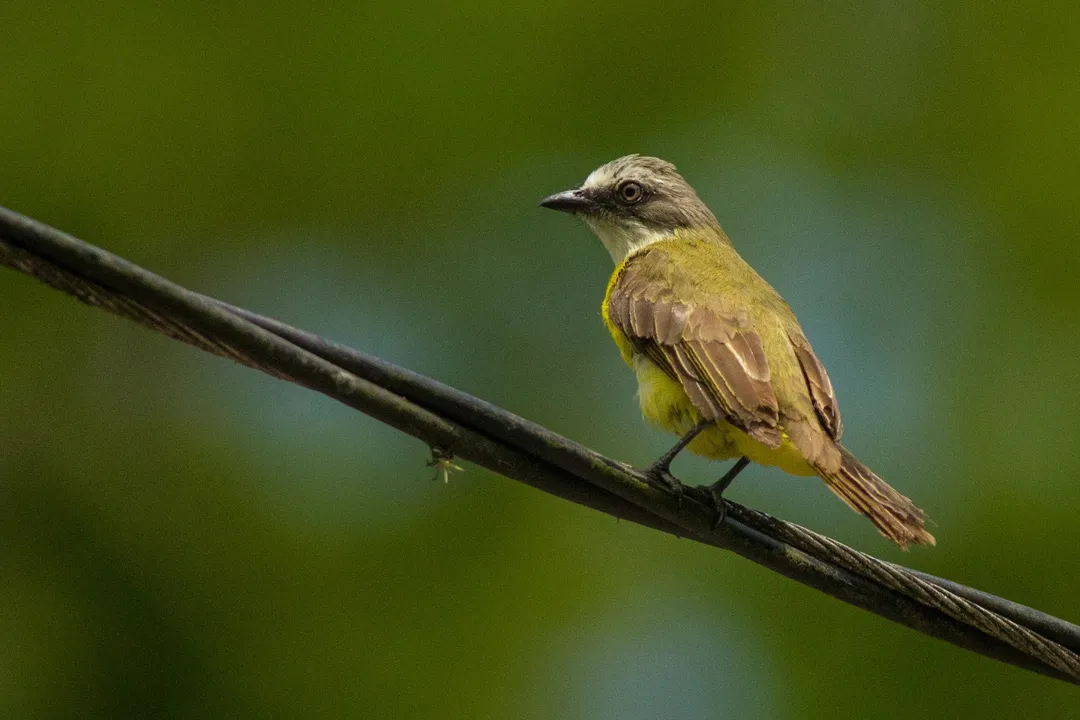
Aside from the head markings, the general body coloration follows a consistent pattern across the genus that can sometimes lead to confusion if one is focusing solely on the yellow belly. Both species exhibit a bright yellow belly and a white throat. A key feature shared by the Great Kiskadee, which is evident in its overall description, is the presence of rufous (reddish-brown) coloration on the tail feathers. While specific tail color details for the Lesser Kiskadee aren't always contrasted directly in these sources, the shared family appearance means observers must look past the yellow and focus intently on the head and size for accurate separation.
# Geographic Distribution
Where you observe the bird significantly narrows down the possible identification. The Great Kiskadee has an extensive range, stretching from the southern United States down through Central America and into South America. For example, it is a well-known species in places like Belize. The Lesser Kiskadee occupies a range further south, typically being found from Panama southward into northern South America. If you are birding in the Amazon region of Ecuador, for instance, the Lesser Kiskadee is a strong possibility, though the Great Kiskadee can also be present depending on the precise habitat and elevation. Knowing the regional overlap, or lack thereof, is essential for confirming an ID when features are ambiguous.

# Identification Tactics
Distinguishing between these two birds in the field requires a systematic approach, especially when the birds are not calling. If you find yourself in an area where both might occur, such as parts of Central America, you need to prioritize the most reliable markers.
When visual confirmation is difficult due to distance or lighting, paying close attention to the behavior associated with the crown patch can be more helpful than a simple measurement of stripe width. Since the Great Kiskadee's bright orange-red crown is often hidden, noticing any sudden, agitated movement that causes that flash of color to erupt is a positive confirmation of P. sulphuratus, as the Lesser Kiskadee's patch is smaller and less intensely colored. This behavioral clue bypasses the need to precisely measure the black band's width, which is prone to lighting distortion.
Another helpful approach is establishing a relative scale. If you are in a known range for the Lesser Kiskadee, you should treat any bird that appears particularly large or heavy-bodied as suspect for being the Great Kiskadee. Conversely, if the bird seems small and neat, it leans toward P. lictor. Since both birds announce themselves with loud vocalizations—the Great Kiskadee is famous for its harsh, unmistakable "kis-ka-dee" call—if the bird is singing, the species confirmation often becomes trivial, though the call structure might differ slightly between the two species across different regions.
# Comparison Summary Table
To aid in quick reference, here is a breakdown of the primary distinguishing characteristics discussed:
| Feature | Great Kiskadee (P. sulphuratus) | Lesser Kiskadee (P. lictor) |
|---|---|---|
| Relative Size | Larger, more robust | Smaller |
| Facial Stripe | Black stripe extends from bill through eye | Black stripes meet above the bill |
| Crown Patch | Larger, bright orange-red, often concealed | Smaller, more orange |
| Range | Southern US to South America | Panama south to Northern South America |
Ultimately, while both species are magnificent, assertive flycatchers dominating their local soundscape, the field guide key remains the connection point of the black facial stripe relative to the bill—a physical detail that remains consistent whether the bird is feeding quietly or announcing its presence across the landscape.
Related Questions
#Citations
How to tell the difference between Social Flycatcher and Great ...
Great Kiskadee and Lookalikes - outdoor photography
Great Kiskadee Identification - All About Birds
Lesser Kiskadee, Great Kiskadee, or another flycatcher? (Osa ...
Which Kiskadee? Yasuni, Amazonas, Ecuador. - BirdForum
Lesser Kiskadee Philohydor lictor - eBird
Birds of The World: Flycatchers, Kingbirds, Kiskadees (Tyrannidae)
Great Kiskadee and Lookalikes | Focusing on Wildlife
Birds of Belize: The Great Kiskadee | Lower Dover Field Journal