What physiological adaptation allows the Wood Frog to survive freezing solid during winter?
Answer
Possession of specialized cryoprotectants
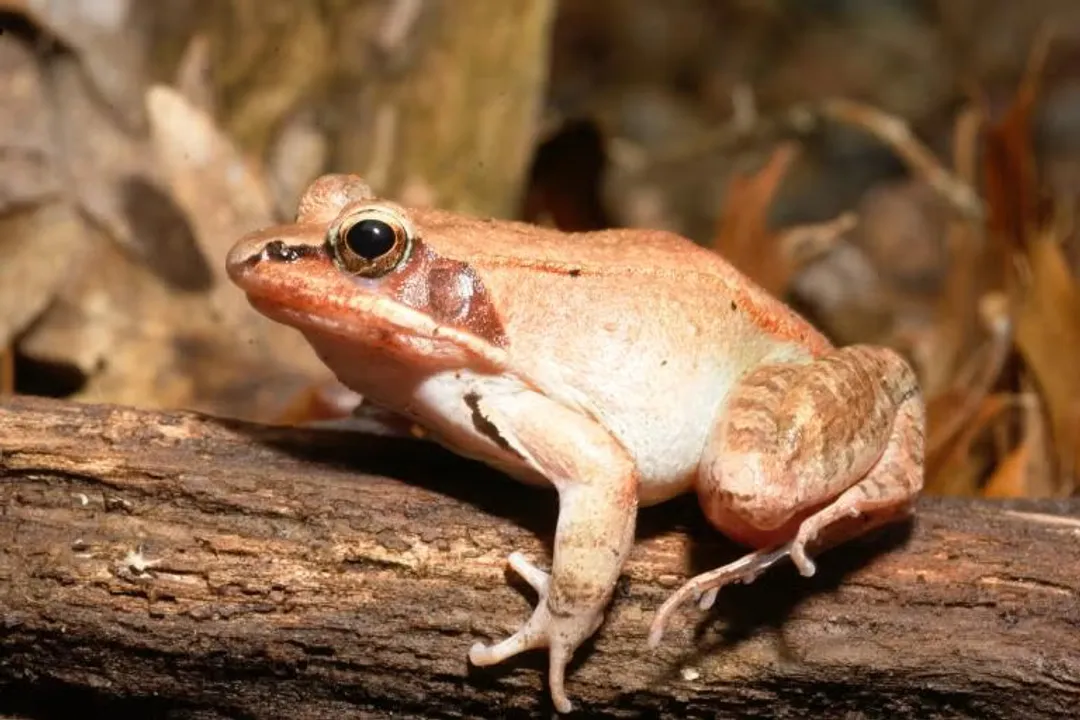
One of the most remarkable attributes of the Wood Frog is its specialized physiological adaptation allowing it to withstand freezing temperatures, a process unique among many woodland amphibians. This tolerance is achieved through the presence of natural antifreeze agents within its body fluids, referred to as cryoprotectants. These substances protect vital tissues by managing ice formation, allowing up to $65\%$ of the frog's body water to turn into ice and its heart function to cease temporarily, with a full recovery upon thawing in the spring.
Related Questions
What is the maximum snout-vent length (SVL) recorded for an adult Wood Frog in metric units?What marking is considered the single most reliable field mark for identifying the Wood Frog?What is the technical term for the two prominent, raised skin folds running down the Wood Frog's back?How is the skin texture of the Wood Frog generally described compared to other terrestrial frogs?What physiological adaptation allows the Wood Frog to survive freezing solid during winter?What characteristic describes the hind feet webbing of the Wood Frog?What coloration generally characterizes the ventral side (belly and throat) of the Wood Frog?Which scientific name is also used to classify the Wood Frog, depending on the classification system?What distinguishes the juvenile Wood Frog's facial mask from that of a mature adult?What behavior makes the Wood Frog notable among woodland frogs immediately following the spring thaw?In addition to the main dark mask, what lighter marking is frequently found immediately above the dark mask on the Wood Frog's head?