Wood Duck Physical Characteristics

The Wood Duck, scientifically known as Aix sponsa, is instantly recognizable, even to a casual observer, as one of North America’s most spectacularly colored waterfowl species. [1][3] The sheer vibrancy of the male, or drake, often stops people in their tracks, making it a favorite among birders and hunters alike. [7] While the male captures the most attention, the female, or hen, possesses a subtle beauty and distinct field marks that are just as crucial for proper identification. [1] Understanding the physical profile of this bird reveals adaptations suited to its unique wetland and woodland habitats. [6]
# Drake Colors

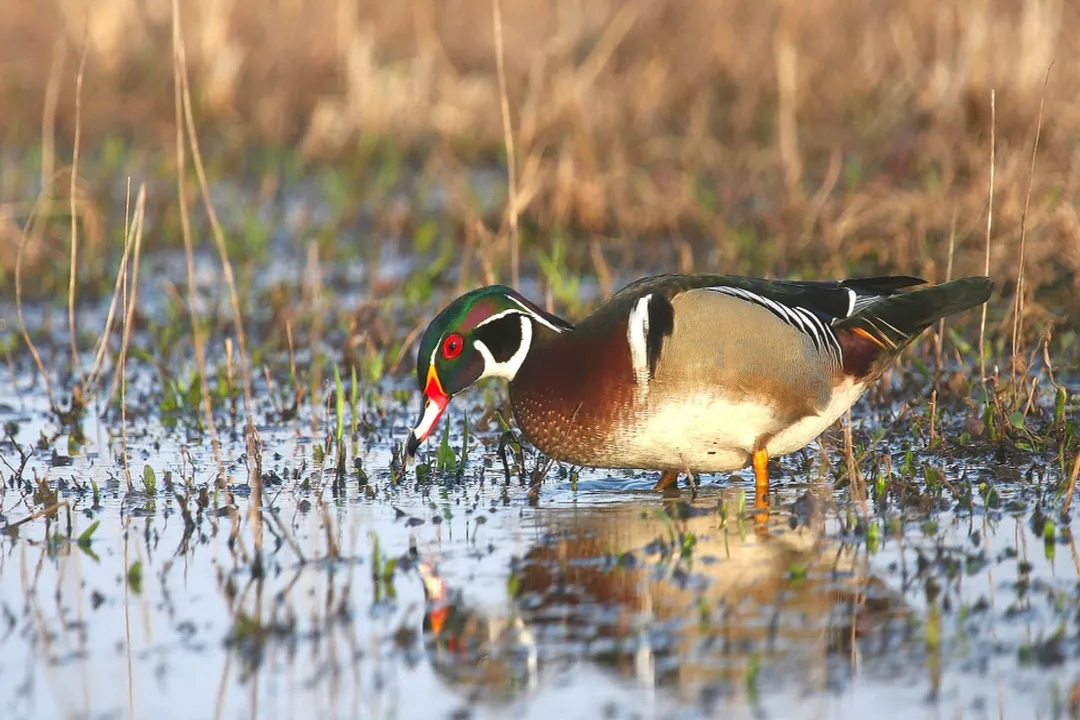
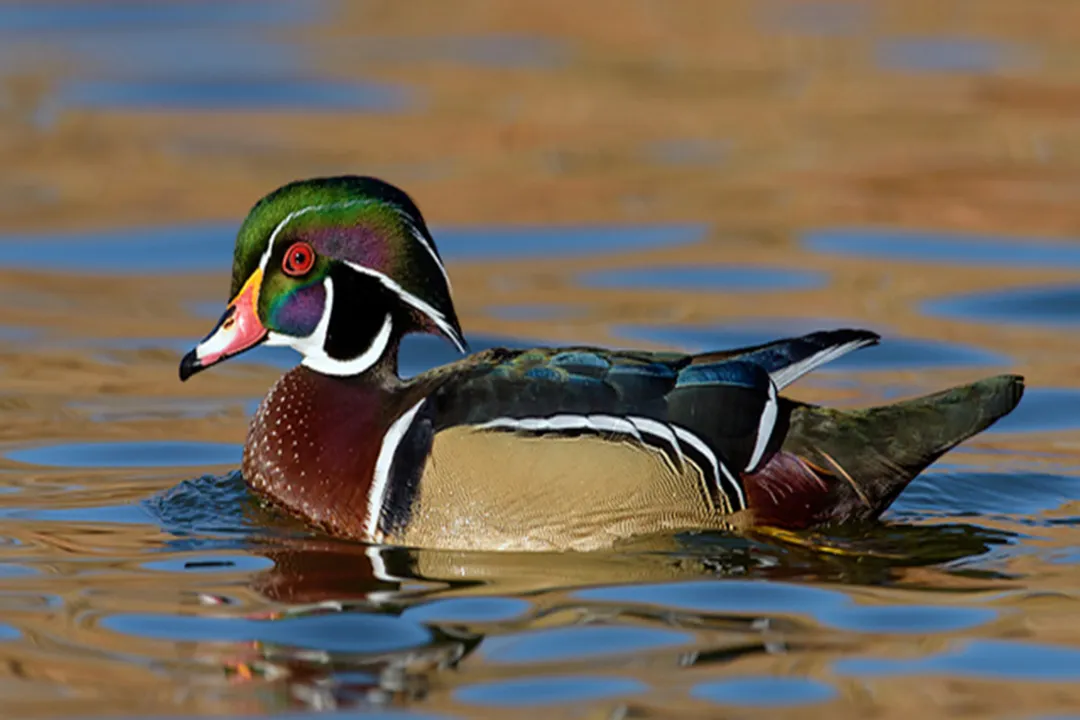
The male Wood Duck is arguably the most adorned duck in the region, and its name, sponsa, even reflects this finery, meaning "bride" or "bridal dress". [3] Its head and crest are truly arresting, presenting an iridescent sheen that shifts between deep purplish-bronze and dark green depending on the angle of the light. [1][6] This complex coloration on the crest is one of the key features that distinguish it from other waterfowl.
Moving down the head, the drake displays striking facial markings. A distinct, bright red eye is framed by white bordering, and a bold white stripe runs from the eye toward the back of the head. [1] Perhaps most defining is the extensive white patch that starts below the eye and sweeps down to cover the throat and the sides of the neck, creating a sharp contrast against the iridescent backdrop. [1][6] Two prominent white lines also border the darker plumage on the side of the neck, further segmenting the head pattern. [6]
The chest of the male is a deep, rich purplish-chestnut color, dotted with small white spots. [1][6] This rich color transitions into flanks of buffy-yellow or tan, separated from the chest by a noticeable black band. [1] The back is generally dark, but the secondary feathers on the wing feature an iridescent speculum that flashes blues and greens when the light catches it, much like the head coloration. [1][6] The belly provides a clean contrast, being pure white. [1]
# Hen Features
In contrast to the male’s dramatic palette, the female Wood Duck is considerably more subdued, primarily displaying various shades of grayish-brown. [1][6] While less showy, her plumage offers excellent camouflage within shaded nesting areas. [1] Her head is also crested, though the crest is noticeably shorter and less exaggerated than the male's. [1]
The most reliable field mark for identifying a female is the patterning around her eye. She possesses a prominent white eye-ring that encircles the dark eye, combined with a distinctive, elongated teardrop-shaped white patch that extends backward from the lower edge of the eye. [1][6] This bright eye-ring and patch stand out clearly against her otherwise muted head coloration. [1] Her chest is typically duller than the male's, often appearing brownish or grayish and flecked with white. [1] The rest of her body follows a general gray-brown pattern, though she shares the characteristic long, squared tail of the species. [6]
# Size and Form
Wood Ducks fall into the category of medium-sized ducks. [1] In terms of overall body structure, they possess a relatively slender profile when compared to some of the broader-bodied dabbling ducks. [7] A mature bird typically measures between 17 and 21 inches from bill to tail tip. [1][6] Their wingspan is fairly broad for their size, generally ranging from 25 to 29 inches. [1][6]
Weight can fluctuate based on season and sex, but a common range sees males averaging around 1.5 pounds and females slightly lighter at about 1.2 pounds. [6] However, weights can vary significantly, with individuals recorded anywhere from under one pound up to two pounds. [8] This size places them larger than many smaller puddle ducks but smaller than large diving ducks. [7] A curious note on their posture, particularly when resting on the water, is that they often sit noticeably higher on the surface compared to many other duck species. [7]
# Head Structure
The head crest is a hallmark of the Wood Duck and is pronounced in both sexes, though executed differently. [1] For the male, this crest is essentially an extension of the feathers on the crown and nape, engineered to catch the light and flash color. [1] The complexity of the feather arrangement here is incredible; imagine viewing the bird in dappled sunlight filtering through a thick canopy over a slow-moving stream—the constantly shifting iridescence of that crest and head plating would make the bird incredibly difficult to track precisely, creating a visual flicker effect that could confuse a predator or competitor. [1]
The female’s crest is reduced, acting more as a subtle curve to her silhouette than a dramatic visual feature. [1] Despite the difference in coloration, the shape of the crest remains an important indicator that you are looking at a Wood Duck rather than a different species of teal or Anas duck.

# Bill and Appendages
The bill structure of the Wood Duck is also distinctive and offers immediate clues for identification, especially when observing the bird foraging. [7] Unlike many common dabblers whose bills are broad and spade-like for filtering surface vegetation, the Wood Duck's bill is less exaggeratedly wide. [7]
The drake's bill is a spectacle in itself, featuring a complex pattern of colors: bright red at the base, transitioning to a patch of yellow, and ending with a dark or black tip. [1][6] This multi-hued bill, when combined with the red eye, creates a sharp contrast against the darker head plumage. [6] The female's bill is much simpler, typically appearing dark gray or blackish, though a small patch of color near the face may be visible. [1]
The legs and feet are another point of interest. For both sexes, they are generally yellowish to orange in color. [1][6] As cavity nesters that frequent wooded areas, their feet are well-equipped for perching on branches near the water, unlike the more strictly aquatic feet of many other waterfowl. [6] This adaptability in foot structure supports their behavior of nesting high up in tree cavities. [2]
# Plumage Variations
While the descriptions above cover the breeding adult plumage, it is important to remember that waterfowl undergo seasonal changes. [6] After the summer breeding season, adult males undergo a complete molt, entering a "eclipse" plumage that renders them temporarily much plainer, resembling the female more closely, albeit often retaining some of the male's body shape and perhaps slightly brighter markings. [6] This temporary transformation provides essential camouflage during the period when they are flightless or near flightless due to the simultaneous shedding of flight feathers. [6]
Juvenile Wood Ducks, both male and female, exhibit a plumage that generally mirrors the female's drabber appearance, though they often show less distinct eye-rings or the characteristic white teardrop patch. [1] A young male will begin to acquire flashes of his adult coloration throughout his first year, with full adult male plumage generally achieved by the time he is ready to breed, usually in his second fall. [6]
When trying to ID a bird in poor light, perhaps just as it flies past at dawn or dusk, focusing on the overall shape—the long, squared tail and the crested head—is often more reliable than waiting for the full spectrum of color to appear, especially if you are trying to distinguish a distant hen from another female duck species like a female Mallard. The shape remains constant, even when the light obscures the precise hues. [7] The sheer variety in plumage, from the fiery breeding male to the cryptic eclipse male and the subtly marked female, highlights why this species is considered physically remarkable across all its life stages. [1][3]
Related Questions
#Citations
Wood Duck Overview, All About Birds, Cornell Lab of Ornithology
Wood Duck | National Wildlife Federation
Wood Duck (Aix sponsa) | U.S. Fish & Wildlife Service
10 Fun Facts About the Wood Duck - National Audubon Society
Wood duck description and characteristics - Facebook
Wood duck - Wikipedia
Wood Duck Profile | MeatEater Hunting
Aix sponsa (wood duck) | INFORMATION - Animal Diversity Web
Wood duck | Smithsonian's National Zoo and Conservation Biology ...