What moniker do paleontologists often use for *Epicyon haydeni* due to its feeding habits?
Answer
Bone crusher
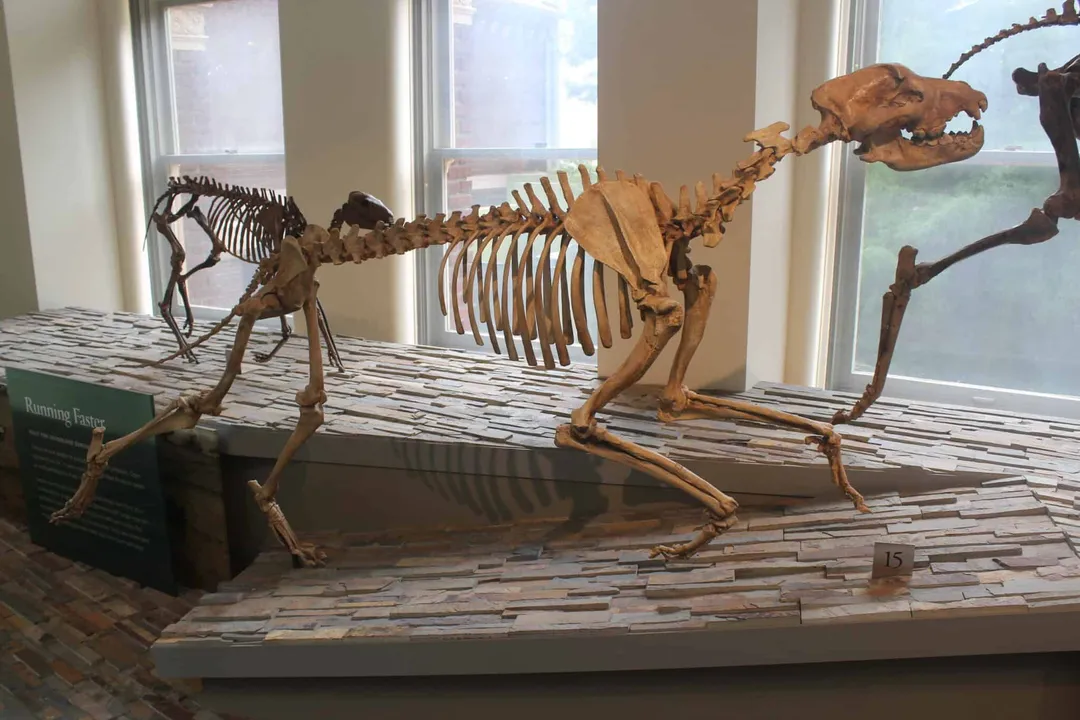
The name *Epicyon* itself hints at one of its most remarkable characteristics, leading paleontologists to frequently refer to this extinct predator as the 'bone crusher.' This nickname is directly attributable to its specialized physical adaptations, namely its robust skull and thick, blunt cheek teeth. These features indicate a dietary strategy centered around processing bone, a capability rare among modern canids. This contrasts sharply with the flesh-slicing focus of its modern relatives, signifying an ecological role requiring access to dense caloric resources like marrow.
#Videos
Epicyon, the largest dog species ever, capable of killing a tiger or ...
Related Questions
What is the estimated length of *Epicyon haydeni*, recognized as the largest canid?What specialized feature characterized *Epicyon haydeni*'s dentition for processing bone?What moniker do paleontologists often use for *Epicyon haydeni* due to its feeding habits?How did the robust build of *E. haydeni* contrast with modern cursorial canids?During which geological epoch did *Epicyon haydeni* exist as a giant among canids?What adaptation contrasts the bone processing strategy of *E. haydeni* with most modern canids?Which genus represents the line of canids that *Epicyon haydeni* is explicitly stated to predate?What caloric resource provided a competitive advantage to the bone-crushing *E. haydeni*?Based on feeding mechanics, what modern animal might *Epicyon* functionally resemble?What type of pursuit strategy did the powerful build of *E. haydeni* suggest, unlike long-distance chasing?