What is special about Amargasaurus?
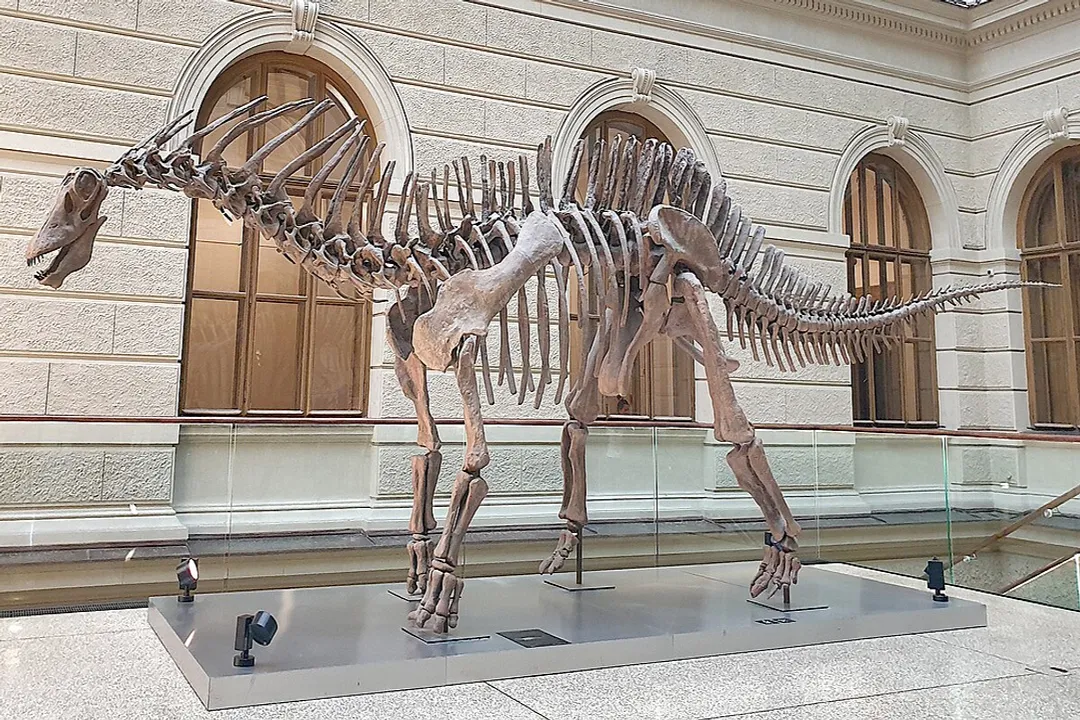
The Amargasaurus stands out immediately among the massive long-necked dinosaurs, often called sauropods, because it decided to trade sheer vertical scale for dramatic flair along its back. While its cousins stretched to heights that dwarfed modern buildings, this creature, which roamed South America during the Early Cretaceous period, roughly 129 to 122 million years ago, presented a silhouette unlike any other known giant. [1][5] It wasn't simply a scaled-down version of the giants; it was a specialized animal whose most defining characteristic was a series of tall, bony rods sprouting from its vertebrae, creating what looks like a spectacular medieval crest. [1][5]
# Early Clues

The initial discovery of Amargasaurus cazaui took place in Argentina, specifically within the geological beds known as the La Amarga Formation in Patagonia. [1][5] It was formally named by the renowned Argentine paleontologist José Bonaparte in 1991. [1] This region and time frame placed Amargasaurus in an ecosystem populated by formidable predators, including early forms of the giant carnivore Giganotosaurus. [1][5] Being discovered in the Southern Hemisphere links it directly to the diverse sauropod fauna that evolved in isolation on Gondwana, a continent that was still fragmenting during the mid-Cretaceous. [1]
# Midsize Profile

When discussing sauropods, the mind often jumps to giants like Argentinosaurus or Brachiosaurus, animals stretching far beyond 25 meters in length and weighing many dozens of tons. [5] Amargasaurus, by contrast, was relatively diminutive for a sauropod. [5] Paleontologists estimate its total length to be around 10 meters (approximately 33 feet). [1][5] Its estimated mass sits around 1 to 2 tons. [5] This medium size likely influenced its life history strategies, allowing it to occupy a different ecological niche than the truly gigantic long-necks of its time. [1] Its overall body plan was generally long and low-slung, typical of its family, but its neck structure was highly modified. [1]
# Spine Structure
The real spectacle of Amargasaurus is undoubtedly the double row of elongated neural spines that project upward from its vertebrae, running along both its neck and its back. [1][5] These spines are not just single projections; they are double-rowed, meaning they project upward and slightly backward, creating a distinctive, almost feathered or pronged appearance along the dorsal line. [1] In the neck region, these spines were the tallest, potentially reaching lengths of nearly a meter, though they shortened as they moved toward the tail. [1]
The precise function of these elaborate structures has been a topic of considerable debate among researchers. [5] One leading theory suggests they were primarily for display. [1] A tall, prominent crest would have been excellent for intraspecies communication, possibly signaling sexual fitness to potential mates or helping individuals recognize members of their own species in the dense Cretaceous landscape. [1] Another hypothesis centers on defense, suggesting the tall spines could have made the animal a far less appealing target for large theropod predators by presenting a formidable visual barrier or making a neck bite much more difficult. [1] A third possibility, often associated with such structures, involves thermoregulation—the sail-like arrangement could have functioned to absorb or dissipate heat, though the specific shape here perhaps favors display over sheer surface area efficiency. [1]
It is fascinating to consider how the scale of the display elements relates to the overall body size. For an animal only 10 meters long, having neck spines that approach a full meter in height represents a significant proportional investment in external ornamentation. This suggests that visual signaling was extremely important to the survival or reproductive success of Amargasaurus, potentially more so than for a Titanosaur whose massive body size alone provided ample visual presence. [5]
# Feeding Apparatus
Unlike the long, whip-like tails and pencil-thin teeth often associated with other sauropods like Diplodocids, Amargasaurus possessed a comparatively small, short skull. [1] This structure housed distinct, peg-like or spatulate teeth. [1] This specific tooth morphology suggests a highly specialized diet. It was likely adapted for browsing low-lying vegetation, such as ferns, cycads, and horsetails, rather than the high-level stripping of conifers seen in other sauropods. [1] The structure implies a precise, selective feeding method, perhaps nipping off the most nutritious bits of foliage rather than simply taking massive mouthfuls of less desirable bulk material. [1]
# Family Grouping
Amargasaurus belongs to the family Dicraeosauridae, a distinct lineage within the larger group of sauropods known as Neosauropoda. [1] Its closest relatives include the well-known Dicraeosaurus from the Morrison Formation in North America. [1] What unites the Dicraeosaurids is this shared feature of specialized, often tall, neural spines along the neck and back, contrasting them with the other major sauropod groups like the long-necked Diplodocidae or the massive Titanosauria. [1] This family represents an evolutionary experiment in sauropod morphology, emphasizing spinal ornamentation and shorter overall neck lengths relative to the giants of the Jurassic. [1]
# Niche Differentiation
The combination of specialized feeding tools and unique display structures suggests Amargasaurus occupied a specific ecological niche within the Early Cretaceous Patagonian environment. In ecosystems where very large herbivores (like contemporaneous titanosaurs) occupy the generalist, bulk-feeding role, a smaller dinosaur often finds success by specializing. [1] The low browsing style indicated by the teeth points toward Amargasaurus having been a ground-level feeder. [1] This positioning would have reduced direct competition with taller herbivores that stripped leaves from mid-level canopy layers. [1] It is plausible to imagine herds moving through denser, scrubbier undergrowth, using their relatively compact size to their advantage in navigating the landscape, while the striking dorsal sails flashed signals through the vegetation—a sort of "mid-story" specialist compared to the towering browsers. [5]

# Comparing Spine Variation
While the fossil evidence only gives us a snapshot of this species, the known specimens hint at variability in the spine structures, which is typical for many dinosaur species as they mature or between sexes. [1] One specimen shows very tall spines, while another might exhibit comparatively shorter ones, although this difference can sometimes be attributed to preservation biases or the exact position on the vertebral column. [1] A key area for future understanding will be obtaining more complete skeletons that allow paleontologists to map the full range of spine height and shape across a population, potentially confirming whether the variation relates to age, sex, or simply individual idiosyncrasies. [1] Without more specimens, we rely on the most complete fossils to define the species' iconic look.
# Interpreting the Record
The fact that the most distinctive features of Amargasaurus—the spines and the specialized teeth—are preserved alongside basic body proportions gives paleontologists a surprisingly rich picture of this animal's life strategy. [1] It was not a titan of mass, but a master of display and selective grazing. [1] Its existence demonstrates that even within the generally successful sauropod blueprint, evolution favored dramatic, localized specialization rather than just maximizing overall size throughout the Cretaceous period. [1]
Related Questions
#Citations
Amargasaurus
Dino News | The National Dinosaur Museum Amargasaurus
Amargasaurus: 10 Best Dinosaur Facts For Kids
Amargasaurus | Western Australian ...
Amargasaurus
Exhibit Spotlight: Amargasaurus cazaui
Amargasaurus | Jurassic Park Wiki - Fandom
Amargasaurus
Amargasaurus | Research Starters