How big is the Epicyon haydeni skull?

The question of the exact dimensions of the Epicyon haydeni skull remains a topic that requires deep dives into paleontological literature, but the fossil evidence we do have paints a vivid picture of a creature whose entire head structure was built for sheer destructive power. When we look at the known remains of this prehistoric canid, which roamed the North American plains roughly seven million years ago, the immediate takeaway is not just how big the head was, but how it was built. Epicyon haydeni holds the distinction of being the largest dog that ever lived, a title that inherently suggests massive, powerful cranial structures to support its lifestyle.
# Largest Canid
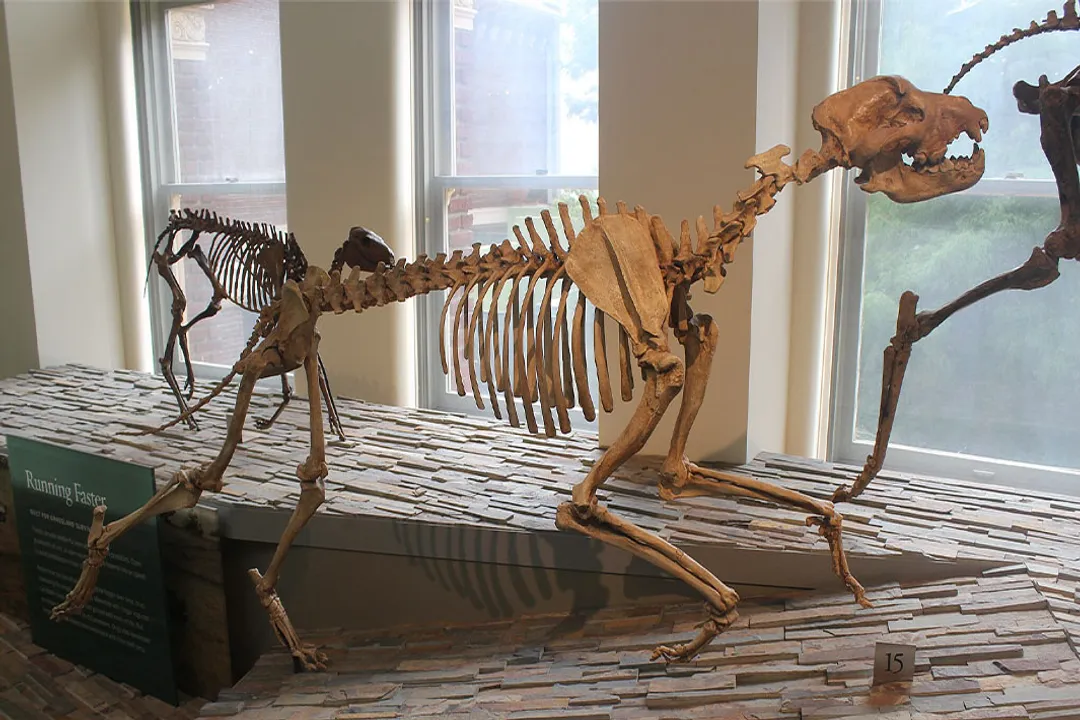
To appreciate the skull, one must first understand the animal it belonged to. Epicyon haydeni was truly enormous for a member of the dog family, often equated in size to a small bear. While precise figures for body length are often estimates or derived from fragmentary remains, researchers place its shoulder height around 1 meter, or 3.3 feet. More telling for cranial scale is the estimated body mass. These bone-crushing dogs were considerably heavier than any modern wolf, likely reaching weights up to 200 pounds, and possibly slightly more, around 220 pounds (100 kg).
This places Epicyon into a size class that modern canids simply do not occupy. For comparison, a very large modern Gray Wolf (Canis lupus) might weigh around 175 pounds at the extreme upper end of the species range, but Epicyon seems to have been consistently heavier and much more robustly built. This massive body weight necessitates a skull capable of handling enormous loads during feeding and intraspecific competition. The general assessment places it as the undisputed heavyweight champion of the canid family tree.
# Jaw Structure
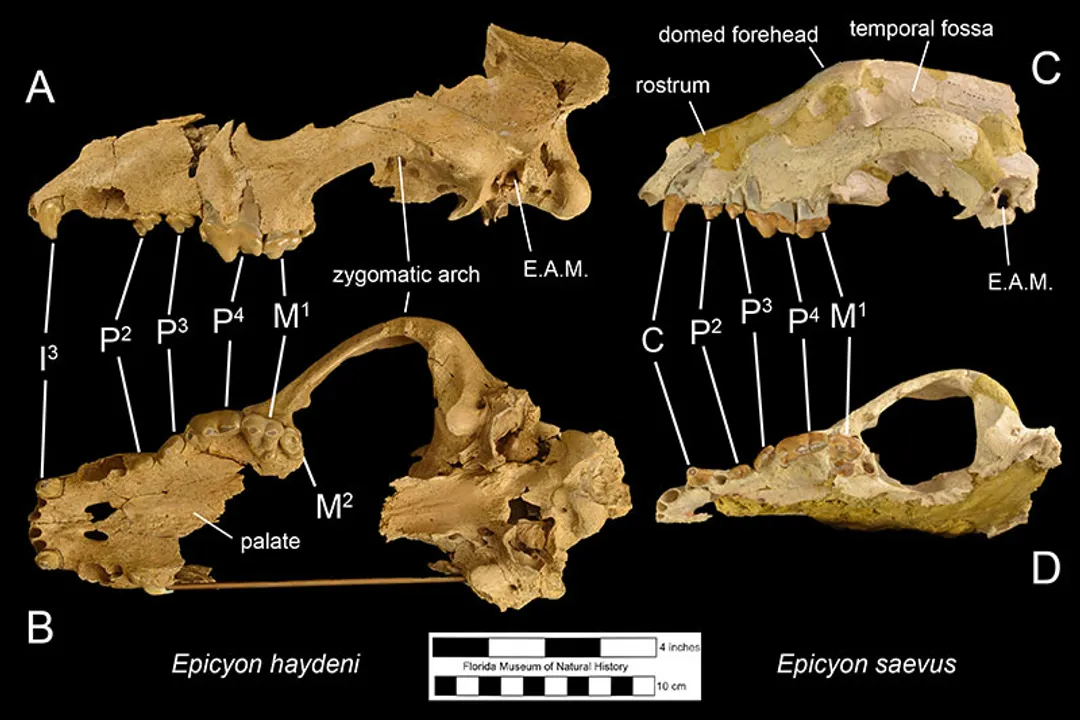
The most significant characteristic evident from the fossil record concerning the Epicyon skull is its adaptation for bone-crushing, placing it firmly within the subfamily Borophaginae. This specialized feeding habit dictates specific morphological requirements in the skull's architecture. While we may lack a singular, published measurement for the total length or width of a complete Epicyon haydeni skull, the implications of its dentition and jaw mechanics are clear.
The jaws themselves were exceptionally robust, designed not just for shearing meat but for exerting immense pressure to fracture bone. This implies a comparatively short, broad snout compared to leaner, running predators like modern coyotes or even wolves, where a longer muzzle aids in faster, more precise strikes. A shorter, stockier muzzle generally allows for greater mechanical advantage in bite force transmission.
Imagine a modern Black Bear, which is the size comparator often used. While a bear’s skull is large, Epicyon carried that mass in a predatory package. A key structural element tied to this function would be the sagittal crest—the ridge of bone running along the top of the skull. In hypercarnivores specialized for powerful bites, this crest serves as a critical anchor point for the massive temporalis muscles, the primary muscles responsible for closing the jaw. While source descriptions focus on the overall robustness, it is a near certainty that the Epicyon skull exhibited a significantly more pronounced sagittal crest than its modern relatives to accommodate the necessary muscle volume for bone breakage.
If we consider the known overall robusticity, a fascinating proportional comparison arises. Modern canids, especially those adapted for biting, often have a skull-to-body-mass ratio that balances head size against the need for speed and agility. Because Epicyon was built more like a heavy-duty blunt instrument than a fast sprinter, its skull likely occupied a greater percentage of its total cranial-caudal length than in a modern wolf of comparable mass, even if the absolute skull length was proportionally similar to other large wolves. The difference lies in the depth and width—the sheer volume packed into the jaw and temporal regions—rather than just the length from nose to the back of the cranium.
# Fossil Dimensions Context
While the skull itself eludes a simple summary statistic in these readily available sources, we can anchor its likely size using the known length of its limb bones. One source mentions an eight-foot-long bone associated with this massive dog, possibly referring to a reconstructed total length or a very long femur used in size estimates. If we take the estimated 3.3-foot shoulder height and a reasonably proportioned body length (perhaps 5 to 6 feet from nose to tail base, typical for a bear-sized quadruped), the skull must have been substantial enough to command the forequarters of an animal weighing up to 220 pounds.
We can try to infer a potential skull length by looking at other large extinct canids, though caution is required. For instance, a large modern wolf might have a skull length in the range of 10 to 12 inches. Given Epicyon's significantly greater mass and robusticity, it is reasonable to estimate that the skull of Epicyon haydeni would have been noticeably longer than 12 inches, perhaps approaching the 14- to 16-inch range, but with a considerably greater vertical depth and width across the cheekbones compared to a proportionally sized modern predator. This depth is what provided the mechanical advantage for crushing.
To put this inferred size into a functional context, consider the mechanics of force. To crush thick weight-bearing bones, the force required is substantial. This requires not only powerful muscles anchored to the skull but also thick bone walls in the maxilla and mandible to resist cracking under the high impact stress. Paleontologists examining these fossils invariably note the thickened bone texture in these regions, which directly impacts the overall size and bulk of the skull structure, even if the external measurements look less extreme than one might initially expect for an animal this heavy.
# Comparative Analysis
Comparing Epicyon to other large prehistoric predators helps contextualize the skull. While dire wolves (Canis dirus) were formidable, Epicyon appears to have been the heavier animal, prioritizing crushing power over sustained running speed. A dire wolf skull, while robust for a Canis, would have lacked the extreme bone-crushing adaptations of the earlier Borophagine canids like Epicyon.
If we look at the fossil record broadly, the lineage of bone-crushing dogs was gradually replaced by more cursorial (running) forms, which generally favored longer, lighter skulls suited for rapid pursuit and killing bites, rather than protracted grappling with bone. Epicyon's skull represents the apex of the bone-crushing specialization within this group before the shift in ecological dominance occurred. Its robustness is the key differentiator; it's not just about the overall length but the density and muscle attachment area provided by the skull's architecture.
This divergence in form is critical to understanding why a direct size comparison is often less illuminating than a functional one. A predator specialized in slicing flesh might have a longer, narrower skull, maximizing the cutting edge of its canines relative to the bone structure supporting them. Epicyon, however, needed a "nutcracker" skull—short, deep, and incredibly strong—to process the entire carcass, including the nutrient-rich marrow locked inside bones that other predators left behind.

# Life Reconstruction Considerations
When paleoartists reconstruct Epicyon, the skull size must be balanced with the depicted body mass. If the body is correctly scaled to the 200-pound estimate, the skull cannot appear delicate or small; it must look heavy and somewhat blocky atop the neck. If one were to encounter a cast of an Epicyon skull in a museum setting, the immediate impression would likely be one of immense width across the zygomatic arches (cheekbones) and the density of the jaw bones, more so than surprising length.
This points to an important takeaway for general readers: the most impressive dimension of the Epicyon haydeni skull is its inferred strength-to-volume ratio. It was an engineered weapon for its niche. While we may not have a definitive museum label stating "Skull Length: 15.5 inches," we know it was the foundation for the most powerful biting instrument known in canid history. This specialization required a significant investment in cranial structure, making the skull one of the defining features of this "small bear" sized dog of the Miocene epoch. The exact measurement is less important than understanding that every aspect of that skull was calibrated for maximum crushing utility in the prehistoric environment.
Related Questions
#Citations
Epicyon haydeni – Florida Vertebrate Fossils
Dire Wolf (maximum size) vs Epicyon haydeni - Bestiary - Tapatalk
Ancient eight-foot long “bone-crushing” dog was the largest ever
This prehistoric monster is the largest dog that ever lived and was ...
Epicyon - Prehistoric Wildlife
The Prehistoric World - Facebook
Epicyon | Dinopedia - Fandom
Epicyon vs Deinonychus - Animalia Enthusiasts - ProBoards