What is the primary morphological feature distinguishing *Cerastes cerastes* from *Cerastes vipera*?
Answer
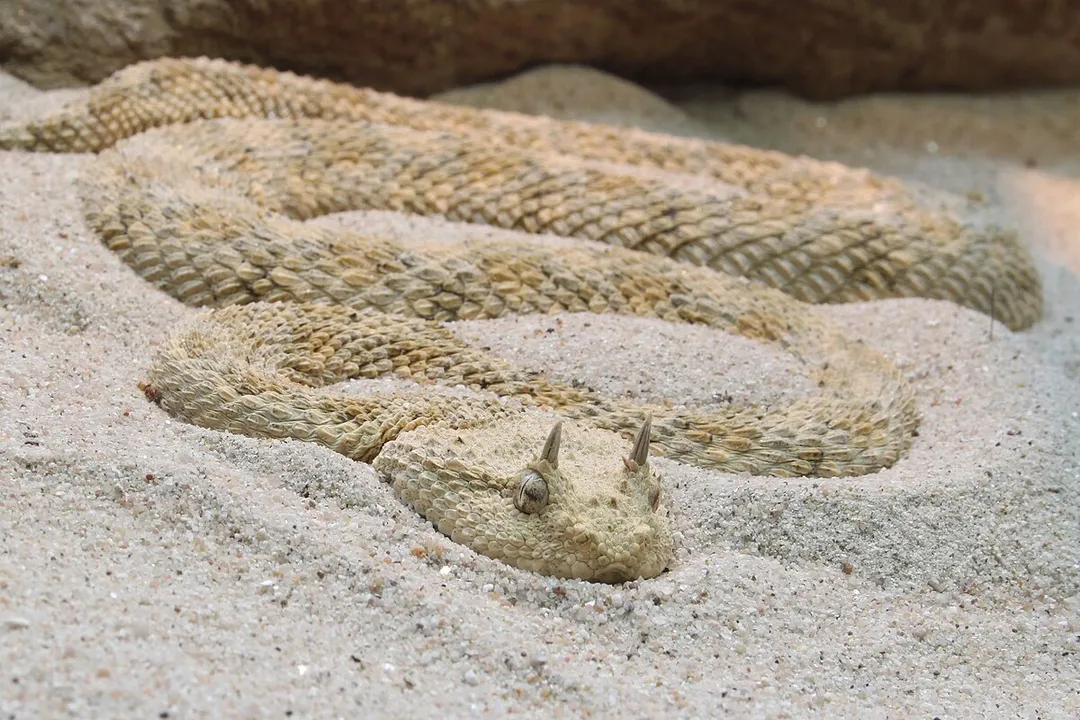
*C. cerastes* typically possesses one or two prominent horns, while *C. vipera* completely lacks them.
The presence of one or two prominent supraocular horns is the primary physical feature that taxonomically separates *Cerastes cerastes* from its close relative, *Cerastes vipera*, which lacks these structures.
Related Questions
What distinct feature immediately recognizable on *Cerastes cerastes* gives it its common name?Which Order encompasses all lizards and snakes, characterized by kinetic skulls and shedding skin?What key anatomical characteristic defines the Family Viperidae, placing *C. cerastes* among true vipers?What is the primary morphological feature distinguishing *Cerastes cerastes* from *Cerastes vipera*?To what Greek word does the genus name *Cerastes* trace its derivation?What classification level often relies on countable, fixed traits like the number of ventral scales for delineation?In what year and under which genus was *C. cerastes* originally described by Carl Linnaeus?The *Cerastes* genus is specialized for which type of locomotion often associated with fine, loose sand?Where is the Genus *Cerastes* generally geographically restricted?What does classification in the Class *Reptilia* indicate about *C. cerastes*'s physiological traits?