What is the taxonomy of the northern elephant seal?

The classification of the northern elephant seal, Mirounga angustirostris, places this massive marine mammal within a specific branch of the animal kingdom that defines its evolutionary relationships and shared characteristics with other life forms. Tracing this lineage, we begin at the broadest level with the Kingdom, where the northern elephant seal belongs to Animalia, indicating it is a multicellular, heterotrophic organism. [1][2][5] Moving down the hierarchy, it falls into the Phylum Chordata, signifying that at some point in its development, it possessed a notochord, a dorsal nerve cord, and pharyngeal slits. [1][2][5]
# Class Mammalia

The next classification step leads to the Class Mammalia, a grouping that encompasses all warm-blooded vertebrates characterized by the presence of mammary glands in females, hair or fur, and three middle ear bones. [1][2][5] This membership firmly establishes the elephant seal as a creature that nurses its young and maintains a constant internal body temperature, crucial for surviving in the cold ocean environment. [5]
# Order Carnivora

Within Mammalia, the northern elephant seal is placed in the Order Carnivora. [1][5] While the modern perception of Carnivora often centers on predatory terrestrial animals like bears or cats, this order historically groups animals sharing common dental characteristics suited for shearing flesh, though the diet of elephant seals is specialized. [5] This order includes both dog-like (Caniformia) and cat-like (Feliformia) suborders, placing the elephant seal in the Caniformia group alongside weasels, bears, and otters. [1]
# Family True Seals

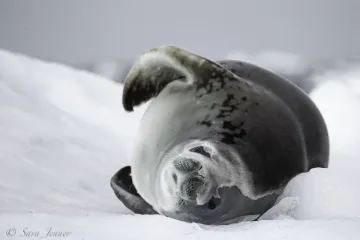
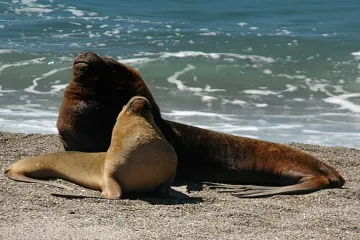
The family level is where the elephant seal begins to share more immediate physical traits with its closest relatives. The northern elephant seal is a member of Phocidae, commonly known as the true seals. [1][2][5] This is a key distinction in pinniped classification. True seals are characterized by their lack of external ear flaps—unlike sea lions and fur seals (family Otariidae)—and their method of terrestrial locomotion, which involves wriggling or "galumphing" because their hind flippers cannot rotate underneath their bodies. [1][7] It is interesting to observe how this massive animal, sometimes weighing over 4,000 pounds, is grouped by relatively subtle anatomical features like the absence of an external ear pinna, rather than just sheer physical bulk. [3][4]
# Genus Grouping
The classification narrows further into the Genus Mirounga. [1][2][5] This genus is shared with its only close relative, the Southern elephant seal (Mirounga leonina). [1] The origin of the name Mirounga is quite distinct from the descriptive Latin used for the species name. It is widely believed to be derived from an Indigenous Australian word, perhaps mirowar, which referred to a large aquatic animal. [1] This linguistic divergence—using an Indigenous Australian term for a genus that spans both the Northern and Southern hemispheres—provides a unique cross-cultural marker within scientific nomenclature, contrasting sharply with the descriptive Latin often employed for the species level. [1]
# Species Designation
Finally, the specific species is Mirounga angustirostris. [1][2][5] The species epithet, angustirostris, is Latin and translates directly to "narrow-beaked" or "narrow-snouted". [1][6] This descriptive name specifically references the most notable feature distinguishing the males of this species from those of the Southern elephant seal—the much smaller, less bulbous proboscis (or nose) that the males develop as they mature. [1][6] This specific anatomical difference is critical for species identification in the field and within the taxonomic record. [7]
Here is a summary of the standard taxonomic hierarchy for quick reference:
| Rank | Classification |
|---|---|
| Kingdom | Animalia |
| Phylum | Chordata |
| Class | Mammalia |
| Order | Carnivora |
| Family | Phocidae |
| Genus | Mirounga |
| Species | M. angustirostris |
| Authority | Gray, 1875 |
# Species Distinction
The genus Mirounga is monospecific except for the presence of the Southern elephant seal (M. leonina). [1] While both species share the genus name due to their shared morphology and general characteristics—namely their immense size, sexual dimorphism (males are significantly larger than females), and the characteristic proboscis in males—they are geographically separated and distinct species. [1] The Northern elephant seal is found along the Pacific coast of North America, ranging from Baja California north to Alaska, whereas the Southern species occupies sub-Antarctic and Antarctic islands. [3][4][6]
The subtle differences encoded in their species names reflect the scientific decision to keep them separate. M. angustirostris is the narrow-snouted species, while M. leonina (lion seal) reflects the lion-like appearance of the large, mature males. [1] Even though they are closely related, their reproductive isolation across the equator ensures they remain distinct evolutionary units. [1] A key takeaway for any naturalist studying these animals is recognizing that while the Southern species is generally larger overall, the males of M. angustirostris still achieve sizes approaching 5,000 pounds, making them an astonishing example of gigantism within the seal family. [3][4]

# Taxonomic Authority
The formal scientific description and naming of the Northern elephant seal date back to 1875, credited to Gray. [1] In biological taxonomy, the name assigned to a species is followed by the authority who first described it, sometimes including the year. In this case, the full binomial nomenclature is often written as Mirounga angustirostris Gray, 1875. [1] This practice establishes a clear, citable reference point for the scientific community regarding the species' initial formal recognition and placement within the Linnaean system. [1]
# Comparative Taxonomy
Understanding the taxonomy of M. angustirostris benefits from comparing it to other seals. As a member of the Phocidae family, it shares characteristics with harbor seals and leopard seals, but its classification within the genus Mirounga sets it apart from all other true seals globally. [7] Its immense size and breeding ecology place it in a class of its own within the North Pacific region. For instance, a seal found near the Channel Islands or Año Nuevo State Park in California is unequivocally M. angustirostris based on these established taxonomic rules, distinguishing it from any vagrant Southern elephant seal that might occasionally wander far north. [7][9] The clear division at the genus level highlights that while they are true seals, their ecological niche and physical evolution have diverged significantly enough to warrant separation from other North Pacific phocids like the northern fur seal or sea lion, which belong to entirely different families (Otariidae). [1] The taxonomic structure clearly prioritizes shared ancestry and defining morphological features—like the external nose structure—over superficial similarities such as general streamlined body shape. [1]
The rigorous application of this system, from Kingdom down to the specific epithet, ensures that scientists worldwide understand exactly which animal is being discussed, regardless of local common names that might be misleading or applied inconsistently across different coastal regions. [3][9] This precision is vital for conservation efforts, such as those managed by NOAA Fisheries, which track population dynamics based on these specific biological identifiers. [3]
Related Questions
#Citations
Northern elephant seal - Wikipedia
Northern Elephant Seal | NOAA Fisheries
Northern elephant seal - Mirounga angustirostris - OBIS-SEAMAP
Northern Elephant Seal (Mirounga angustirostris)
Mirounga angustirostris (northern elephant seal) | INFORMATION
Mirounga angustirostris Northern Elephant Seal - Species Summary
Northern Elephant Seal - Channel Islands National Park (U.S. ...
Mirounga angustirostris: Taxonomy and Image Index File
Northern Elephant Seal - Creature Feature - WiseOceans