What are the characteristics of a Gaboon viper?
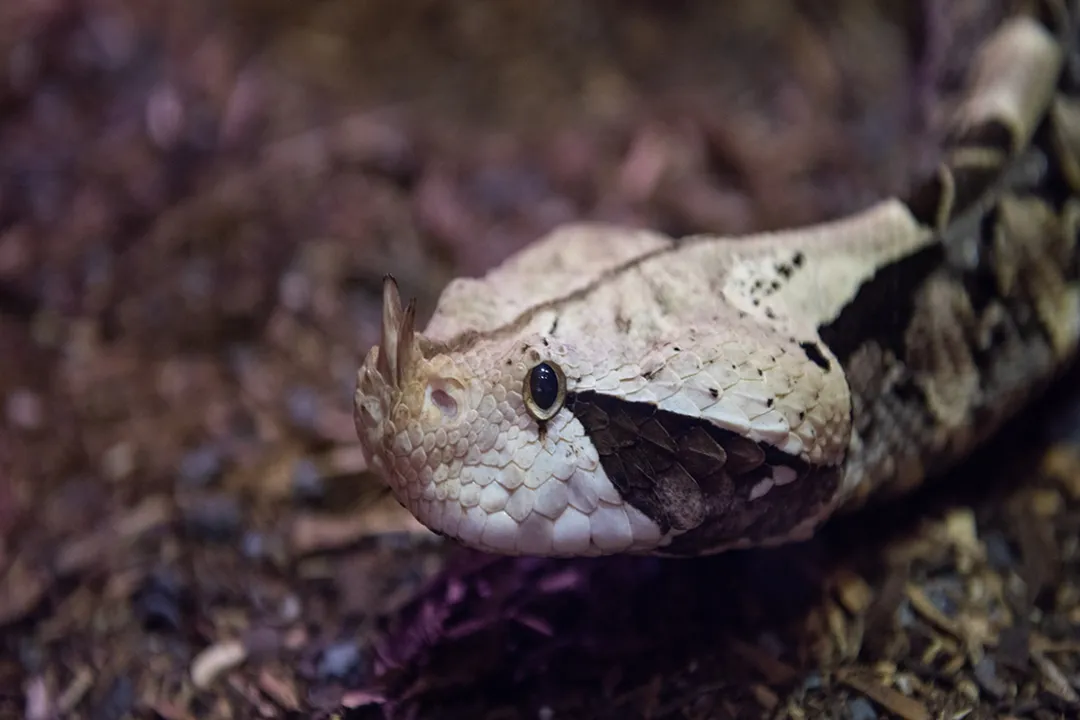
The Gaboon viper, Bitis gabonica, stands out among snakes not just for its potent venom but for its sheer physical presence, frequently being cited as the heaviest viper species across the globe. [2][8] This impressive mass contributes significantly to its overall characteristics, distinguishing it from many other venomous serpents found across its African range. [2] They are often described as being sluggish, but this description belies an animal perfectly engineered for its specific ecological niche—an ambush predator relying almost entirely on deception rather than pursuit. [3][4]
# Physical Bulk
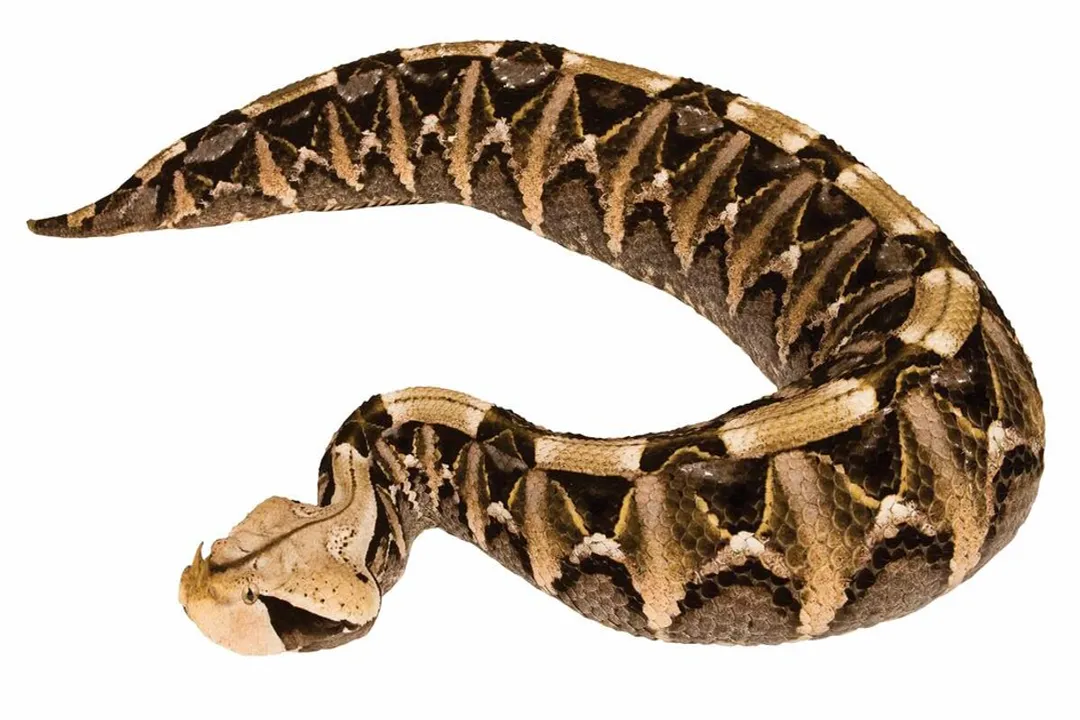
When discussing the physical attributes of the Gaboon viper, one must start with size and weight. [2][8] They are recognized as the largest of the African vipers and the world's heaviest viper overall. [2][8] While length records often hover around 6 feet (1.8 meters), it is the circumference and mass that truly set them apart. [2][8] Female Gaboon vipers are markedly heavier than their male counterparts, a common characteristic in many viper species where females need the bulk to carry developing litters. [2] This substantial build means they carry a significant reservoir of venom, a fact directly tied to their remarkable dental equipment. [3]
The snake’s body is thick, giving it a somewhat blunt, heavy appearance. [7] The head is broad and large relative to the body, often described as shovel-shaped. [2][8] A unique feature often observed, though sometimes reduced or absent, is the presence of one or two horn-like scales situated between the eyes. [2][8] These features, combined with their substantial girth, make them instantly recognizable, even among those only casually familiar with venomous snakes. [7]
# Scale Pattern
The camouflage of the Gaboon viper is legendary among herpetologists and naturalists alike. [3][7] It is a masterwork of natural artistry, making the snake nearly invisible against the leaf litter of the forest floor where it spends most of its time. [3] The pattern is complex, featuring a series of alternating brown, purplish-brown, or dark maroon blotches, often interspersed with lighter pinkish, yellowish, or grayish markings. [3][8] The background coloration ranges from tan to deep brown. [7]
The arrangement of these markings breaks up the snake's outline so effectively that it can be easily mistaken for a pile of decaying leaves or forest debris. [3] This crypsis is its primary defense mechanism, often employed before striking behavior. [4] The scales themselves contribute to this effect; they are heavily keeled, meaning they have a ridge down the center, giving the skin a rough, almost abrasive texture. [2] This rough texture further diffuses light reflection, enhancing the illusion of organic, three-dimensional debris rather than a smooth-skinned reptile lying in wait. [2]
Considering the snake's immense bulk and its reliance on remaining undetected, the coloration acts as an evolutionary investment. A creature this large requires infrequent, but substantial, meals to sustain itself. If camouflage fails, its primary defense shifts to the venom, but preserving energy by remaining unseen is the default strategy. This creates an interesting dynamic where the need for perfect concealment is paramount, leading to the incredibly variable and detailed patterns seen across different regional populations. [1]
# Venom Apparatus
Perhaps the most astonishing physical characteristic of the Gaboon viper is its dentition. [3][8] These snakes possess the longest venom fangs of any snake species anywhere in the world. [3][8] These fangs can measure well over 2 inches, sometimes reaching 5 centimeters or more in length. [3][4] To put that into perspective, that is longer than a typical human canine tooth. [3]
These fangs are not just long; they are curved backward and connected to an extremely potent venom delivery system. [3][4] The great length of the fangs is considered an adaptation; while many snakes strike quickly, the Gaboon viper is heavy and somewhat slower to react in an aggressive display, needing to ensure the fangs penetrate deeply enough to deliver the payload, perhaps compensating for slightly slower strike initiation by ensuring maximum depth penetration on contact. [3]
The venom itself is primarily hemotoxic, meaning it attacks the circulatory system, causing severe pain, massive tissue destruction, and internal bleeding. [2][8] While the venom is extremely potent, the Gaboon viper typically delivers a smaller relative dose in defensive bites compared to some other highly venomous snakes because its primary strike is usually aimed at prey it intends to consume, rather than a panicked defensive slap. [4] However, bites to humans are rare due to their retiring nature, but when they do occur, the combination of large fang size and potent venom makes them medically significant events requiring immediate attention. [1][3]
# Behavior and Temperament
The temperament of the Gaboon viper is frequently characterized by its placidity and reluctance to engage in confrontation. [3][4] When disturbed or approached, the typical reaction is not to flee or immediately strike, but rather to freeze in place, relying completely on its camouflage. [3][4][1] This instinct to remain still is an exceptional survival trait for a heavy-bodied animal that would struggle to escape quickly through dense undergrowth. [4]
When retreat is impossible, or the snake feels directly threatened—often by being stepped on or handled—it becomes dangerous in an instant. [3] They can strike with surprising speed for their bulk. [3] When striking prey, they often hold onto it briefly to ensure the venom takes effect, which is different from some elapids that bite and immediately retreat. [4]
Their activity schedule is largely nocturnal. [2] During the day, they are almost certainly stationary, conserving energy and blending into the forest floor environment. [2] Their feeding habits revolve around larger prey items such as small antelope, rodents, and birds, reflecting the large venom capacity they carry. [2][8]
It is important to contrast this behavior with that of a more agile snake. A Gaboon viper's defensive posture is often characterized by a defensive coil, sometimes lifting the front third of its body off the ground, ready to strike forward or slightly sideways. [7] This sluggish, camouflage-dependent lifestyle means that human encounters are usually accidental, which underscores why anti-venom awareness and rapid medical response are essential where these snakes live. [1]
# Habitat Distribution
The distribution of Bitis gabonica is centered in West and Central Africa. [2][8] They require environments with adequate ground cover and moisture to support their preferred lifestyle and prey base. [8]
Their preferred habitats include:
- Tropical and subtropical forests. [2][8]
- Forested savannas. [2]
- Areas with dense vegetation or rocky terrain. [2]
This habitat preference means that while they are generally confined to specific ecological zones, human encroachment into these forested areas increases the probability of accidental encounters. [1] The conservation status can vary depending on the specific region, with habitat loss being a recognized threat to local populations. [1]
# Comparative Characteristics
When comparing the Gaboon viper to its close relatives, like the Rhinoceros viper (Bitis nasicornicornis), the similarities in camouflage and heavy build are striking, though the Gaboon viper often exhibits the most dramatic patterns and the longest fangs. [2] Its sheer weight easily separates it from slender, fast-moving vipers found in more arid regions.
One interesting point arises when comparing the energy investment into its defensive weaponry versus its locomotor capabilities. Unlike highly arboreal or semi-arboreal snakes that might prioritize agility, the Gaboon viper maximizes its static defense—camouflage and venom potential. [3] This suggests a long evolutionary history favoring energy conservation and maximizing the yield of rare, large meals, rather than frequent, small captures that require active pursuit. It is a biological extreme in specializing for a sit-and-wait strategy, pushing camouflage and venom capacity to their limits. [3][4]
Another subtle aspect to consider is the role of their triangular head shape. While this is common among vipers, in the Gaboon viper, it is exaggerated, housing large venom glands located far back on the jaw. When the snake strikes, this large head acts almost like a spring-loaded mechanism, allowing for the rapid extension of those incredibly long fangs. [8] The length of the fang relative to the skull size is arguably greater here than in many other viper species, representing a specialized morphological adaptation for delivering a deep, deep envenomation in a single, rapid jab. [3]
# Final Considerations
The Gaboon viper embodies specialization. It is a snake that invests heavily in defense through invisibility and extreme chemical weaponry, accepting the trade-off of slower movement and a reliance on perfect camouflage for daily survival. [3][4] From its colossal mass to its needle-like weaponry, every aspect of Bitis gabonica is geared toward a highly effective, low-energy ambush predation in the dense African forest understory. [2][7] Understanding these characteristics—the incredible camouflage, the massive size, and the disproportionately long fangs—is key to appreciating this impressive, though often unseen, reptile. [3][8]
#Videos
Gaboon viper facts! - YouTube
Related Questions
#Citations
Gaboon viper | Smithsonian's National Zoo and Conservation ...
Gaboon viper - Wikipedia
3 Nightmarish Facts About The 'Gaboon Viper'—Fang Length ...
Bitis gabonica (Gaboon Adder) - Animal Diversity Web
Gaboon Viper Snake Facts and Characteristics in Africa - Facebook
Gaboon Viper, the snake with the world's longest fangs ... - Instagram
Gaboon viper | AMNH
Gaboon viper | Venomous, Africa, Rainforest | Britannica
Gaboon viper facts! - YouTube