How do the legs and feet of the *Diomedea exulans* primarily differ in design purpose compared to walking birds?
Answer
They are webbed, designed for buoyancy and propulsion in water
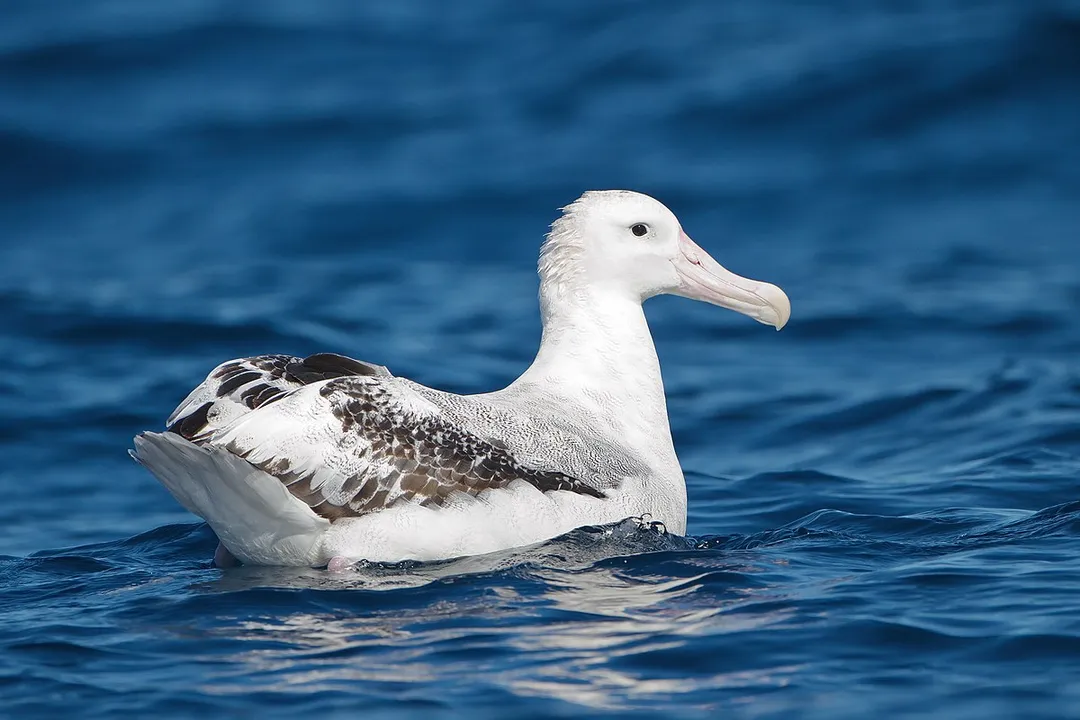
The locomotion appendages of the Wandering Albatross are specialized for its aquatic environment rather than terrestrial movement. While the birds appear somewhat ungainly when walking on land, their legs and feet are structurally adapted for use in the water. Specifically, they possess webbed feet, a characteristic adaptation that allows them to swim, paddle, and maintain stability while resting or feeding on rough sea surfaces. Despite spending the majority of time airborne, this aquatic capability is vital for moments when they must interact with the water, such as during nesting or resting periods.
Related Questions
What measurement places the Wandering Albatross in the record books regarding its wingspan?What technique allows the Wandering Albatross to travel vast distances without flapping its wings for hours or days?What is the typical coloration of the plumage displayed by juvenile Wandering Albatrosses when they fledge?What specific feature of the Wandering Albatross bill provides the necessary grip for feeding on carrion or prey?What is the heaviest recorded weight, in kilograms, cited for a Wandering Albatross specimen?How do the legs and feet of the *Diomedea exulans* primarily differ in design purpose compared to walking birds?What term describes the ratio of wingspan to wing chord mentioned in relation to the albatross's flight efficiency?What distinguishes the body length measurement of 107 to 130 centimeters on the Wandering Albatross?How does the plumage of mature male Wandering Albatrosses typically differ from that of mature females?What characteristic hue is given to the robust bill of the Wandering Albatross?