Yellowhammer Facts
The Yellowhammer, Emberiza citrinella, holds a special place among European songbirds, largely thanks to the distinctive, almost metronomic quality of its call, which often serves as the first clue to its presence in the landscape. [2][6] This small passerine bird, a member of the bunting family, is instantly recognizable, especially the male, due to its brilliant splash of yellow adorning the head and underparts during the breeding season. [1][4] While its bright appearance makes it a favorite among birdwatchers, its recent population decline across parts of its range has drawn significant concern from conservation groups. [7][3] To truly appreciate this species, one must look closely at its specific habitat preferences, the structure of its famous song, and the challenges it faces in modern agricultural settings. [6][3]
# Bird Look
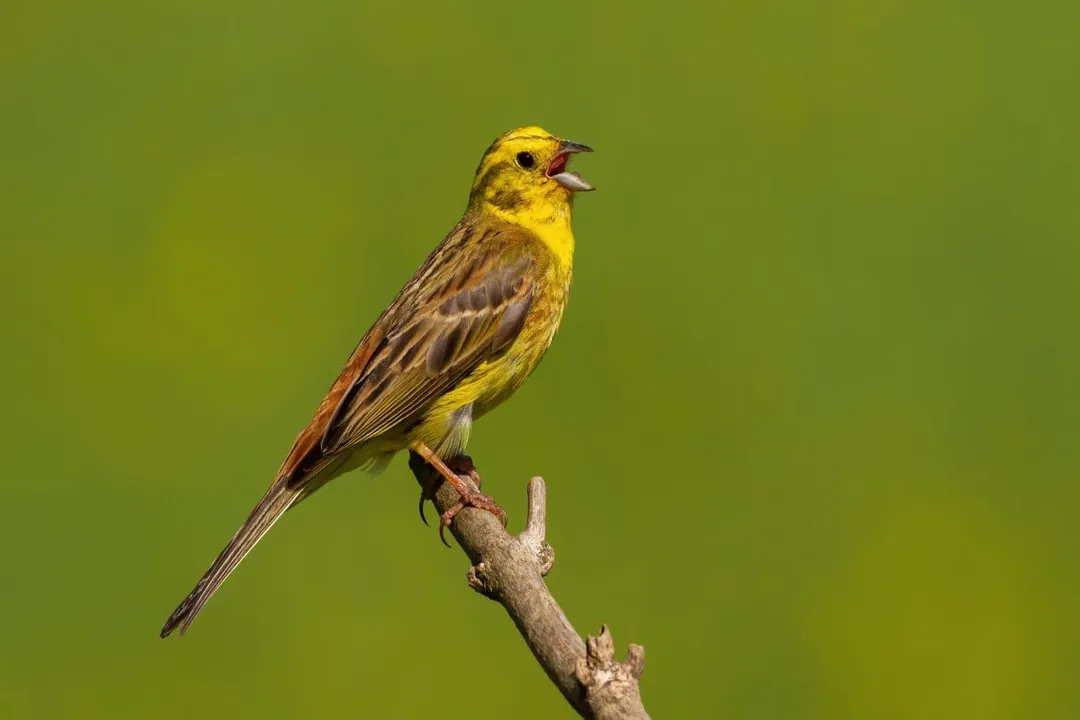
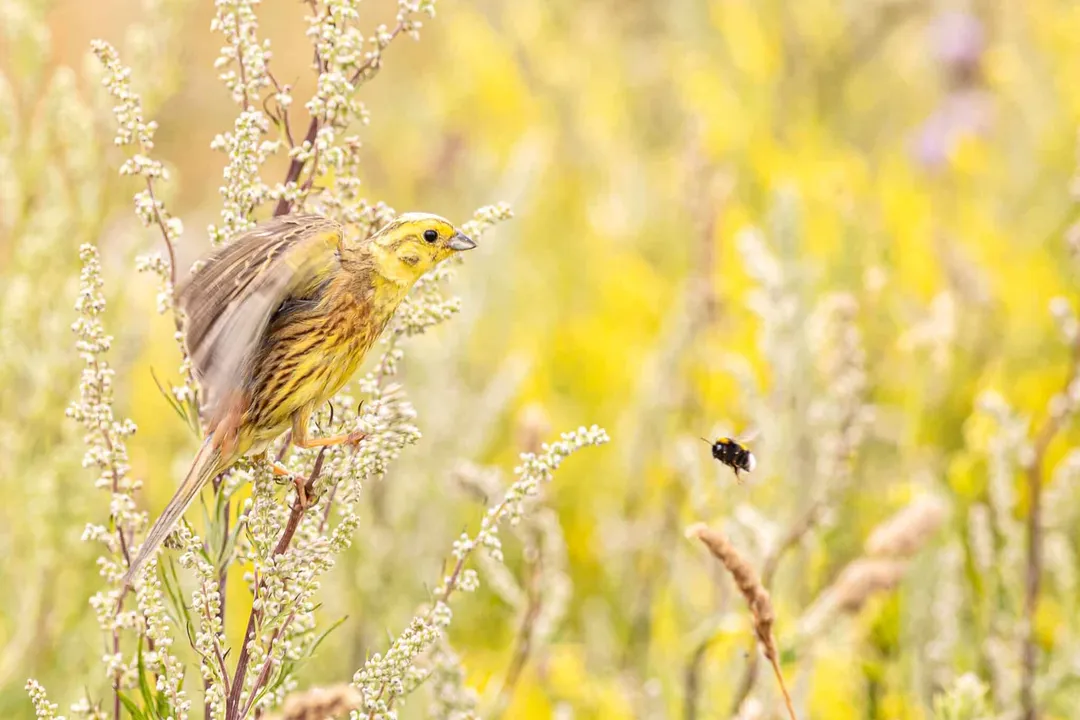
Distinguishing the male and female Yellowhammer requires a careful eye, though the overall shape and size are consistent for both sexes. [4] The bird is relatively small, typically measuring about 16.5 centimeters in length. [5] Adults generally weigh around 20 to 25 grams. [1] The primary identifying feature, particularly conspicuous in the breeding male, is the vivid, bright yellow wash that covers the head and breast. [4][1] This yellow is beautifully contrasted by streaks of chestnut brown along the back and flanks, offering excellent camouflage when viewed from above against hedgerows or scrub. [2] The male also features a reddish-brown back streaked with black, and its tail feathers are dark brown, often showing white outer edges when fanned in flight. [1]
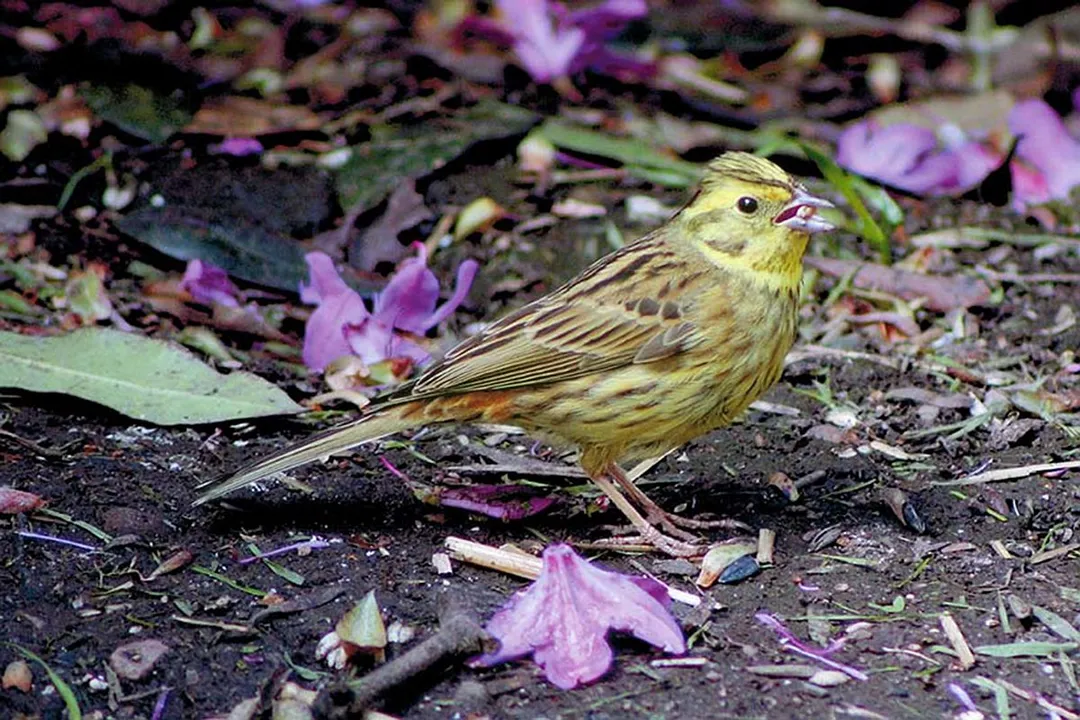
In non-breeding plumage, the bright colors are somewhat muted, which can make identification trickier for the novice observer. [2] Furthermore, the female Yellowhammer is considerably duller than her counterpart. [4] She lacks the intense, clean yellow of the male, instead possessing a more washed-out, pale yellow on the face and chest, often appearing more buff or brownish overall. [1][2] Her streaking may appear bolder or more extensive than the male's, helping her blend into the nesting environment. [4] Young birds resemble the female, having a duller appearance overall. [4] All Yellowhammers share a relatively stout, conical bill, perfectly adapted for cracking seeds, which is a characteristic feature of the bunting group. [2] Their legs are typically a pale fleshy-pink color. [1]
If you are attempting to differentiate a female Yellowhammer from other similar-looking finches or buntings in mixed flocks during the winter months, focus on the fine, intricate pattern of the head and breast wash, even if it is subdued; it rarely presents as a solid block of color like some related species, maintaining a streaked or mottled appearance even in duller plumage. [5][2]
# The Song
Perhaps the most famous attribute of the Yellowhammer is its song, which is highly distinctive and frequently used to locate the species, even when they are hidden from view. [6] The call is surprisingly simple, yet musical, and often described as monotonous or repetitive. [2] It typically consists of a series of rapid, high-pitched notes followed by a final, lower, drawn-out note. [5][6]
The common description of the song rhythm is "a little bit of bread and no cheese" or, more scientifically, five or six quick notes followed by one or two drawn-out notes. [2][6][5] The male sings this sequence repeatedly from prominent perches, such as the top of a bush, a fence post, or an overhead wire, usually in the early mornings during the breeding season. [2] This vocal display serves primarily to attract females and advertise territory to rival males. [2] The song is audible from quite a distance, helping the bird maintain contact across open farmland. [3] It is the quality of this song, rather than its complexity, that is so memorable. [6]
# Distribution Range
The Yellowhammer has a wide geographical distribution across Eurasia, though its presence varies significantly in density depending on the region. [2] In Europe, its range extends from the British Isles eastward across the continent to parts of Western Asia. [2] They are generally considered sedentary or only short-distance dispersers in many areas, meaning they tend to stay relatively close to where they were born. [2]
In the UK, for example, the species is widespread but unevenly distributed. [3] While they can be found across much of England, Wales, and parts of Scotland, their populations are noticeably scarcer in the far north and in upland areas. [2] They favor open countrysides, usually avoiding dense woodland or treeless moorland. [2][4] Their preferred habitat is characterized by a mosaic of cultivated land interspersed with hedges, scattered trees, and rough, scrubby grassland—the traditional mixed agricultural landscape. [3][6]
Globally, while the species is generally common across a large area, localized declines mean that the overall picture is one of contraction in parts of Western Europe. [2][7] They are also found in parts of North Africa. [4] The ability of the Yellowhammer to thrive is intrinsically linked to the type of landscape management practiced in a given area. [3]
# Nesting Habits
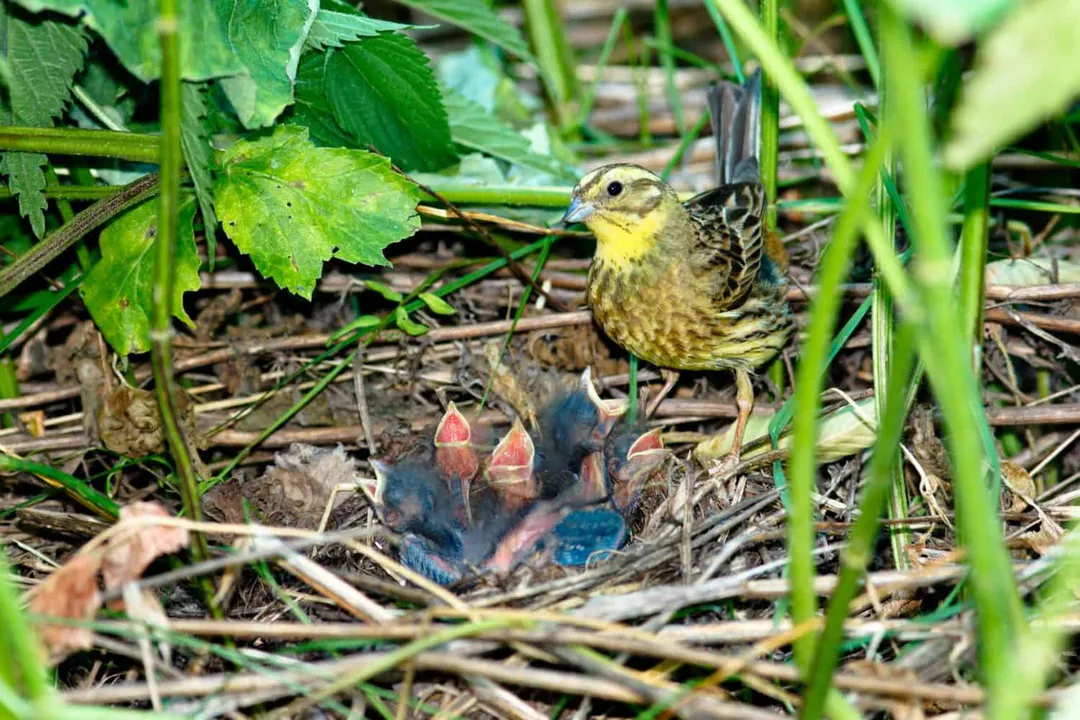
The breeding cycle for the Yellowhammer usually commences in spring, with nesting activity often starting as early as April. [2] They are known to raise multiple broods per year, sometimes up to three, depending on food availability and the success of earlier attempts. [2] The female undertakes the construction of the nest almost entirely by herself. [2][4]
The nest site is typically low down, often concealed in thick vegetation, such as dense brambles, bracken, or within a thick, low hedge. [2][6] This low placement provides cover from aerial predators but leaves the nest vulnerable to ground-level disturbances. [4] The structure itself is a neat, cup-shaped construction, woven tightly from fine grasses, rootlets, and moss, often lined with animal hair to provide insulation and a soft bed for the eggs. [2]
The clutch size usually consists of four to five eggs. [2] These eggs are quite attractive, featuring a pale, buff, or greenish-white background color that is heavily marked with brown, grey, and black speckles and spots. [4][1] Incubation is primarily managed by the female, usually lasting for about 12 to 14 days. [2] Once hatched, the nestlings are fed by both parents, relying heavily on insects and soft invertebrates during this crucial early stage of development. [2][6] The young birds fledge—leave the nest—after around 10 to 12 days. [2]
# Feeding
The diet of the Yellowhammer shifts significantly between the seasons, reflecting the differing nutritional demands of the adult birds and their rapidly growing chicks. [6] During the late autumn, winter, and early spring, the Yellowhammer is predominantly a seed-eater. [2] They forage close to the ground, often in small flocks, seeking out seeds from various grasses and arable crops. [2][6] They utilize their strong, conical bills to crack open the husks to access the nutritious kernel inside. [2] Grains like wheat, barley, and oats become important dietary staples when natural seed sources are scarce. [3]
However, when the breeding season arrives and young must be provisioned, the reliance on seeds drops dramatically. [6] Adult Yellowhammers switch to feeding their chicks almost exclusively on insects, spiders, and other soft-bodied invertebrates. [2][6] This requirement for high-protein food during chick-rearing is why the availability of suitable insect life, often found in fallow margins, weedy corners, or less intensely managed field corners, is vital for reproductive success. [3][7] A lack of suitable insect prey directly limits the number of chicks that can be successfully reared, irrespective of the abundance of seeds available for the adults. [6]
It's interesting to observe how this dietary dichotomy influences behavior; while winter feeding often involves birds gathering in small, mixed-species flocks near food sources like farmyard spills, the breeding period sees them more dispersed as males defend territories necessary to secure both nesting sites and insect-rich foraging patches. [2]
# Decline Status
Across much of Western Europe, the Yellowhammer population trend is concerningly downward. [7] In Great Britain, for instance, studies have shown a marked decline in numbers over recent decades. [3][6] While the species is not currently classified as globally endangered, the rate of loss in specific agricultural regions has led conservation bodies to list it as a bird of high conservation priority. [7]
The reasons for this decline are strongly tied to changes in modern agricultural practices. [3][7] Intensification of farming, leading to the removal of hedgerows, increased herbicide use that suppresses weed growth (and thus reduces invertebrate prey and seed sources), and earlier harvesting of crops have all contributed to habitat degradation. [3][7] The loss of suitable low nesting cover and the reduction in insect availability during the critical chick-rearing phase are thought to be the primary drivers of local extinctions. [7] When fields are drilled early or heavily sprayed, the essential insect biomass needed to feed the subsequent brood simply isn't present in time for the second or third nesting attempt. [3]
The British Trust for Ornithology (BTO) monitors these changes, highlighting how changes to the landscape structure directly impact the persistence of a bird so dependent on that specific habitat mix. [6] Data from initiatives like the Big Farmland Bird Count often reveal that areas with higher counts correlate with farms that maintain more diverse field margins and hedgerow networks. [3]
# Action Needed
For those interested in supporting Yellowhammer populations, particularly those living near their habitat, some targeted actions can be quite effective, drawing directly from understanding their ecological needs. [7] Since their survival hinges on both seed availability in winter and invertebrates in summer, management should aim for year-round support. [6]
One highly beneficial step involves rethinking how field margins are managed. Instead of keeping all land under intensive arable production, leaving small strips of land unsown or managed later in the season can create crucial insect habitats for the summer. [3] Furthermore, planting specific seed-bearing crops or allowing native weeds to thrive along field edges provides a vital winter larder, helping birds survive lean times between feeding bouts. [7]
To put this into a practical, non-intensive approach for a landowner or keen gardener: consider the density of your low cover. If you have hedges, avoid cutting them back severely or too frequently, especially in spring and early summer when nesting is occurring. [2] A slightly ragged, thicker base to a hedge provides ideal, safe nesting locations that are less accessible to predators like cats or stoats that might struggle in very tight, thorny cover. [2] By recognizing the bird’s dual dependency—seeds then bugs—management efforts become much clearer, focusing on structural diversity rather than just volume of food. [6]
Related Questions
#Citations
Yellowhammer - Facts, Diet, Habitat & Pictures on Animalia.bio
Yellowhammer - Wikipedia
Yellowhammer facts, song, habitat, food, nesting
Yellowhammer Bird Facts - Emberiza citrinella - A-Z Animals
Yellowhammer Facts - Softschools.com
Yellowhammer - BTO
YELLOWHAMMER (Emberiza citrinella) - songbird factfile
Yellowhammer Facts For Kids | AstroSafe Search - DIY.ORG
Yellowhammer Facts for Kids