Xiphactinus Facts
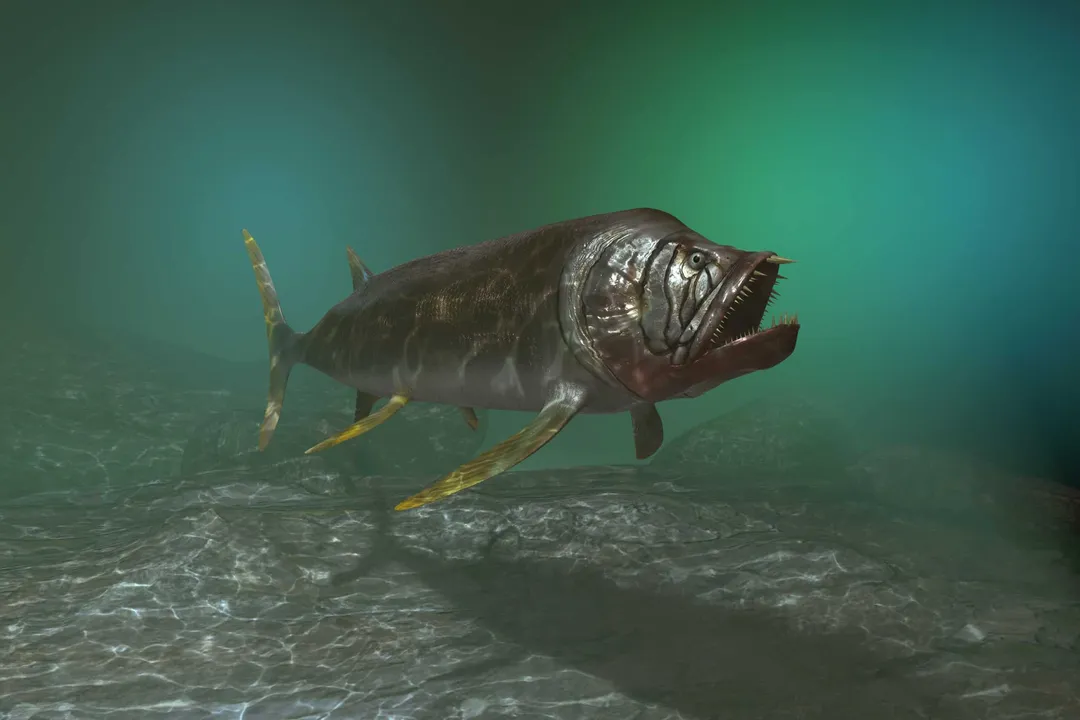
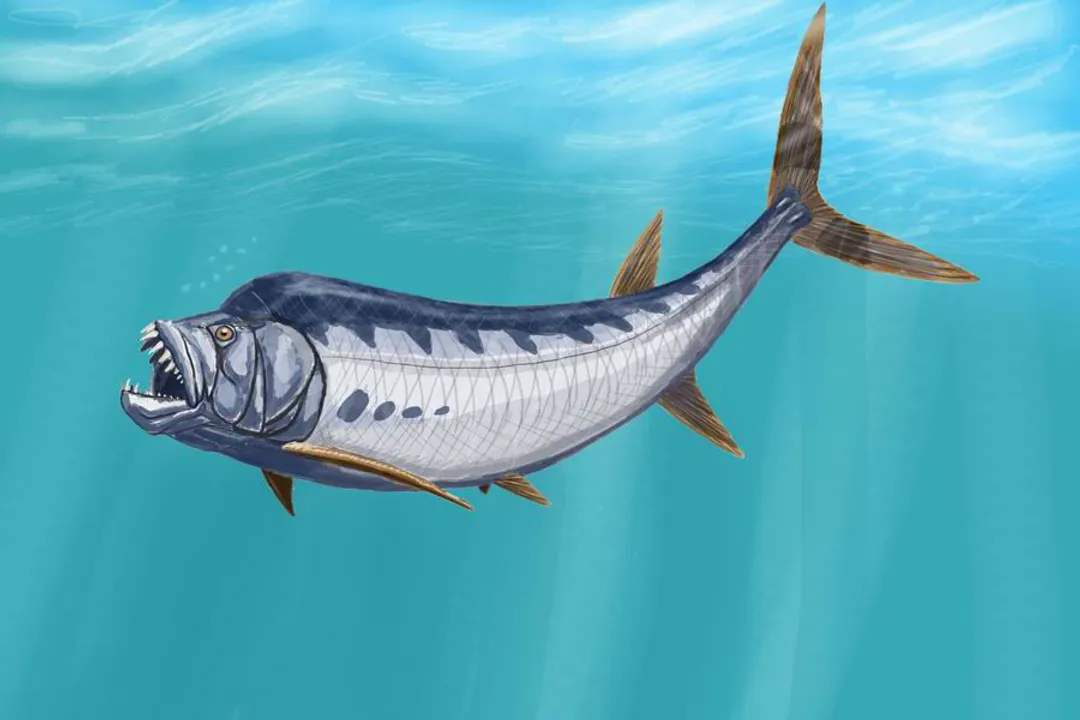
The massive predatory fish known as Xiphactinus once dominated the warm, shallow seas that covered much of North America during the Late Cretaceous period. [1][2][4][6] This creature was anything but a background player in the ancient marine ecosystem; it was an active, aggressive apex hunter, a true terror of the inland seaway that separated the eastern and western parts of the continent. [2][5][6][7] Unlike many fish today, Xiphactinus belonged to the group known as teleosts, or bony fish, though its sheer size and ferocity place it in a category all its own among its contemporaries. [1][4]
# Giant Fish
Estimates regarding the size of Xiphactinus consistently place it among the largest known predatory bony fish of the Mesozoic Era. [5] While precise figures vary among paleontologists, the general consensus suggests these animals routinely reached lengths of up to 10 to 13 feet (about 3 to 4 meters). [2][4][5][6] Some larger, less certain estimations even push the maximum length toward 16 feet (5 meters). [1][5] To put that scale into perspective, a 13-foot specimen weighing near 500 pounds would have been an astonishing sight, easily dwarfing most modern large marine predators found in coastal waters today. [5] This immense size, coupled with its presumed lifestyle, establishes Xiphactinus as a top-tier predator within the ancient Western Interior Seaway (WIS). [2][5][7]
# Fearsome Jaws
The anatomy of Xiphactinus was clearly tailored for an active, high-impact predatory existence. [3] One of its most striking features was its mouth. Paleontologists have noted that this fish possessed a capacity to open its mouth extremely wide, allowing it to engulf surprisingly large prey items relative to its own body size. [2] Its jaw structure was armed with sharp, conical teeth. [2][4][6] These teeth were designed not for chewing or tearing large chunks off struggling victims but rather for gripping and holding onto slippery, struggling fish until they could be swallowed whole. [2]
Interestingly, Xiphactinus lacked scales. [1][6] While many prehistoric fish were armored or heavily scaled, the absence of scales suggests that speed and maneuverability, or perhaps simply its overwhelming size advantage, were prioritized over dermal armor protection. Its body shape, described as deep and powerful, would have been propelled by a robust tail fin, essential for bursts of speed needed to ambush or pursue prey in the open water of the seaway. [1] Its formal classification places it within the ichthyodectiforms, a group of ancient, often large, predatory marine fish. [1]
# Apex Predator
The diet of Xiphactinus was almost exclusively carnivorous, placing it firmly at the top of its food web. [2][4] Its primary targets were other fish that populated the abundant waters of the Cretaceous ocean. [2][6] Given the rich fossil record of the region, these victims would have included schools of smaller bony fish, as well as other substantial predators. [2]
Perhaps the most compelling evidence of its predatory nature comes directly from the fossil record itself. There are documented specimens where the stomach contents were preserved alongside the skeleton, providing direct proof of diet. [2][4][6] One of the most famous examples involves a Xiphactinus fossil found with the nearly intact skeleton of another large fish lodged within its rib cage area. [2][4][6][7] This unfortunate victim was Gillicus. [2][6]
The preserved position of the Gillicus suggests that the Xiphactinus had swallowed it whole, only to perish shortly thereafter—perhaps due to the stress of the meal or another cause—before digestion could complete its course. [2][6] The sheer volume of the prey relative to the predator is remarkable. [2] Considering that both Xiphactinus and Gillicus were sizable fish, this incident highlights the extreme feeding mechanism of the larger predator. [2] If we imagine a 12-foot Xiphactinus swallowing a 3-foot Gillicus whole, it speaks to an incredible gape and digestive capacity, similar to how some modern snakes consume prey much wider than their own resting girth. [4] The fact that this specific individual appears to have died immediately post-ingestion suggests that such rapid, large-scale meals were high-risk, high-reward propositions in its lifetime. [2]
# Fossil Record
The story of Xiphactinus largely unfolded in the sedimentary rocks of the central United States, particularly in what is now Kansas. [2][7] The region was submerged beneath the Western Interior Seaway during the time the fish lived, around 85 million years ago, which is the Late Cretaceous. [2][6] This inland sea provided the perfect environment for preserving marine life when the animals died and settled into the fine muds of the seabed. [7]
The scientific description of Xiphactinus began in 1870 when paleontologist Edward Drinker Cope named the genus. [7] Cope also coined the common name "Bulldog Fish" for some specimens, likely due to the robust structure of the skull and jaws. [7] Many of the key specimens recovered from the Niobrara Formation in Kansas have been crucial for understanding the species. [7]
When examining the fossil evidence, it's worth noting a subtle point about the preserved diet: one famous specimen contained Gillicus, but other finds, though less dramatic, suggest a varied diet of other fish species available in the rich environment. [2] The sheer number and quality of Xiphactinus fossils recovered from this specific geological layer attest to its former abundance within that ancient ecosystem. [7]
# Modern Relatives
Although Xiphactinus is extinct and vastly larger than almost anything swimming in the oceans today, it shares a direct lineage with modern fish. [4] It is an ancient relative of the modern teleosts, the group that includes the vast majority of all extant fish species, from tuna to trout. [1][4] This connection shows a long, uninterrupted evolutionary line of successful bony fish development spanning over 85 million years. [1][2] Understanding Xiphactinus gives paleontologists a glimpse into the massive diversity and scale that was possible within this lineage long before the age of marine mammals and modern sharks truly dominated the seas. [4] While no contemporary fish rivals its size and predatory behavior within the same bony-fish group, the fundamental body plan that allowed for its success in the Cretaceous—powerful tail, streamlined form, and capable jaws—can still be seen in forms like the modern billfish, albeit on a much smaller scale. [3]
When we consider the ecological role of this Cretaceous giant, it’s interesting to ponder the resource dynamics. If an animal the size of a modern large tarpon or small shark was regularly consuming other large, fast-moving fish, including potential conspecifics (as suggested by some interpretations of its potential diet), it implies that the food chain in the Western Interior Seaway was incredibly energy-rich. [2][6] This density of resources would have been necessary to sustain a population of such large, active predators. The preservation of the Gillicus inside shows that the energy transfer—from smaller fish to mid-sized prey like Gillicus to the apex predator Xiphactinus—was rapid and direct. For context, if a 500-pound Xiphactinus consumed a 100-pound Gillicus, that single meal represented about 20 percent of its estimated maximum body weight, a caloric intake that would sustain a modern shark for weeks. [5] This points to an environment where prey availability likely fluctuated rapidly, forcing these predators to gorge when the opportunity arose.
Furthermore, the fossil evidence suggests that Xiphactinus did not rely on schooling for defense or hunting, unlike many smaller bony fish. [1] Its sheer size acted as its primary defense, meaning its existence was one defined by active pursuit and overwhelming physical dominance over its targets within the water column. [3] Its legacy remains a powerful illustration of just how large and formidable the bony fishes were capable of becoming millions of years ago. [1][4]

#Videos
#9 Xiphactinus- The Monster Fish - YouTube
Related Questions
#Citations
Xiphactinus - Wikipedia
Xiphactinus, Terror Of The Inland Seaway - FossilEra.com
Xiphactinus Audax Pictures, Facts, Desktop Wallpaper, Animals ...
Xiphactinus | Prehistoric Planet Wiki - Fandom
Xiphactinus audax - A-Z Animals
Xiphactinus | Smithsonian Ocean
Xiphactinus - Facts and Figures - ThoughtCo
Science & Nature - Sea Monsters - Fact File: Xiphactinus - BBC
#9 Xiphactinus- The Monster Fish - YouTube
Xiphactinus Facts for Kids