Wrasse Evolution
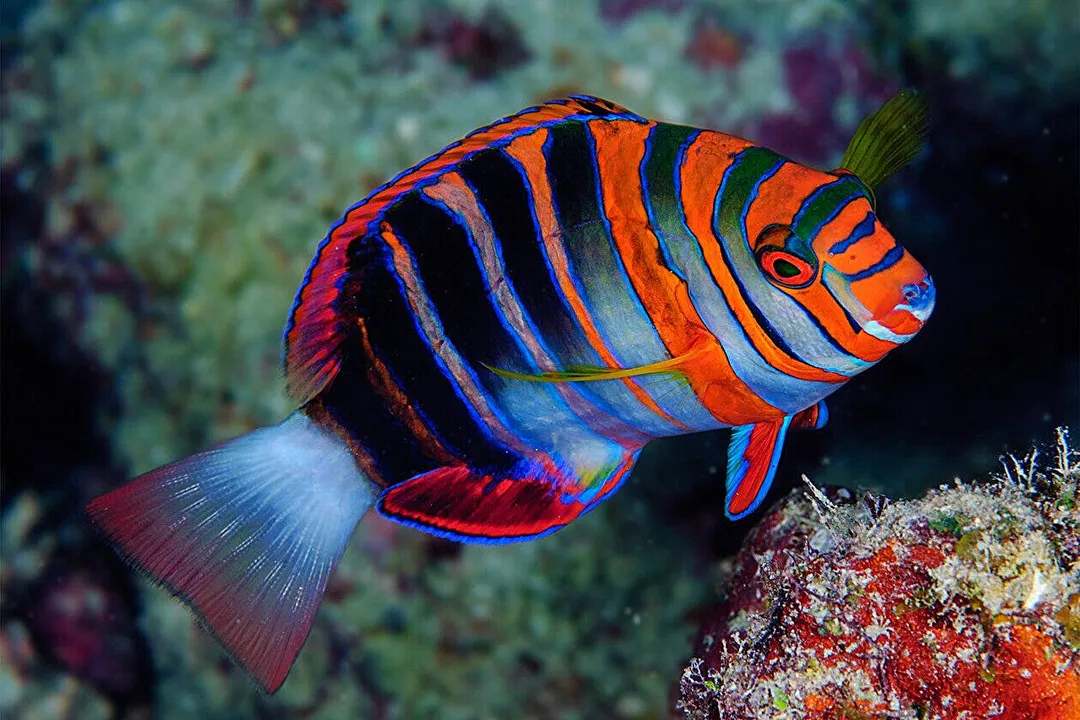
The sheer variety of colors and shapes found among the wrasses makes them one of the most striking and diverse families of reef fish. Belonging to the family Labridae, these creatures inhabit tropical and subtropical waters across the globe, demonstrating an incredible array of adaptations honed over millions of years of evolution. [6] While many people recognize their smaller, more brightly adorned cousins, the wrasse group is massive, encompassing over 500 species arranged into roughly 50 genera. [6] Tracking their evolutionary paths reveals a story of rapid success, environmental sculpting, and dazzling chromatic specialization, particularly evident in the lineage known as the Fairy Wrasses.
# Wrasse Diversity
Wrasses are generally recognized by their thick lips and a single, continuous dorsal fin. [6] They occupy a vast ecological niche, ranging in size from the tiny Minority wrasse, which barely exceeds an inch, up to the massive Queensland Maori Wrasse, Cheilinus undulatus, which can reach lengths of over two meters. [1][6] Their distributions are global, though the greatest diversity is found in the Indo-Pacific region. [6] The family Labridae itself has a deep evolutionary history, with molecular phylogenetic analysis helping to map out the relationships between these many lineages. [7] Studies focusing on the deeper evolutionary splits within the family suggest that diversification has been a significant theme throughout their history. [5] The structure of the family, as mapped out by genetic data, often places the most recently diverged or specialized groups, such as the Fairy Wrasses, within a broader context of ancient evolutionary success. [7]
# Explosive Radiation
One of the defining characteristics of the Labridae family is its history of explosive radiation—periods of rapid speciation that allow a single lineage to quickly give rise to many distinct species in a relatively short geological timescale. [5] This rapid diversification has been confirmed by molecular clock analyses, which suggest that the family has undergone several pulses of quick evolution. [5] In fact, molecular divergence dating points to the family having undergone rapid diversification events that contrast with the slower evolutionary rates seen in other comparable fish families. [5] This high rate of speciation helps explain the current enormous number of species found today, suggesting that wrasses have been evolutionarily opportunistic, rapidly filling available ecological space when conditions allowed. [5]

# Color Origins
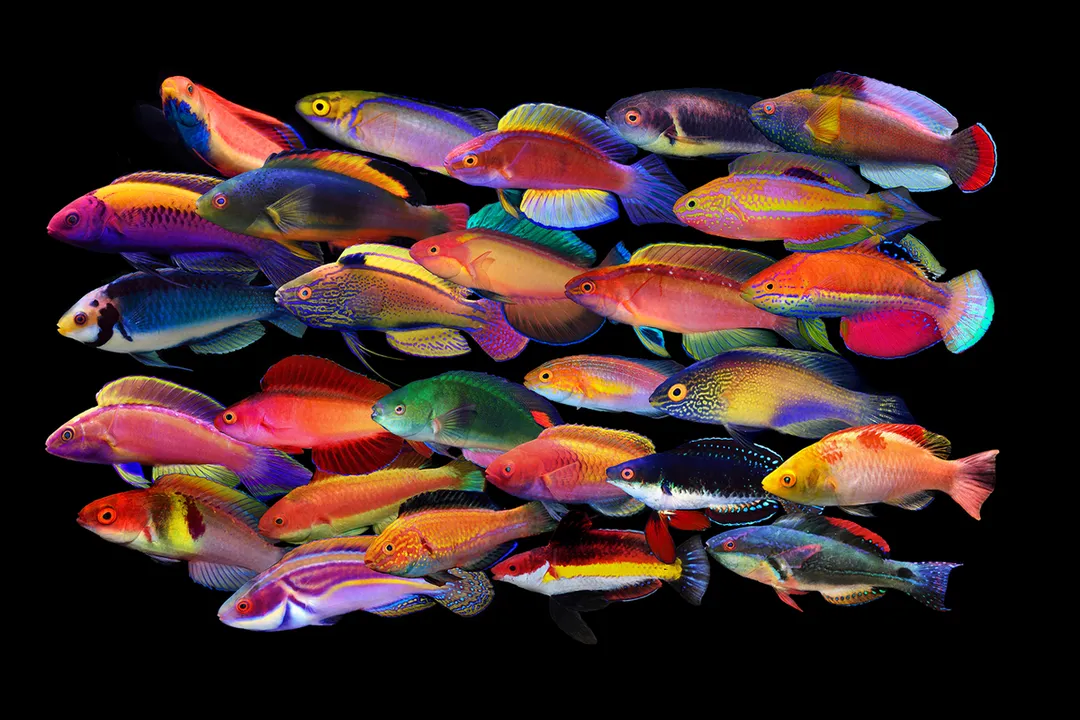
Perhaps no group within the Labridae better illustrates the outcomes of this evolutionary dynamism than the Fairy Wrasses, genus Cirrhilabrus. [3] These smaller wrasses are famous for their incredibly vibrant and complex color patterns, which are often sexually dimorphic—meaning males and females look quite different. [3][8] The development of these flamboyant colors has been a subject of focused research, revealing a direct link between genetics, mating success, and environmental history. [3] In many species, the males display complex patterns involving bright reds, blues, and yellows, which are crucial for attracting mates. [3]
Genetic analysis has shown that the evolution of these vivid colors is not a simple, gradual process. Instead, the acquisition of new color genes or regulatory elements seems to have occurred relatively quickly, leading to rapid visual differentiation between species. [3] This contrasts with more gradual evolutionary changes and suggests that selection pressures favoring visual signaling were intense and perhaps episodic. [3] For instance, if two distinct populations become separated, the evolutionary path they take regarding color might diverge rapidly due to localized mate preference or differing selective pressures on camouflage, even if their environments are superficially similar. [3]
# Sea Level Influence
A fascinating external driver implicated in the speciation and color divergence of the Fairy Wrasses is the dramatic environmental fluctuation caused by Pleistocene ice ages. [4] During periods when global sea levels dropped significantly—sometimes by more than 100 meters—vast expanses of shallow, interconnected coral reef habitat would have been exposed or isolated. [4] This had a profound effect on marine life adapted to these specific zones.
The lowering of sea levels created barriers, separating populations of Cirrhilabrus that previously shared gene flow. [4] When these populations were geographically isolated on different reef patches or continental shelves separated by dry land or deep, unsuitable water, they began to evolve independently. [4] Over many cycles of rising and falling seas, these isolated groups developed reproductive isolation, eventually becoming distinct species—a process known as allopatric speciation. [4] The resulting species, even if they now share an environment again, retain their unique genetic differences, including the distinct color patterns that evolved during their time apart. [4] It is remarkable that the ebb and flow of ancient oceans effectively sculpted the current tapestry of wrasse species we observe today. [4]
I find it particularly noteworthy that the primary driver for speciation in this group appears to be habitat fragmentation dictated by global ice volume, rather than just competition for a specific food source within a stable environment. [4] This suggests that tectonic or climatic shifts are more critical architects of wrasse diversity than simple localized ecological niches, at least for the Fairy Wrasse lineage. This stands in contrast to some fish groups where speciation is driven more by niche partitioning within a continuous habitat.
# Molecular Patterns
Molecular phylogeny, which relies on DNA sequencing to reconstruct evolutionary relationships, consistently supports the rapid diversification narrative. [5][7] By examining the genetic makeup of various wrasse species, researchers can establish a timeline for their divergence. [7] The genetic markers confirm that the family Labridae is relatively young in terms of major clade formation, yet highly successful in subsequent diversification. [5] The relationships established through these genetic markers allow scientists to trace when major splits occurred, often correlating these deep evolutionary events with major geological or environmental changes reflected in the fossil record or sediment cores, such as the sea-level changes discussed earlier. [5][7]
Comparing results across studies reveals a consensus: the rate of evolution within Labridae is often faster than the background rate for teleost fishes generally. [5] This rapid turnover suggests strong, consistent selective pressures favoring novelty and adaptation within the family's history. [5]
# Cultural Naming
Beyond the hard science of genetics and paleoclimatology, the visual splendor of these fish has left an imprint on human culture, particularly in naming conventions. [2][8] The term "Fairy Wrasse" itself speaks to their almost mythical appearance. [8] In some regions, these beautiful fish have been associated with local tales or folklore, perhaps due to their vibrant colors being perceived as otherworldly or magical. [2][8] This cultural recognition, stemming from direct observation of their striking phenotypes, highlights how immediately accessible and impactful their evolutionarily derived colors are to observers. [2]
When considering the evolution of the common names, it's interesting to note the dual interpretation of the "fairy" moniker. [2][8] Is it derived from their diminutive size relative to other large reef fish, or from the ethereal quality of their coloration—the result of billions of years of fine-tuning structural colors and pigment expression? My assessment leans toward the latter being the stronger component in common parlance, as many other small, colorful fish exist without achieving the "fairy" designation. [3]
# Evolutionary Tempo
The story of wrasse evolution presents a classic case study in how a successful family achieves dominance. The combination of a relatively recent origin followed by periods of explosive speciation, driven in part by large-scale geological events like glacial cycles, provides a compelling model for rapid adaptive radiation. [4][5] For conservationists and taxonomists working today, this rapid tempo presents a challenge. [7] When species evolve quickly, sometimes their morphological differences lag behind their genetic separation, or conversely, similar environments can cause unrelated species to evolve superficially similar traits (convergent evolution). [3]
This evolutionary speed means that many wrasse species might be identified based on subtle color differences that evolved over a few million years, rather than drastic skeletal changes that take much longer to accumulate. [3][4] Therefore, a deeper integration of molecular techniques with traditional morphology is not just beneficial but essential for accurately describing and conserving the true breadth of wrasse biodiversity. [7] If a single reef system was isolated for 100,000 years during an ice age, it may have given rise to several genetically distinct species of Fairy Wrasse that now coexist, and only genetic testing would reveal their distinct evolutionary statuses. [4] This ongoing evolutionary dynamism confirms that the Labridae family remains a fertile ground for biological discovery.
Related Questions
#Citations
Dating the evolutionary origins of wrasse lineages ...
The colorful history of fairy wrasses
how fairy wrasses got their flamboyant colours
Flamboyant fishes evolved an explosion of color ...
Study reveals rapid diversification of coral-reef ...
Wrasse
Phylogenetic relationships and evolutionary history of the ...
Fairy Wrasses and Fairy Tales! - Australian Museum